Greater White-fronted Goose (Plate 286)
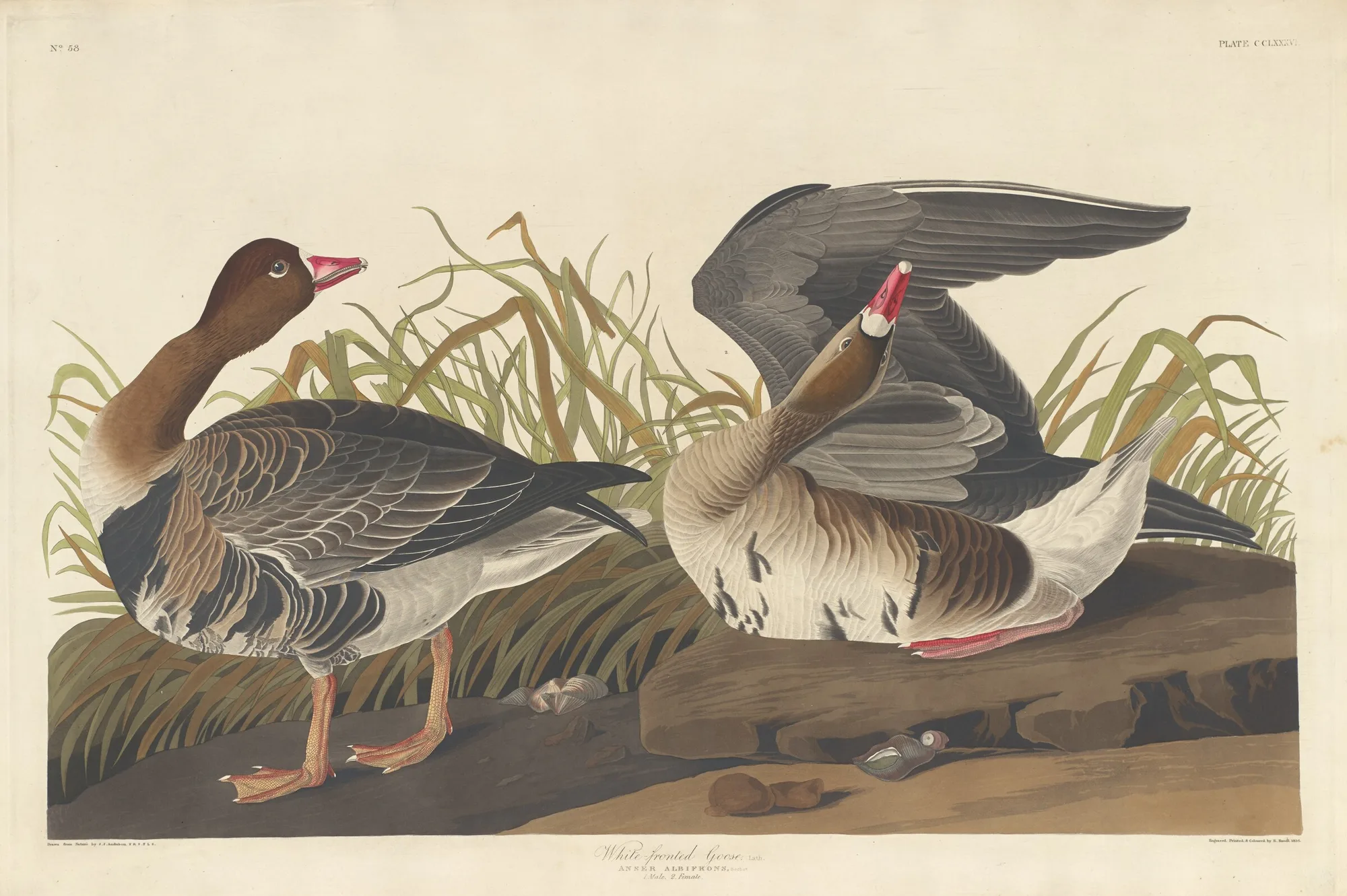
Audubon's “White-fronted Goose”, The Birds of America, plate CCLXXXVI
Click or press Enter to enlarge
Open the full-resolution image (5507 px, National Gallery of Art)
| Plate | 286 (CCLXXXVI) |
|---|---|
| Audubon's name | White-fronted Goose |
| Modern name | Greater White-fronted Goose |
| Scientific name | Anser albifrons |
| Status | Least Concern |
| Engraved by | Robert Havell, after Audubon's watercolor |
| Date | 1836 |
| Medium | Hand-colored engraving and aquatint on Whatman wove paper |
| Collections | Ducks, Geese and Swans |
| This impression | National Gallery of Art, Washington, 1945.8.286; Gift of Mrs. Walter B. James |
About this plate
Plate 286 shows one male goose, grey-brown, with a white band at the base of a pink bill and orange legs. Audubon believed his bird was in winter dress and guessed that the belly turned pure black in summer. In fact adults carry irregular black bars on the belly all year. Young birds lack both the bars and the white face. The bars give the bird its hunters' name, specklebelly.
Audubon's Anser albifrons is still the scientific name. The English name is now Greater White-fronted Goose, to separate it from the Lesser White-fronted Goose of Eurasia. Nuttall called it the Laughing Goose after its high, yelping call.
The species breeds on Arctic tundra around the pole, including Alaska, northern Canada and Greenland. North American birds winter mainly in California, Texas, Louisiana and Mexico, with Greenland birds going to Ireland and Britain. It is uncommon on the Atlantic coast of the United States, as Audubon noted. The IUCN lists it as Least Concern.
Audubon said that when he showed his drawing to Alexander Wilson, Wilson called it a young Snow Goose. During his years at Henderson, Kentucky, he saw flocks every winter on a pond across the Ohio. He recalled shooting seven one evening to feed an English visitor bound for Morris Birkbeck's settlement in Illinois, who declared the goose delicious.
In Audubon's words
During the whole of my residence in Kentucky, a winter never passed without my seeing a good number of them; and at that season they are frequently offered for sale in the markets of New Orleans. An English gentleman, who was on his way to the settlement of Birkbeck in the Prairies west of the Ohio, and who spent a few weeks with me at Henderson, was desirous of having a tasting of some of our game. His desire was fully gratified, and the first that was placed before him was a White-fronted Goose. I had killed seven of these birds, the evening before, in a pond across the Ohio, which was regularly supplied with flocks from the beginning of October to the end of March. He pronounced it "delicious," and I have no reason to dissent from his opinion.
John James Audubon, Ornithological Biography, vol. 3 (1835), “The White-fronted Goose”. Read the full chapter.