Ivory Gull (Plate 287)
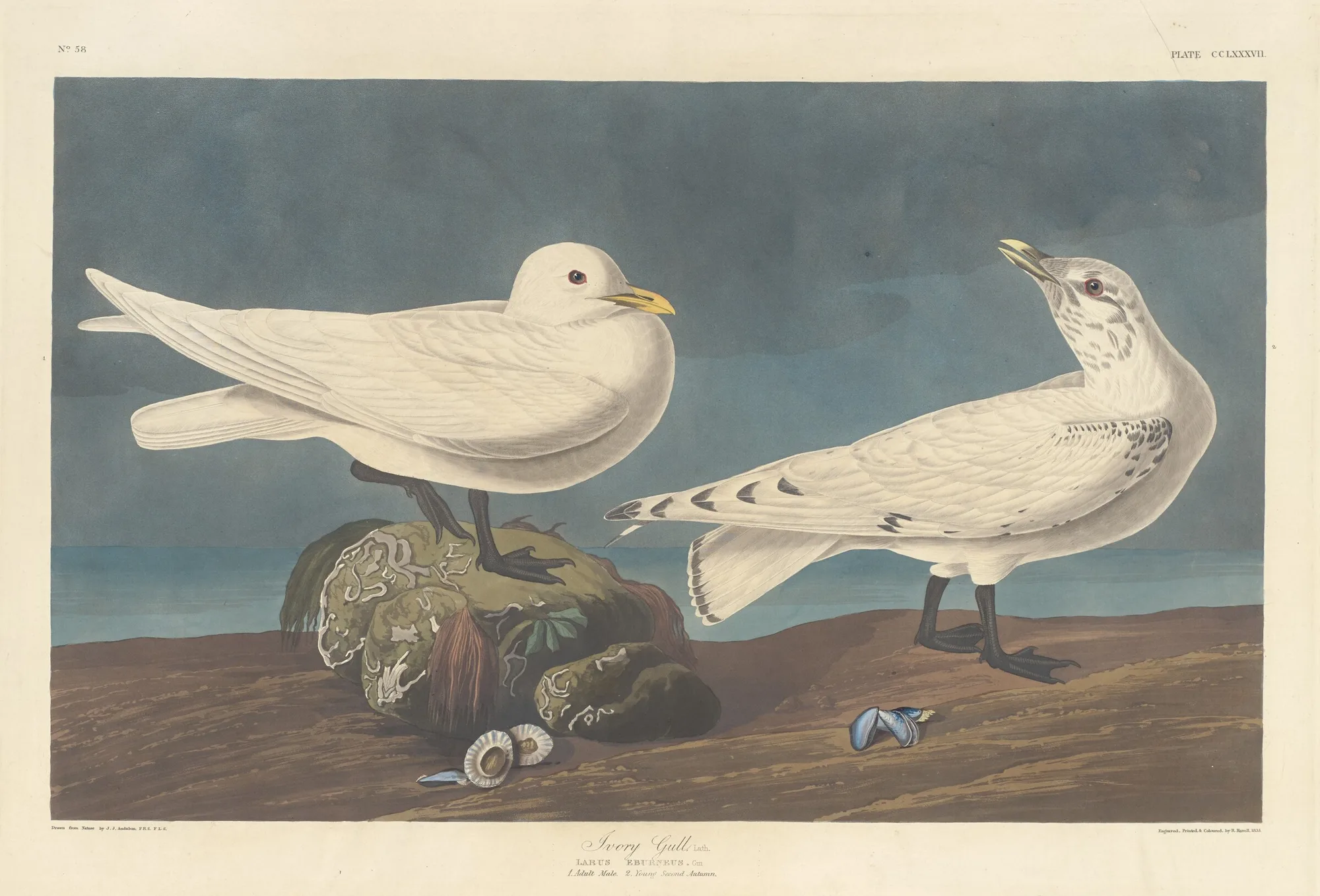
Audubon's “Ivory Gull”, The Birds of America, plate CCLXXXVII
Click or press Enter to enlarge
Open the full-resolution image (4280 px, National Gallery of Art)
| Plate | 287 (CCLXXXVII) |
|---|---|
| Audubon's name | Ivory Gull |
| Modern name | Ivory Gull |
| Scientific name | Pagophila eburnea |
| Status | Near Threatened |
| Engraved by | Robert Havell, after Audubon's watercolor |
| Date | 1836 |
| Medium | Hand-colored engraving and aquatint on Whatman wove paper |
| Collections | Seabirds |
| This impression | National Gallery of Art, Washington, 1945.8.287; Gift of Mrs. Walter B. James |
About this plate
Plate 287 shows two Ivory Gulls. The adult male is pure white, with black legs and a grey-blue bill tipped yellow. The young bird is white with dark spots on the wings and a smudged dark face. Audubon says he drew both from specimens collected by Captain James Clark Ross. He describes the young one as in its second year, although most dark-spotted Ivory Gulls are birds in their first year.
The species is Pagophila eburnea, the only gull in its genus. Its name means ivory ice-lover. Audubon included it because he had learned it visited the coasts of southern Labrador and Newfoundland in winter, and he thought it might stray to the United States. It does reach New England and farther south very rarely.
Ivory Gulls spend their whole lives near sea ice in the high Arctic. They breed on cliffs and gravel flats in northern Canada, Greenland, Svalbard and Russia, and they winter at the edge of the pack ice. They feed on fish and small crustaceans, and they scavenge the remains of seals killed by polar bears and the blubber left by whalers, as Edward Sabine reported. The Canadian breeding population has fallen sharply in recent decades, linked to sea-ice loss and contaminants. The IUCN lists the species as Near Threatened.
Audubon never saw the bird alive. His short chapter relies on Sabine and Richardson.
In Audubon's words
Having ascertained that this beautiful species visits the southern coast of Labrador and Newfoundland every winter, I have thought it probable that it occasionally extends its rambles as far as our eastern shores, and therefore determined to include it in my Illustrations. The figures in the plate were taken from two specimens procured by Captain James Clark Ross, one of which was an adult male, the other a young bird in its second year. Captain Sabine says that the Ivory Gulls are attracted in considerable numbers by whale blubber, are therefore usually found in company with the Procellaria glacialis, and are easily killed, being by no means shy.
John James Audubon, Ornithological Biography, vol. 3 (1835), “The Ivory Gull”. Read the full chapter.