Trumpeter Swan (Plate 406)
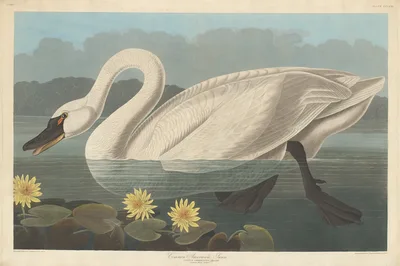
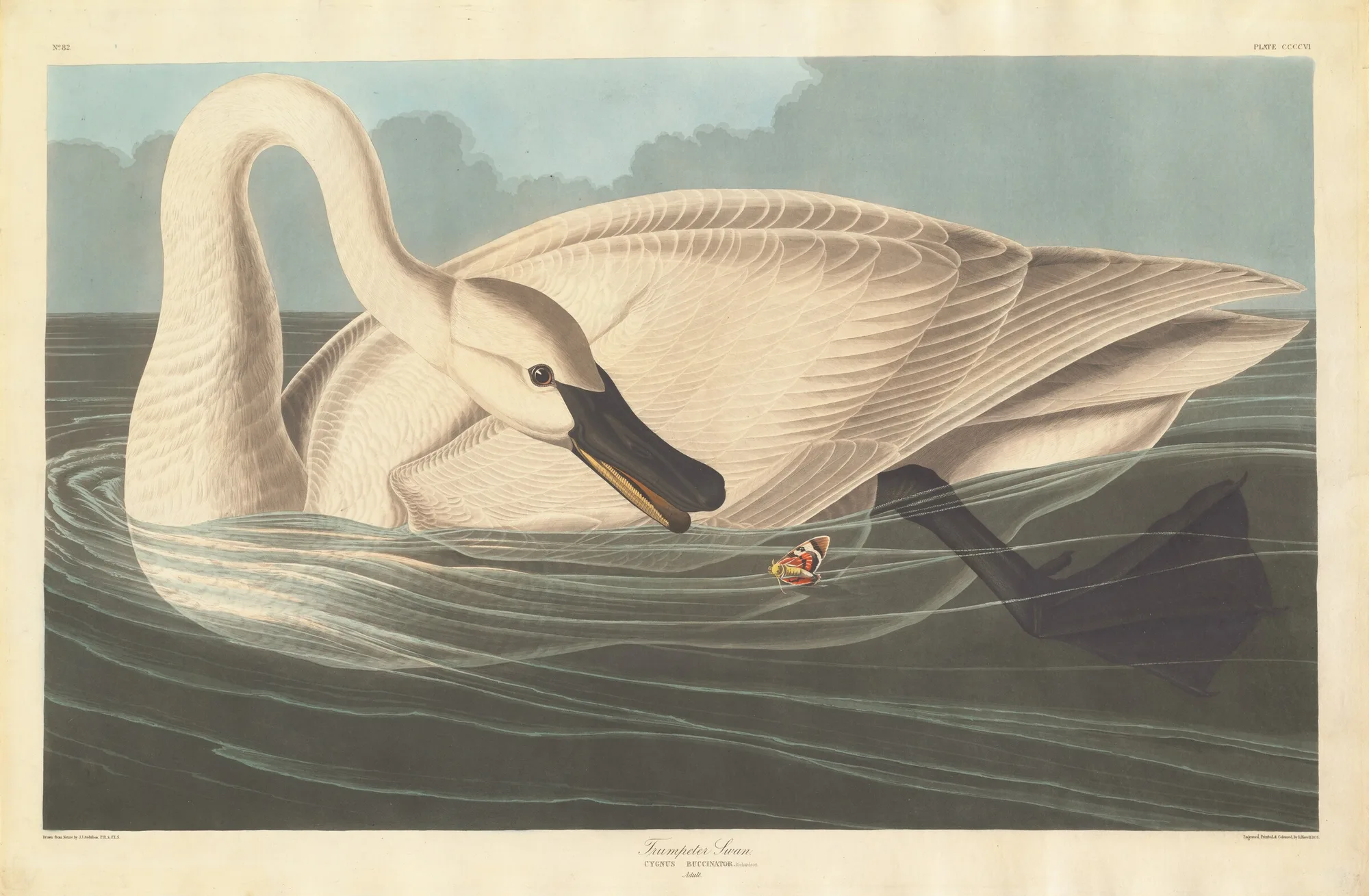
Audubon's “Trumpeter Swan”, The Birds of America, plate CDVI
Click or press Enter to enlarge
Open the full-resolution image (7450 px, National Gallery of Art)
| Plate | 406 (CDVI) |
|---|---|
| Audubon's name | Trumpeter Swan |
| Modern name | Trumpeter Swan |
| Scientific name | Cygnus buccinator |
| Status | Least Concern |
| Engraved by | Robert Havell, after Audubon's watercolor |
| Date | 1838 |
| Medium | Hand-colored engraving and aquatint on Whatman wove paper |
| Size | plate: 64.1 x 98.7 cm (25 1/4 x 38 7/8 in.) sheet: 67.3 x 99.4 cm (26 1/2 x 39 1/8 in.) |
| Collections | Ducks, Geese and Swans |
| This impression | National Gallery of Art, Washington, 1945.8.406; Gift of Mrs. Walter B. James |
About this plate
Plate 406 shows an adult Trumpeter Swan, all white with a black bill and black feet. It complements plate 376, where Audubon had shown a young grey bird drawn at New Orleans. The fifth volume of the Ornithological Biography adds only a technical description of the adult. The story of the species is in the fourth volume.
The name has not changed: John Richardson described the bird as Cygnus buccinator, 'the trumpeter,' for its loud, bugle-like call, produced by a long windpipe looped inside the breastbone. It is North America's heaviest native bird. It can be told from the smaller Tundra Swan, plate 411, by its all-black bill without a yellow spot.
Market hunting for skins, meat and quills nearly wiped the species out. By the early 1930s only a few dozen were known in the lower 48 states, around Red Rock Lakes in Montana and Yellowstone. Larger populations survived in Alaska and Canada. Protection and reintroduction have since restored it to tens of thousands, and it is listed as Least Concern.
Audubon knew the Trumpeter from his years on the Ohio and Mississippi, where it wintered on cane-ringed ponds. He weighed one from the Arkansas River at more than thirty-eight pounds and used its quills as pens for drawing the feet of small birds.
In Audubon's words
The waters of the Arkansas and its tributaries are annually supplied with Trumpeter Swans, and the largest individual which I have examined was shot on a lake near the junction of that river with the Mississippi. It measured nearly ten feet in alar extent, and weighed above thirty-eight pounds. The quills, which I used in drawing the feet and claws of many small birds, were so hard, and yet so elastic, that the best steel-pen of the present day might have blushed, if it could, to be compared with them.
John James Audubon, Ornithological Biography, vol. 4 (1838), “Trumpeter Swan”. Read the full chapter.