Black Scoter (Plate 408)
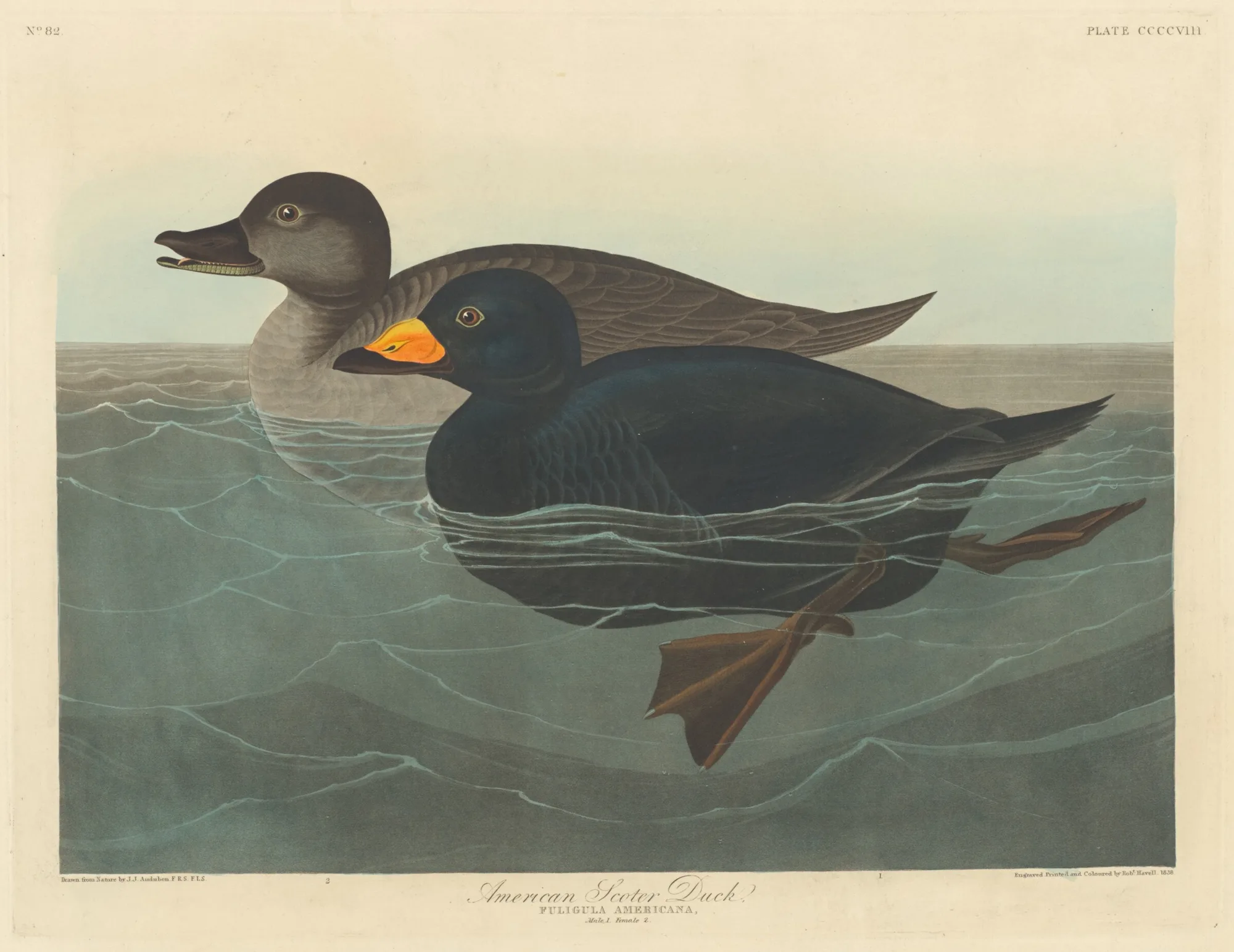
Audubon's “American Scoter Duck”, The Birds of America, plate CDVIII
Click or press Enter to enlarge
Open the full-resolution image (3150 px, National Gallery of Art)
| Plate | 408 (CDVIII) |
|---|---|
| Audubon's name | American Scoter Duck |
| Modern name | Black Scoter |
| Scientific name | Melanitta americana |
| Status | Near Threatened |
| Engraved by | Robert Havell, after Audubon's watercolor |
| Date | 1838 |
| Medium | Hand-colored engraving and aquatint on Whatman wove paper |
| Collections | Ducks, Geese and Swans |
| This impression | National Gallery of Art, Washington, 1945.8.408; Gift of Mrs. Walter B. James |
About this plate
Plate 408 shows a male and female American Scoter. The male is all black, with a swollen orange-yellow knob at the base of the bill. The female is dark brown with pale cheeks. Audubon notes that the male in the plate was drawn in winter, when the bill is less bright than in spring.
Audubon called it Fuligula americana and stressed that it was different from the European Black Scoter. The two were later treated as one species for many years. They have now been split again: the American bird is the Black Scoter, Melanitta americana, and the European one is the Common Scoter, Melanitta nigra.
The Black Scoter breeds on tundra and boreal lakes in Alaska and eastern Canada and winters in large flocks on both coasts, feeding on mussels and other shellfish. It is one of the least studied North American ducks. Its numbers appear to have declined, and the IUCN lists it as Near Threatened.
On 11 July 1833 Audubon's young companions found a nest in Labrador under a low fir near a fresh-water pond, with eight eggs about to hatch. Audubon later watched a female with seven ducklings. When they tired from diving, she took them all on her back and carried them to shore.
In Audubon's words
The eggs, which were ready to be hatched, were eight in number, two inches in length, an inch and five-eighths in breadth, of an oval form, smooth, and of a uniform pale yellowish colour. I afterwards found a female with seven young ones, of which she took such effectual care that none of them fell into our hands. On several occasions, when they were fatigued by diving, she received them all on her back, and swimming deeply, though very fast, took them to the shore, where the little things lay close among the tall grass and low tangled bushes. In this species, as in others, the male forsakes the female as soon as incubation commences.
John James Audubon, Ornithological Biography, vol. 5 (1839), “American Scoter Duck”. Read the full chapter.