Red-breasted Merganser (Plate 401)
Audubon's “Red-breasted Merganser”, The Birds of America, plate CDI
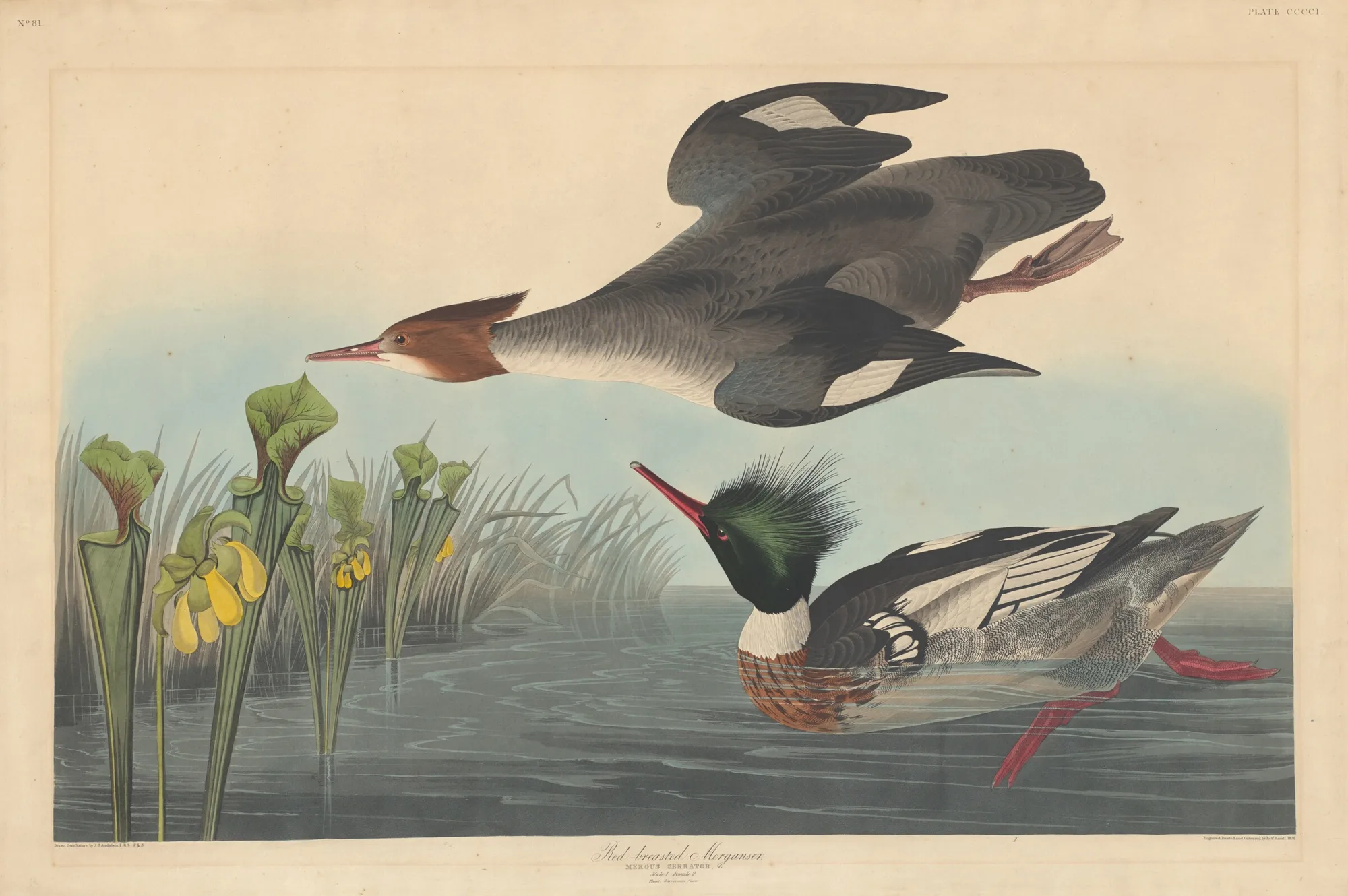
Click or press Enter to enlarge
Open the full-resolution image (5410 px, National Gallery of Art)
| Plate | 401 (CDI) |
|---|---|
| Audubon's name | Red-breasted Merganser |
| Modern name | Red-breasted Merganser |
| Scientific name | Mergus serrator |
| Status | Least Concern |
| Engraved by | Robert Havell, after Audubon's watercolor |
| Date | 1838 |
| Medium | Hand-colored engraving and aquatint on Whatman wove paper |
| Plants and setting | A pitcher plant (Sarracenia), described by Audubon as a new species found from Pensacola to Georgia |
| Collections | Ducks, Geese and Swans |
| This impression | National Gallery of Art, Washington, 1945.8.401; Gift of Mrs. Walter B. James |
About this plate
Plate 401 shows a male and female Red-breasted Merganser. The male has a shaggy green crest, a white collar and a streaked rusty breast. The female is grey-bodied with a ragged brown crest. Both are shown with a pitcher plant, which Audubon described as a new species of Sarracenia found from Pensacola to Georgia.
The species has kept its English and scientific names. Like the other mergansers, it has a slender, saw-edged bill for gripping fish. Audubon noted that it was known across the United States as the 'Shell-drake.'
The Red-breasted Merganser breeds around the northern parts of the globe, by lakes, rivers and coasts in the boreal forest and tundra. It winters mostly on salt water, more so than the Common Merganser. It is among the fastest flying ducks and is listed as Least Concern.
Audubon found it from Texas to Labrador and saw females with broods in Kentucky. He examined nests in Labrador that were still not full by about 20 June, hidden among sedges near fresh-water ponds. He described the birds as so greedy that some gorged until they could not rise from the water, and captives died from swallowing too many fish.
In Audubon's words
Gluttonous in the extreme, it frequently gorges itself so as to be unable to rise. I have several times seen one of them obliged to eject a great part of the contents of its stomach and gullet before it could fly off, and some which I have kept a day or two in confinement have died in consequence of swallowing too many fishes. The "Shell Drake," according to the latitude of the place which it has selected, and the degree of forwardness of the season, begins to form its nest from the first of March until the middle of May. Some nests which I examined in Labrador had not their full complement of eggs until about the 20th of June. In that country, as well as in several parts of the United States, where I have found the nests, they were placed within a very short distance of the margins of fresh-water ponds, among rank grasses and sedges, or beneath the low bushes.
John James Audubon, Ornithological Biography, vol. 5 (1839), “Red-breasted Merganser”. Read the full chapter.