Great Crested Grebe (Plate 292)
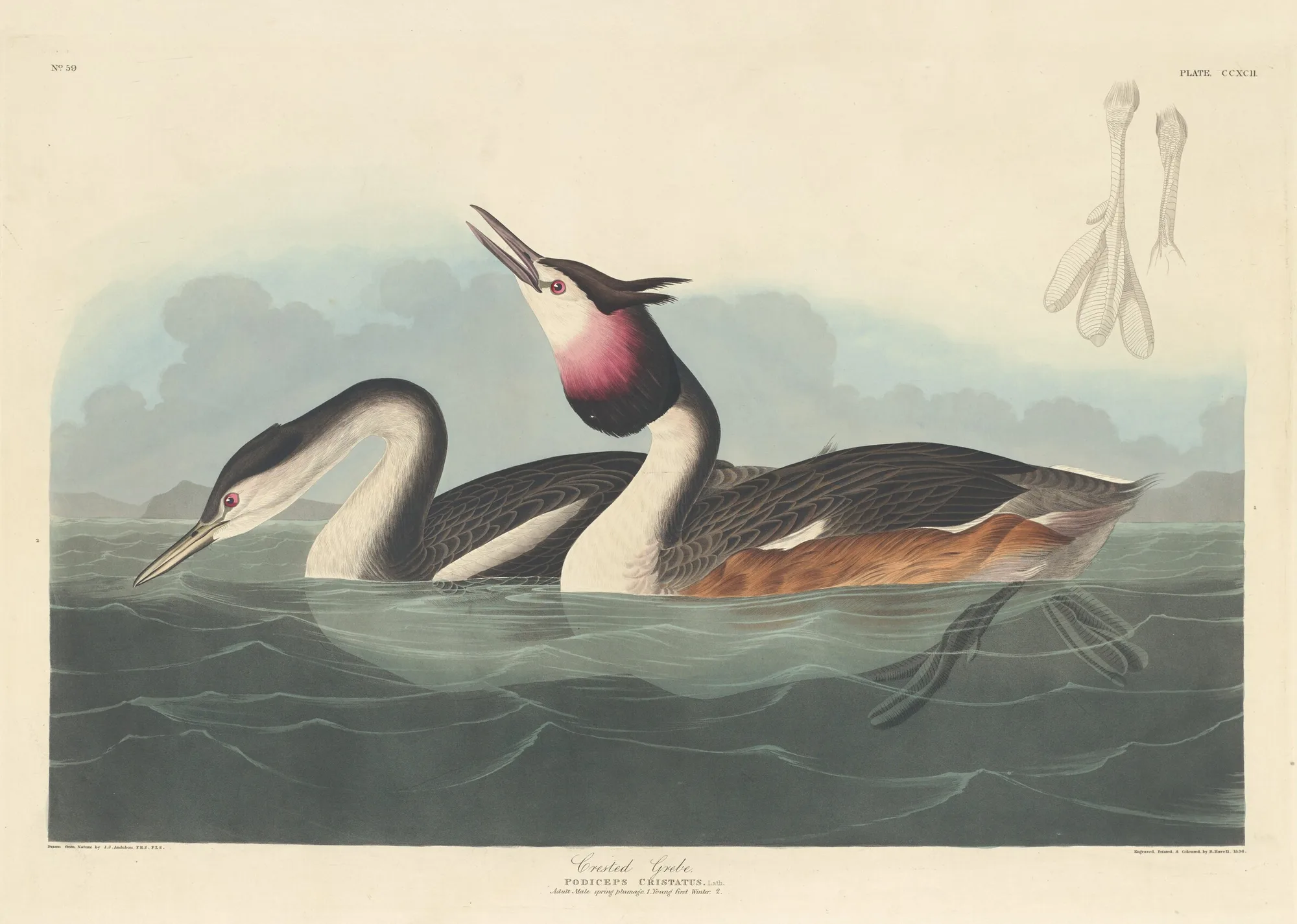
Audubon's “Crested Grebe”, The Birds of America, plate CCXCII
Click or press Enter to enlarge
Open the full-resolution image (4325 px, National Gallery of Art)
| Plate | 292 (CCXCII) |
|---|---|
| Audubon's name | Crested Grebe |
| Modern name | Great Crested Grebe |
| Scientific name | Podiceps cristatus |
| Status | Least Concern |
| Engraved by | Robert Havell, after Audubon's watercolor |
| Date | 1836 |
| Medium | Hand-colored engraving and aquatint on Whatman wove paper |
| Collections | Seabirds |
| This impression | National Gallery of Art, Washington, 1945.8.292; Gift of Mrs. Walter B. James |
About this plate
Plate 292 shows a male and a female Great Crested Grebe. At least one wears the summer head-dress of a dark crest and chestnut-and-black frills, or tippets, around the face. Audubon wrote that the birds he saw in spring seldom had the head-dress as complete as in the plate.
The species is Podiceps cristatus, a grebe of Europe, Asia, Africa and Australasia. It does not occur in North America except as a rare vagrant. Audubon described flocks passing over the Ohio each September and birds on clear ponds in the interior. Modern authorities regard those records as mistakes, most likely for the Red-necked Grebe, which he drew on plate 298, or for other large grebes. The figures were probably drawn from European specimens.
Great Crested Grebes breed on lakes and reed-fringed ponds and dive for fish. They are known for their elaborate courtship dances, including the head-shaking display and the weed dance, in which the pair rise breast to breast holding water plants. In Britain the head plumes were so valued by milliners in the nineteenth century that the bird was nearly wiped out. That decline helped start the movement that became the Royal Society for the Protection of Birds. The IUCN lists the species as Least Concern.
Audubon's chapter also describes catching grebes on baited hooks set near the bottom of a pond.
In Audubon's words
When about to alight on the water, these birds glide swiftly downward, with their wings half-closed, and produce a sound not unlike that of a hawk stooping towards its prey. Their velocity is so great at this moment, that on alighting, they glide on the surface of the water for twenty or thirty yards, leaving a furrow in their wake. In a few moments they are all engaged in washing and cleaning themselves, after which they dive in pursuit of the fishes on which they feed, and which they secure by following them in the manner of Divers and Cormorants. They are exceedingly quick-sighted, and frequently elude by diving the shot intended for their destruction, seldom after being chased raising more than their bill above the water, but rarely making for the shore unless when nearly exhausted.
John James Audubon, Ornithological Biography, vol. 3 (1835), “The Crested Grebe”. Read the full chapter.



