Herring Gull (Plate 291)
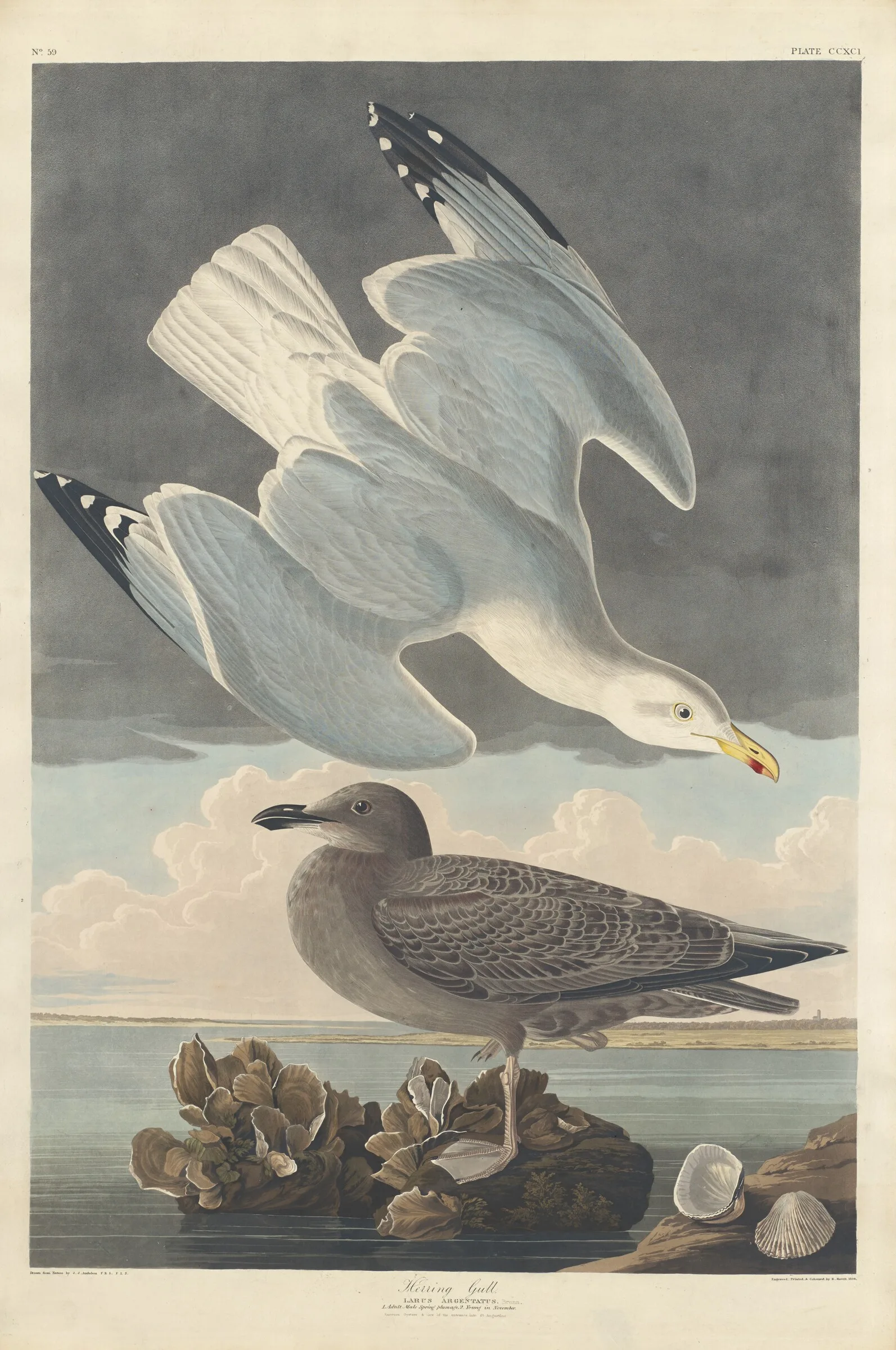
Audubon's “Herring Gull”, The Birds of America, plate CCXCI
Click or press Enter to enlarge
Open the full-resolution image (5520 px, National Gallery of Art)
| Plate | 291 (CCXCI) |
|---|---|
| Audubon's name | Herring Gull |
| Modern name | Herring Gull |
| Scientific name | Larus argentatus |
| Status | Least Concern |
| Engraved by | Robert Havell, after Audubon's watercolor |
| Date | 1836 |
| Medium | Hand-colored engraving and aquatint on Whatman wove paperr |
| Size | plate: 97.2 x 66 cm (38 1/4 x 26 in.) sheet: 101.6 x 68.3 cm (40 x 26 7/8 in.) |
| Collections | Seabirds |
| This impression | National Gallery of Art, Washington, 1945.8.291; Gift of Mrs. Walter B. James |
About this plate
Plate 291 shows an adult Herring Gull, with a pale grey back, black wingtips with white spots, pink legs and a yellow bill with a red spot near the tip. The OB figures line names a single male.
Audubon's Larus argentatus is still the name used by the AOS. The IOC and some other authorities now split the North American birds as the American Herring Gull, Larus smithsonianus, separate from the European Herring Gull. Herring Gulls take four years to reach adult plumage, and the young are mottled brown.
The species breeds along coasts, large lakes and rivers across Canada, Alaska and the northeastern United States. It winters south to the Gulf of Mexico and Central America. In the nineteenth century egging and the feather trade nearly wiped it out on the New England coast, and protection after 1900 led to a large recovery. Numbers have fallen again in recent decades. The IUCN lists the species as Least Concern.
The chapter records one of Audubon's most quoted observations. On 23 May 1833 the revenue cutter Swiftsure landed his party on White Head Island at the mouth of the Bay of Fundy. There he found Herring Gulls nesting in fir trees as well as on the ground. The owner, Mr Frankland, told him the birds had moved into the trees within his memory, after years of egg collecting by his sons and local fishermen.
In Audubon's words
I was greatly surprised to see the nests placed on the branches, some near the top, others about the middle or on the lower parts of the trees, while at the same time there were many on the ground. It is true I had been informed of this by our captain, but I had almost believed that, on arriving at the spot, I should find the birds not to be gulls. My doubts, however, were now dispelled, and I was delighted to see how strangely Nature had provided them with the means of securing their eggs and young from their arch-enemy man.
John James Audubon, Ornithological Biography, vol. 3 (1835), “The Herring Gull”. Read the full chapter.



