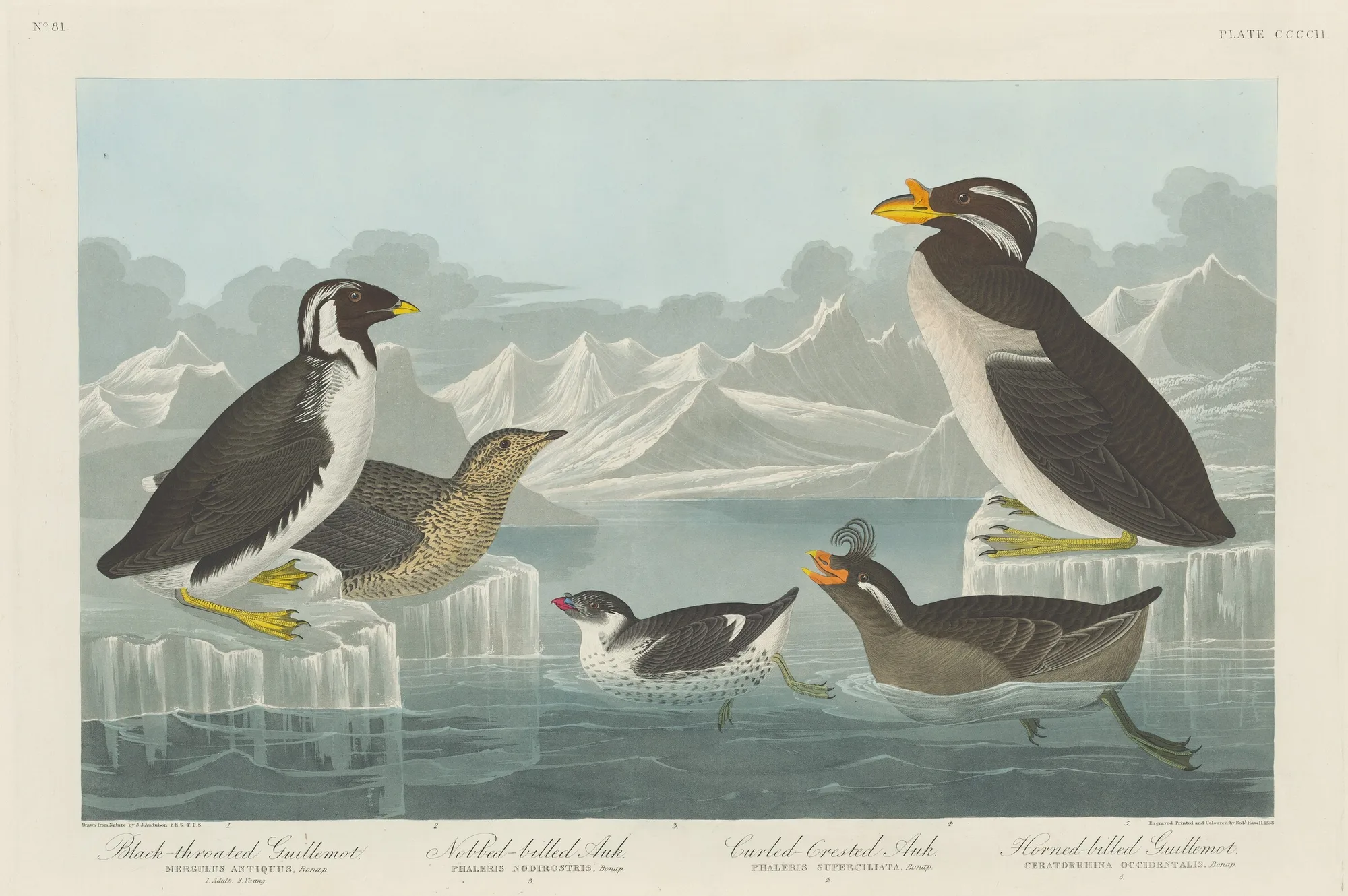
Ancient Murrelet, Least Auklet, Crested Auklet and Rhinoceros Auklet (Plate 402)
Audubon's “Black-throated Guillemot, Nobbed-billed Auk, Curled-Crested Auk and Horned-billed Guillemot”, The Birds of America, plate CDII
Click or press Enter to enlarge
Open the full-resolution image (5247 px, National Gallery of Art)
| Plate | 402 (CDII) |
|---|---|
| Audubon's name | Black-throated Guillemot, Nobbed-billed Auk, Curled-Crested Auk and Horned-billed Guillemot |
| Modern names | Ancient Murrelet, Least Auklet, Crested Auklet, Rhinoceros Auklet |
| Scientific names | Synthliboramphus antiquus, Aethia pusilla, Aethia cristatella, Cerorhinca monocerata |
| Status | Least Concern |
| Engraved by | Robert Havell, after Audubon's watercolor |
| Date | 1838 |
| Medium | Hand-colored engraving and aquatint on Whatman wove paper |
| Collections | Seabirds |
| This impression | National Gallery of Art, Washington, 1945.8.402; Gift of Mrs. Walter B. James |
About this plate
Plate 402 shows four small auks of the North Pacific. There is an adult and young Ancient Murrelet, a Least Auklet, a Crested Auklet and a Rhinoceros Auklet. Audubon never saw any of them alive. He drew the first three from specimens in the museum of the Zoological Society of London, with the Council's permission. The Rhinoceros Auklet was lent by the Prince of Musignano, Charles Lucien Bonaparte.
His Black-throated Guillemot is the Ancient Murrelet, named for the grey back and white streaks on the head of breeding adults, which suggest an old person's hair. The Knobbed-billed Phaleris is the Least Auklet, the smallest auk, which grows a small knob on the bill in the breeding season. The Curled-crested Phaleris is the Crested Auklet, whose forward-curling crest and citrus-scented plumage play a part in courtship. The Horned-billed Guillemot is the Rhinoceros Auklet, a puffin relative with a pale horn at the base of the bill.
All four breed in colonies on islands of the North Pacific and Bering Sea, nesting in burrows or rock crevices. Least and Crested Auklets gather in colonies of hundreds of thousands in the Aleutians and Bering Sea. Introduced rats and foxes have harmed several colonies. All are listed as Least Concern.
Audubon included them because they were reported from the north-west coast of America. His chapters are almost entirely technical descriptions of the skins.
Birds on this plate
- Ancient Murrelet Synthliboramphus antiquus: Audubon's Black-throated Guillemot (adult and young). Least Concern
- Least Auklet Aethia pusilla: Audubon's Nobbed-billed Auk (Knobbed-billed Phaleris) (adult). Least Concern
- Crested Auklet Aethia cristatella: Audubon's Curled-Crested Auk (Curled-crested Phaleris) (adult). Least Concern
- Rhinoceros Auklet Cerorhinca monocerata: Audubon's Horned-billed Guillemot (adult). Least Concern
In Audubon's words
This species, which is said to occur on the north-west coast of America, has not been met with by me. The figures in the plate were taken from specimens in the Museum of the Zoological Society of London, by permission of the Council.
John James Audubon, Ornithological Biography, vol. 5 (1839), “Black-Throated Guillemot”. Read the full chapter.