Black-footed Albatross (Plate 407)
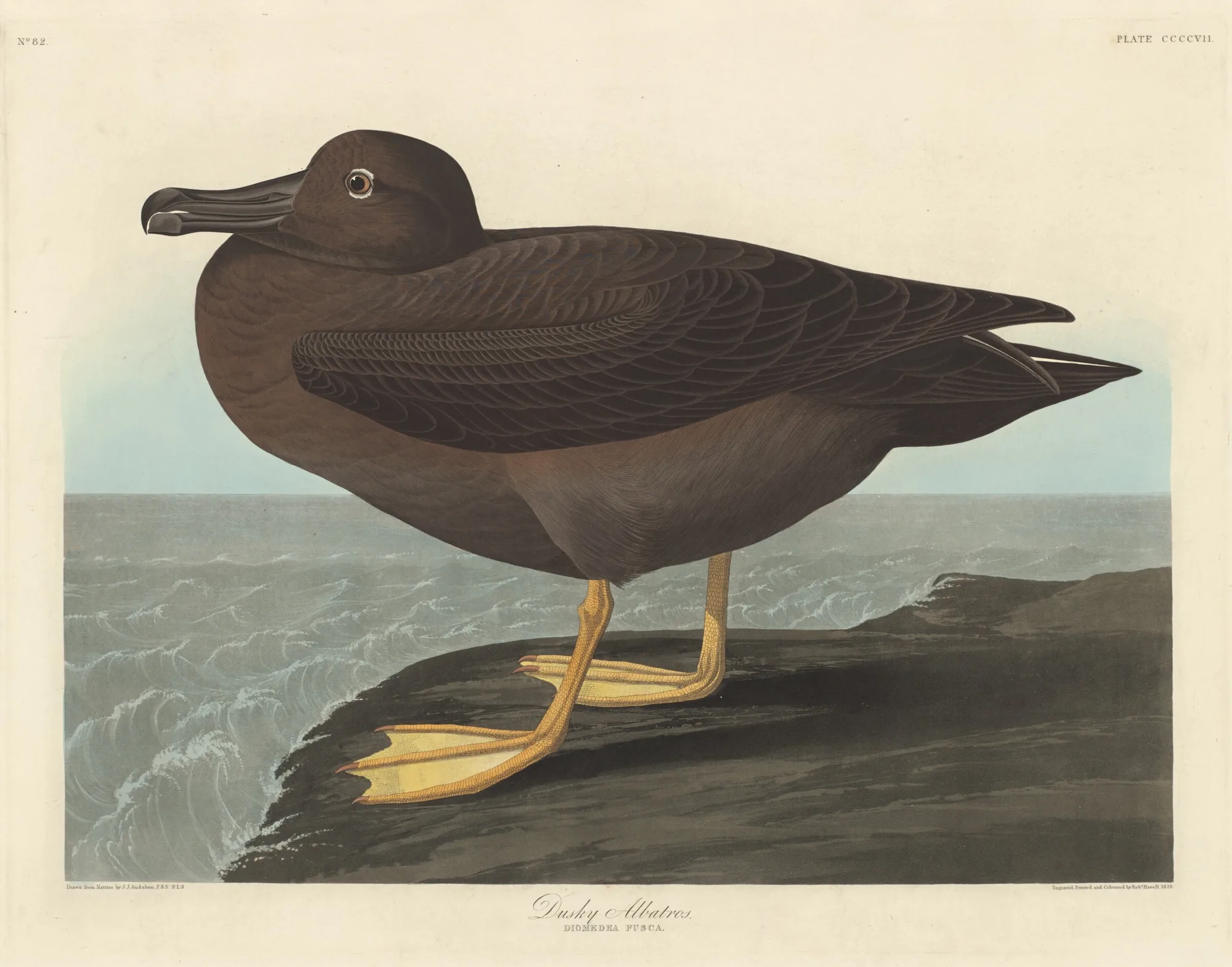
Audubon's “Dusky Albatros”, The Birds of America, plate CDVII
Click or press Enter to enlarge
Open the full-resolution image (4041 px, National Gallery of Art)
| Plate | 407 (CDVII) |
|---|---|
| Audubon's name | Dusky Albatros |
| Modern name | Black-footed Albatross |
| Scientific name | Phoebastria nigripes |
| Status | Near Threatened |
| Engraved by | Robert Havell, after Audubon's watercolor |
| Date | 1838 |
| Medium | Hand-colored engraving and aquatint on Whatman wove paper |
| Collections | Seabirds |
| This impression | National Gallery of Art, Washington, 1945.8.407; Gift of Mrs. Walter B. James |
About this plate
Plate 407 shows a single dark albatross, sooty brown with long narrow wings and a heavy hooked bill. Audubon drew it from a skin prepared by John Kirk Townsend, who took the bird near the mouth of the Columbia River. Audubon admitted he knew nothing of its habits or range.
Finding no matching description, Audubon thought it was new and called it Diomedea fusca, the Dusky Albatross. The name Diomedea fusca had already been used for the Sooty Albatross of the southern oceans, a bird that does not reach Oregon. A dark albatross off the Columbia is almost certainly a Black-footed Albatross, Phoebastria nigripes. That is the identification usually given for this plate.
The Black-footed Albatross nests mainly on the low sandy islands of the northwestern Hawaiian chain. It ranges across the North Pacific to feed, and regularly follows fishing boats off the West Coast. Many are killed on longline fishing hooks, and the low islands where it breeds are at risk from rising seas. The IUCN lists it as Near Threatened.
Like many western birds in the last volume of The Birds of America, this one reached Audubon only as a skin. The text is a brief note followed by a detailed technical description.
In Audubon's words
The skin from which I made my drawing of this species was prepared by Dr Townsend, who procured the bird near the mouth of the Columbia River. Of its habits or distribution I am entirely ignorant. Having failed in finding any figure or description of an Albatross agreeing entirely with it, I have been induced to consider it as new.
John James Audubon, Ornithological Biography, vol. 5 (1839), “Dusky Albatross”. Read the full chapter.