Eared Grebe (Plate 404)
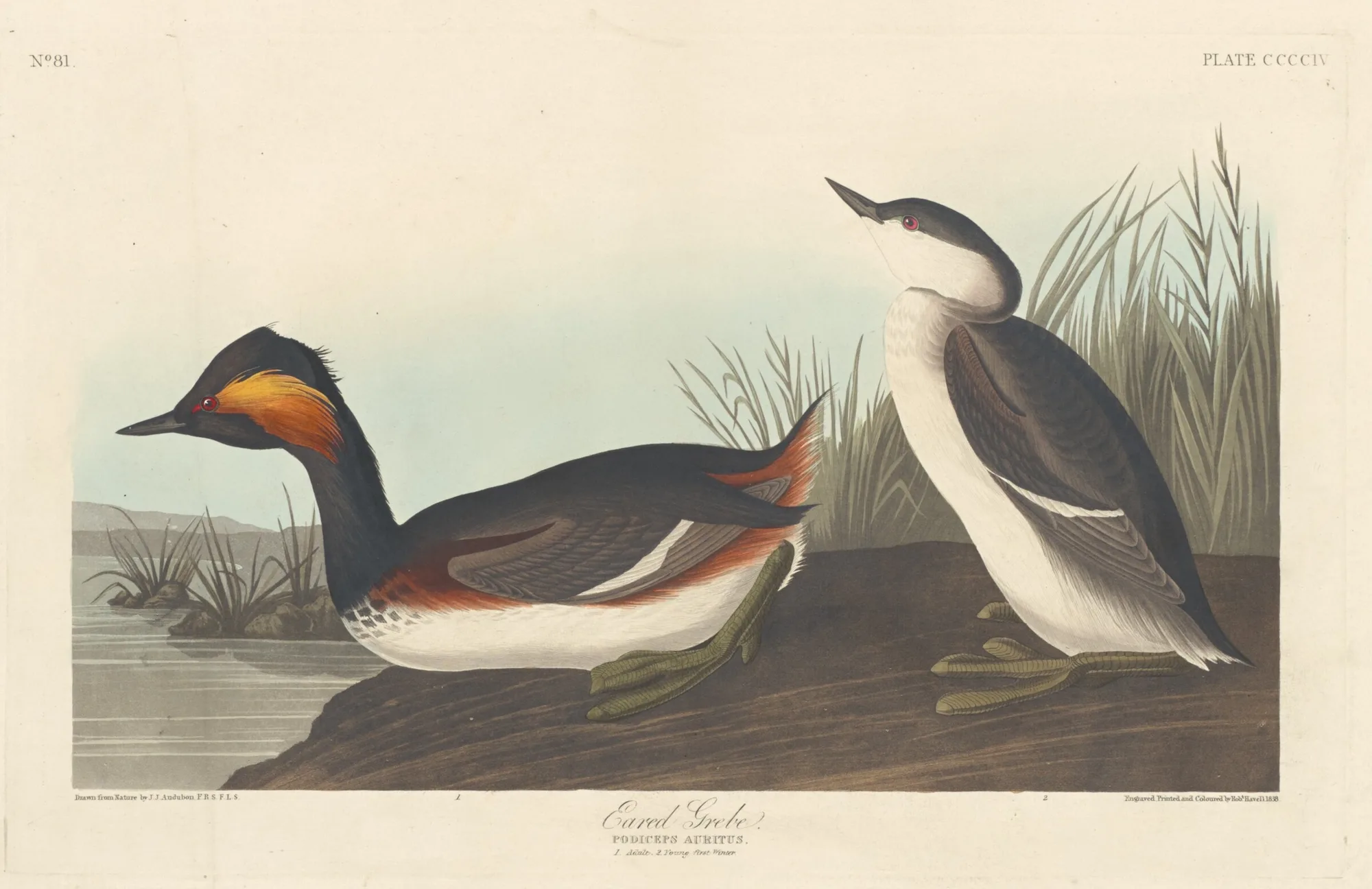
Audubon's “Eared Grebe”, The Birds of America, plate CDIV
Click or press Enter to enlarge
Open the full-resolution image (2842 px, National Gallery of Art)
| Plate | 404 (CDIV) |
|---|---|
| Audubon's name | Eared Grebe |
| Modern name | Eared Grebe |
| Scientific name | Podiceps nigricollis |
| Status | Least Concern |
| Engraved by | Robert Havell, after Audubon's watercolor |
| Date | 1838 |
| Medium | Hand-colored engraving and aquatint on Whatman wove paper |
| Collections | Seabirds |
| This impression | National Gallery of Art, Washington, 1945.8.404; Gift of Mrs. Walter B. James |
About this plate
Plate 404 shows an adult Eared Grebe in breeding plumage, with a black neck, a red eye and a fan of golden plumes behind the eye, and a young bird in plainer grey and white. Audubon never saw the species alive. He drew both from North American specimens lent by the Earl of Derby.
Audubon called it Podiceps auritus, a name now used for the Horned Grebe. The Eared Grebe is Podiceps nigricollis. In Britain the same species is called the Black-necked Grebe.
The Eared Grebe is probably the most numerous grebe in the world. It breeds in colonies on shallow lakes and ponds across the western interior of North America, and also in Europe, Asia and Africa. After breeding, huge numbers gather on salty lakes such as Mono Lake and the Great Salt Lake to feed on brine shrimp. There they grow so fat and their flight muscles shrink so much that they cannot fly for weeks. Over much of the year it is flightless longer than almost any other flying bird. It is listed as Least Concern.
The chapter is short. It consists of a single sentence on the source of the specimens followed by technical descriptions.
In Audubon's words
The specimens from which my figures of this species of Grebe have been taken, were lent me by my noble and kind friend the Right Honourable the Earl of Derby, who received them from North America, where, as I am assured, it is not uncommon, although it has not been my good fortune to meet with it.
John James Audubon, Ornithological Biography, vol. 5 (1839), “Eared Grebe”. Read the full chapter.