Dusky Grouse (Plate 361)
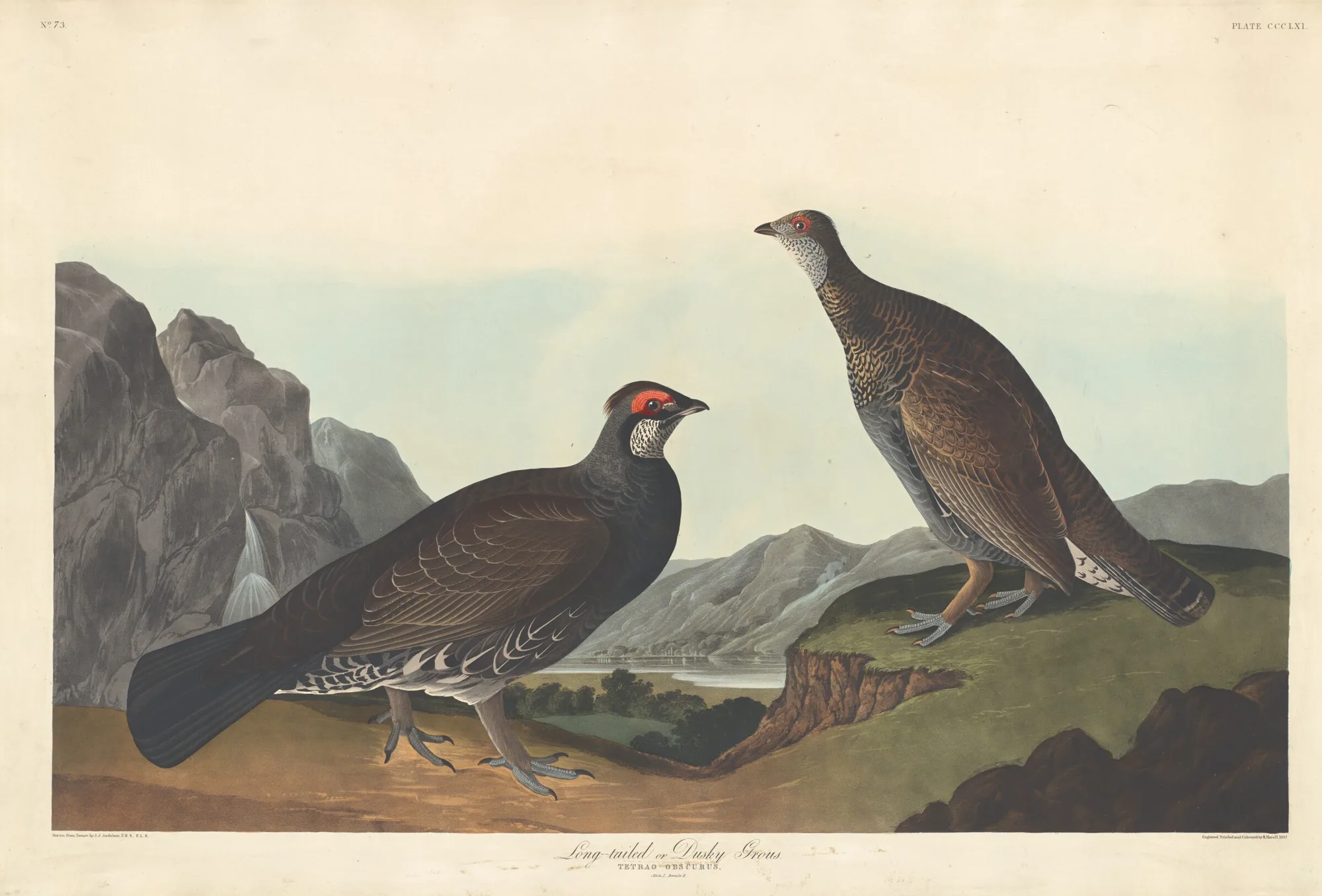
Audubon's “Long-tailed or Dusky Grous”, The Birds of America, plate CCCLXI
Click or press Enter to enlarge
Open the full-resolution image (5398 px, National Gallery of Art)
| Plate | 361 (CCCLXI) |
|---|---|
| Audubon's name | Long-tailed or Dusky Grous |
| Modern name | Dusky Grouse |
| Scientific name | Dendragapus obscurus |
| Status | Least Concern |
| Engraved by | Robert Havell, after Audubon's watercolor |
| Date | 1837 |
| Medium | Hand-colored engraving and aquatint on Whatman wove paper |
| Collections | Turkeys, Grouse and Game Birds |
| This impression | National Gallery of Art, Washington, 1945.8.361; Gift of Mrs. Walter B. James |
About this plate
Plate 361 shows a male and a female of a large forest grouse. The male is slate grey with a yellow-orange comb over the eye and a long dark tail. The female is mottled brown and grey.
Audubon used Say's name Tetrao obscurus. Thomas Say described the bird from a female collected on Major Long's 1820 expedition. For most of the twentieth century it was known as the Blue Grouse. In 2006 the Blue Grouse was split into two species: the Dusky Grouse of the Rocky Mountains and interior, and the Sooty Grouse of the Pacific coast ranges. Audubon's specimens came at least partly from John Kirk Townsend's collecting near the Columbia River, so some may have been what is now the Sooty Grouse.
Dusky Grouse live in conifer forests of the Rocky Mountains and Great Basin ranges. They move uphill in winter and feed on conifer needles. Displaying males inflate bare purplish neck patches and give low hooting calls. The species is listed as Least Concern.
Audubon said plainly that he had never seen the species alive. His chapter is made up of accounts from Richardson, Townsend and Nuttall. Thomas Drummond told Richardson of males hooting from rocks in spring, and a Hudson's Bay Company factor said fighting males could be picked up by hand.
In Audubon's words
I had no opportunity of observing the habits of this bird myself, but I was informed by Mr Drummond that, in the mornings during pairing time, “the usual station of the male is on some rocky eminence or large stone, where he sits swelling out the sides of his neck, spreading his tail, and repeating the cry of ‘coombe, coombe,’ in a soft hollow tone. Its food consists of various berries, and its flesh is very palatable. Mr Alexander Stewart, a chief-factor of the Hudson’s Bay Company, who has often crossed the mountains, informs me that the males of this species fight each other with such animosity, that a man may take one of them up in his hand before it will quit its antagonist.
John James Audubon, Ornithological Biography, vol. 4 (1838), “Dusky Grous”. Read the full chapter.