California Quail (Plate 413)
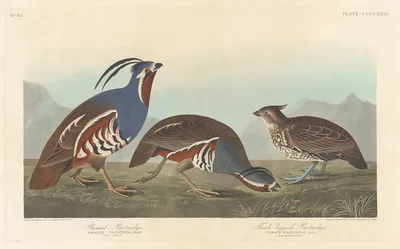
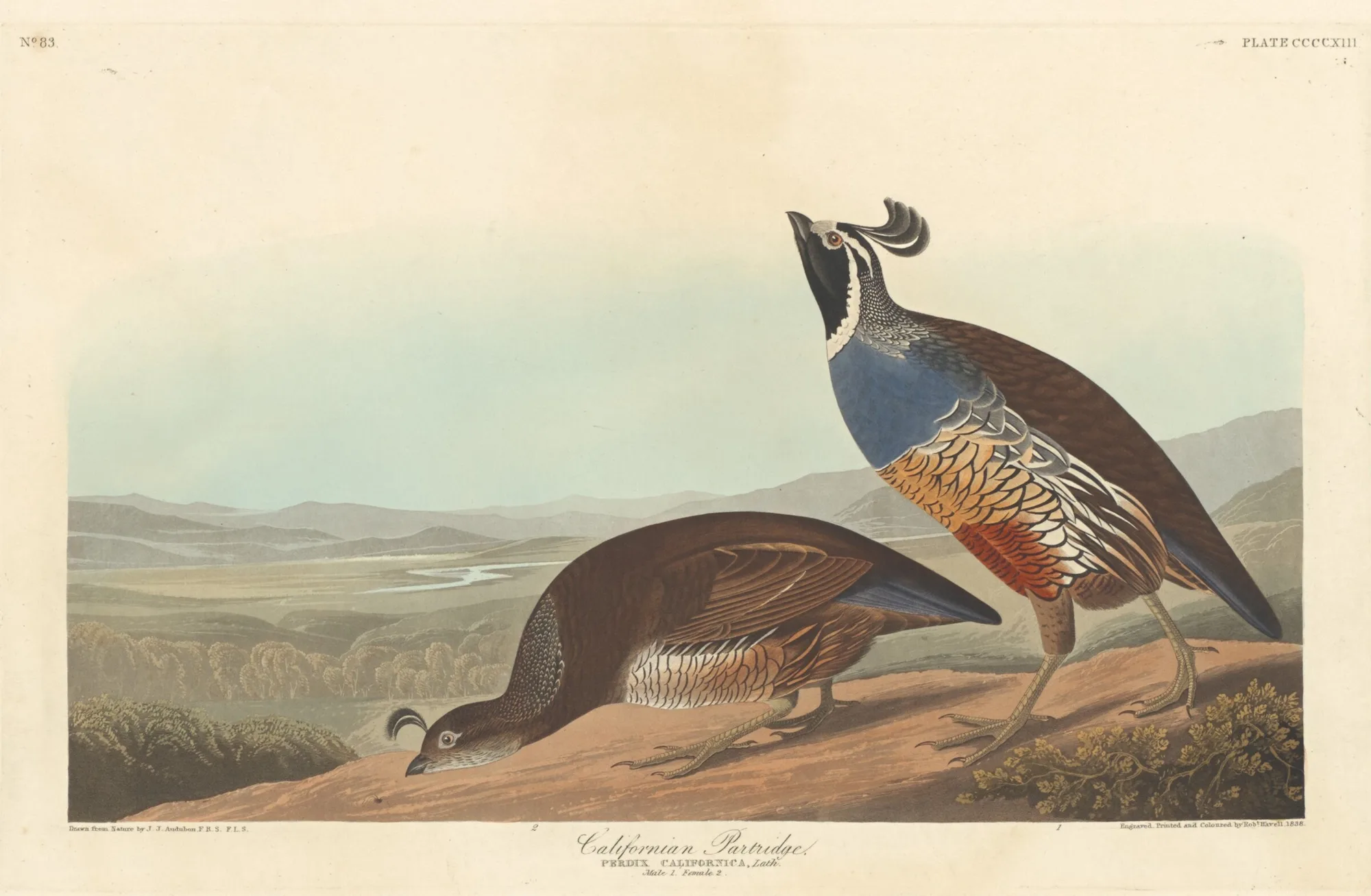
Audubon's “Californian Partridge”, The Birds of America, plate CDXIII
Click or press Enter to enlarge
Open the full-resolution image (2746 px, National Gallery of Art)
| Plate | 413 (CDXIII) |
|---|---|
| Audubon's name | Californian Partridge |
| Modern name | California Quail |
| Scientific name | Callipepla californica |
| Status | Least Concern |
| Engraved by | Robert Havell, after Audubon's watercolor |
| Date | 1838 |
| Medium | Hand-colored engraving and aquatint on Whatman wove paper |
| Size | plate: 31.4 x 49.5 cm (12 3/8 x 19 1/2 in.) sheet: 67.3 x 101.3 cm (26 1/2 x 39 7/8 in.) |
| Collections | Turkeys, Grouse and Game Birds |
| This impression | National Gallery of Art, Washington, 1945.8.413; Gift of Mrs. Walter B. James |
About this plate
Plate 413 shows a male and female California Quail. The male has a black throat bordered with white, a scaled belly and a black teardrop-shaped topknot curling forward from the crown. The female is greyer and plainer, with a smaller plume.
Audubon called it the Californian Partridge, Perdix californica. It is now Callipepla californica, a New World quail and not related to the Old World partridges. The species was first collected on the La Perouse expedition, which visited Monterey in 1786. A figure appeared in that voyage's atlas.
The California Quail lives in brushy country, oak woodland and suburban gardens from southern Oregon to Baja California. It has been introduced to British Columbia, Hawaii, Chile, New Zealand and elsewhere. Outside the breeding season coveys can number dozens or even hundreds of birds, and the male's three-note call carries far. It is the state bird of California and is listed as Least Concern.
Audubon says Townsend sent him a male procured near Santa Barbara on 6 March 1837, though with no notes on its habits. Nuttall told him the bird was tame and that its manners resembled those of the Northern Bobwhite, which Audubon knew as the Virginian Partridge.
In Audubon's words
This beautiful species was discovered in the course of the voyage of La Perouse, and figured in the atlas accompanying the account of that unfortunate expedition, but without any other notice respecting its habits or distribution, than an intimation of its having been found abundant in the plains and thickets of California, where it formed large flocks. Dr Townsend has lately sent me a beautiful specimen of the male, which he procured on the 6th of March 1837, near Santa Barbara in California. I have to regret, however, that he has not furnished me with any account of its habits. Mr Nuttall, in speaking to me of this bird, informed me that it is very gentle or confident, so as to be in a great measure regardless of the approach of man, that its manners resemble those of our Common or Virginian Partridge, and that the males in spring are seen perched on low bushes, where they utter their love-notes in the same emphatic manner as the species just mentioned.
John James Audubon, Ornithological Biography, vol. 5 (1839), “Californian Partridge”. Read the full chapter.