Mountain Quail (Plate 423)
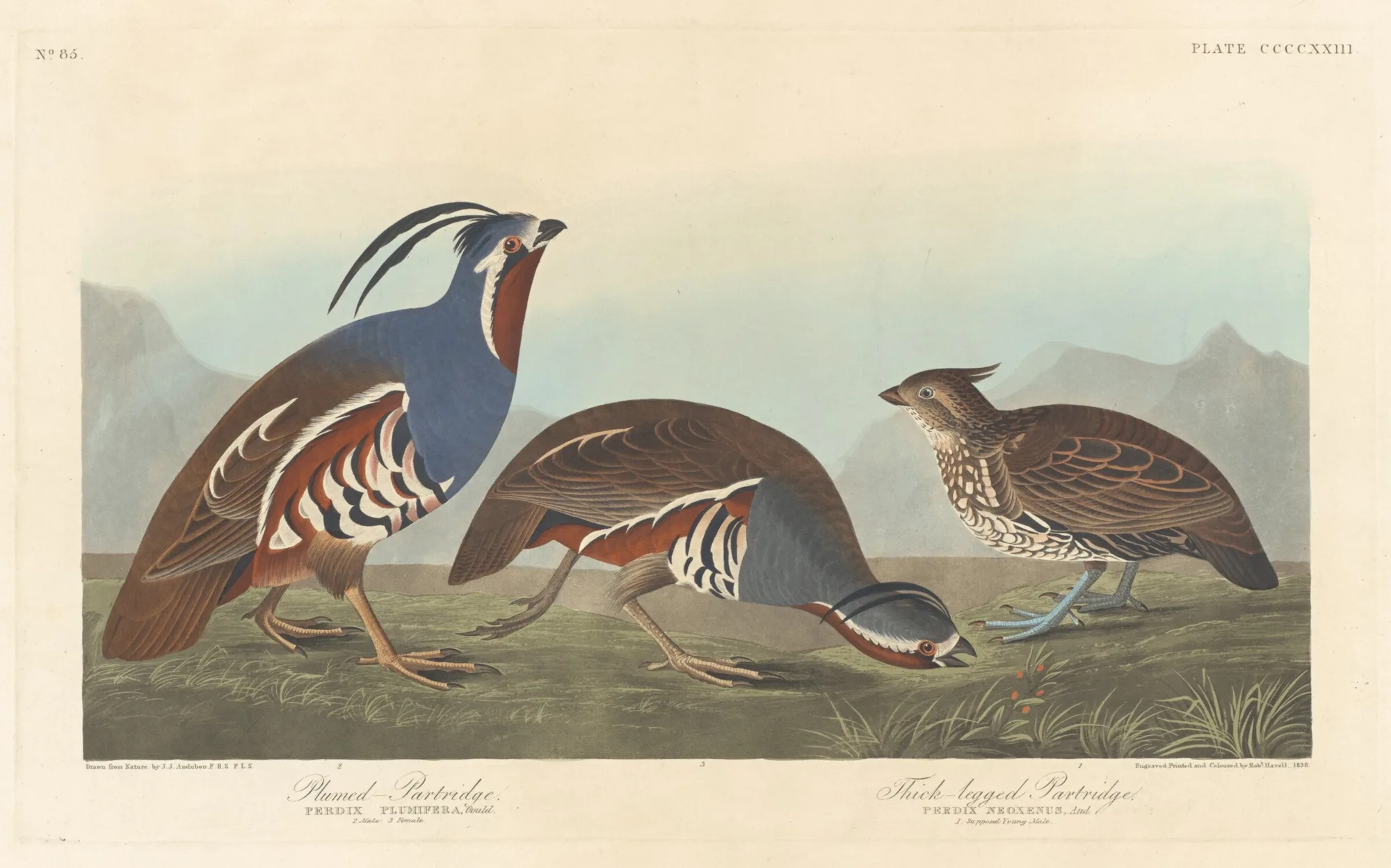
Audubon's “Plumed Partridge and Thick-legged Partridge”, The Birds of America, plate CDXXIII
Click or press Enter to enlarge
Open the full-resolution image (3102 px, National Gallery of Art)
| Plate | 423 (CDXXIII) |
|---|---|
| Audubon's name | Plumed Partridge and Thick-legged Partridge |
| Modern names | Mountain Quail, Unidentified young quail (Welcome Partridge) |
| Scientific names | Oreortyx pictus, Ortyx neoxenus (unresolved) |
| Status | Least Concern |
| Engraved by | Robert Havell, after Audubon's watercolor |
| Date | 1838 |
| Medium | Hand-colored engraving and aquatint on Whatman wove paper |
| Collections | Turkeys, Grouse and Game Birds |
| This impression | National Gallery of Art, Washington, 1945.8.423; Gift of Mrs. Walter B. James |
About this plate
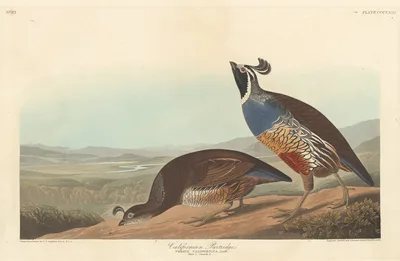
Plate 423 shows a male and female Mountain Quail and a smaller young quail. The adults have long, straight head plumes, grey breasts and chestnut flanks barred boldly with white. Townsend sent Audubon a female from the Columbia region. Audubon drew the male from a fine specimen in the museum of the Zoological Society of London.
The Plumed Partridge, Perdix plumifera, is the Mountain Quail, Oreortyx pictus, the largest quail in the United States and the only member of its genus. The third bird, which Audubon called the Welcome Partridge, came from a Zoological Society specimen collected on Captain Beechey's voyage. Nicholas Vigors had named it Ortyx neoxenus. Audubon treated it as a distinct species and drew it as a young bird. It is not recognized today and was probably a young quail of a known species.
The Mountain Quail lives in dense brush and open conifer forest in the mountains of California, Oregon and western Nevada. It is shy and more often heard than seen. Unlike most quail, it migrates on foot up and down the slopes with the seasons. It is listed as Least Concern, though it has declined in parts of the interior Northwest.
Townsend reported that the bird lived in thick woods along the tributaries of the Columbia in coveys of six to ten. He never saw one himself, and the specimens he sent were obtained by others.
Birds on this plate
- Mountain Quail Oreortyx pictus: Audubon's Plumed Partridge (male and female). Least Concern
- Unidentified young quail (Welcome Partridge) Ortyx neoxenus (unresolved): Audubon's Thick-legged Partridge (Welcome Partridge) (young). Unknown
In Audubon's words
This bird inhabits the dense woods along the tributary streams of the Columbia River, and is said to extend south into California. It is at all times a very scarce species, going in coveys of from six to ten, and is rarely seen away from its favourite places of resort. In all my rambles through the Oregon Country I was never so fortunate as to meet with this pretty bird, the three specimens which I have received having been procured for me by others. One of these specimens has been forwarded to me by Dr Townsend, and as it proved a female, I made a drawing of the male from a superb specimen now in the Museum of the Zoological Society of London.
John James Audubon, Ornithological Biography, vol. 5 (1839), “Plumed Partridge”. Read the full chapter.