Band-tailed Pigeon (Plate 367)
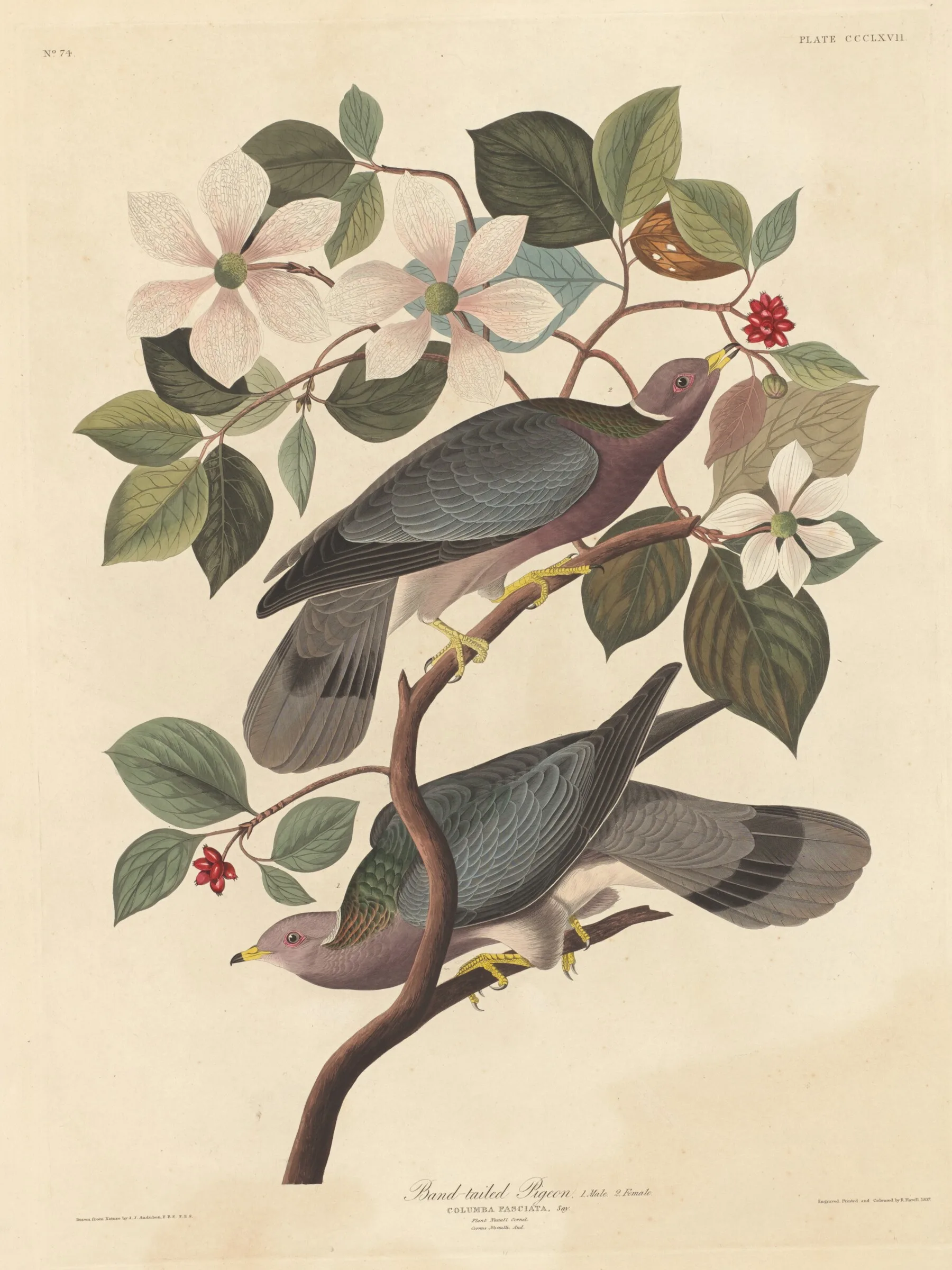
Audubon's “Band-tailed Pigeon”, The Birds of America, plate CCCLXVII
Click or press Enter to enlarge
Open the full-resolution image (4257 px, National Gallery of Art)
| Plate | 367 (CCCLXVII) |
|---|---|
| Audubon's name | Band-tailed Pigeon |
| Modern name | Band-tailed Pigeon |
| Scientific name | Patagioenas fasciata |
| Status | Least Concern |
| Engraved by | Robert Havell, after Audubon's watercolor |
| Date | 1837 |
| Medium | Hand-colored engraving and aquatint on Whatman wove paper |
| Plants and setting | Pacific dogwood (Cornus nuttallii), painted by Maria Martin |
| Collections | Turkeys, Grouse and Game Birds |
| This impression | National Gallery of Art, Washington, 1945.8.367; Gift of Mrs. Walter B. James |
About this plate
Plate 367 shows two adult Band-tailed Pigeons on a flowering branch of dogwood. They are large grey pigeons with a white crescent on the nape above an iridescent green patch, a yellow bill and feet, and a pale band across the end of the tail.
The dogwood is Cornus nuttallii, the Pacific dogwood. Thomas Nuttall discovered it on his journey to the Pacific, and Audubon named it for him. Maria Martin, John Bachman's sister-in-law and later his wife, painted the branch. Audubon sent seeds to Lord Ravensworth, and the plants germinated in England.
Audubon used Say's name Columba fasciata. The New World pigeons have since been moved to the genus Patagioenas. Band-tailed Pigeons live in oak and conifer forests from British Columbia to Argentina. In the United States they live mainly along the Pacific coast and in the southwestern mountains. Heavy hunting reduced them in the early twentieth century, and numbers have declined in places. The species is listed as Least Concern.
Audubon never saw the bird alive. A single specimen had come back from Long's expedition. He bought three adult pairs and some young from John Kirk Townsend, whose notes from the Columbia River described large flocks arriving in April 1836.
In Audubon's words
In my plate are represented two adult birds, placed on the branch of a superb species of Dogwood, discovered by my learned friend, Thomas Nuttall, Esq., when on his march toward the shores of the Pacific Ocean, and which I have graced with his name! The beautiful drawing of this branch was executed by Miss Martin, the amiable and accomplished sister of my friend Dr Bachman. Seeds of this new species of Cornus were sent by me to Lord Ravensworth, and have germinated, so that this beautiful production of the rich valley of the Columbia River may now be seen in the vicinity of London, and in the grounds of the nobleman just mentioned, near Newcastle-upon-Tyne.
John James Audubon, Ornithological Biography, vol. 4 (1838), “Band-tailed Pigeon”. Read the full chapter.