Winter Wren and Rock Wren (Plate 360)
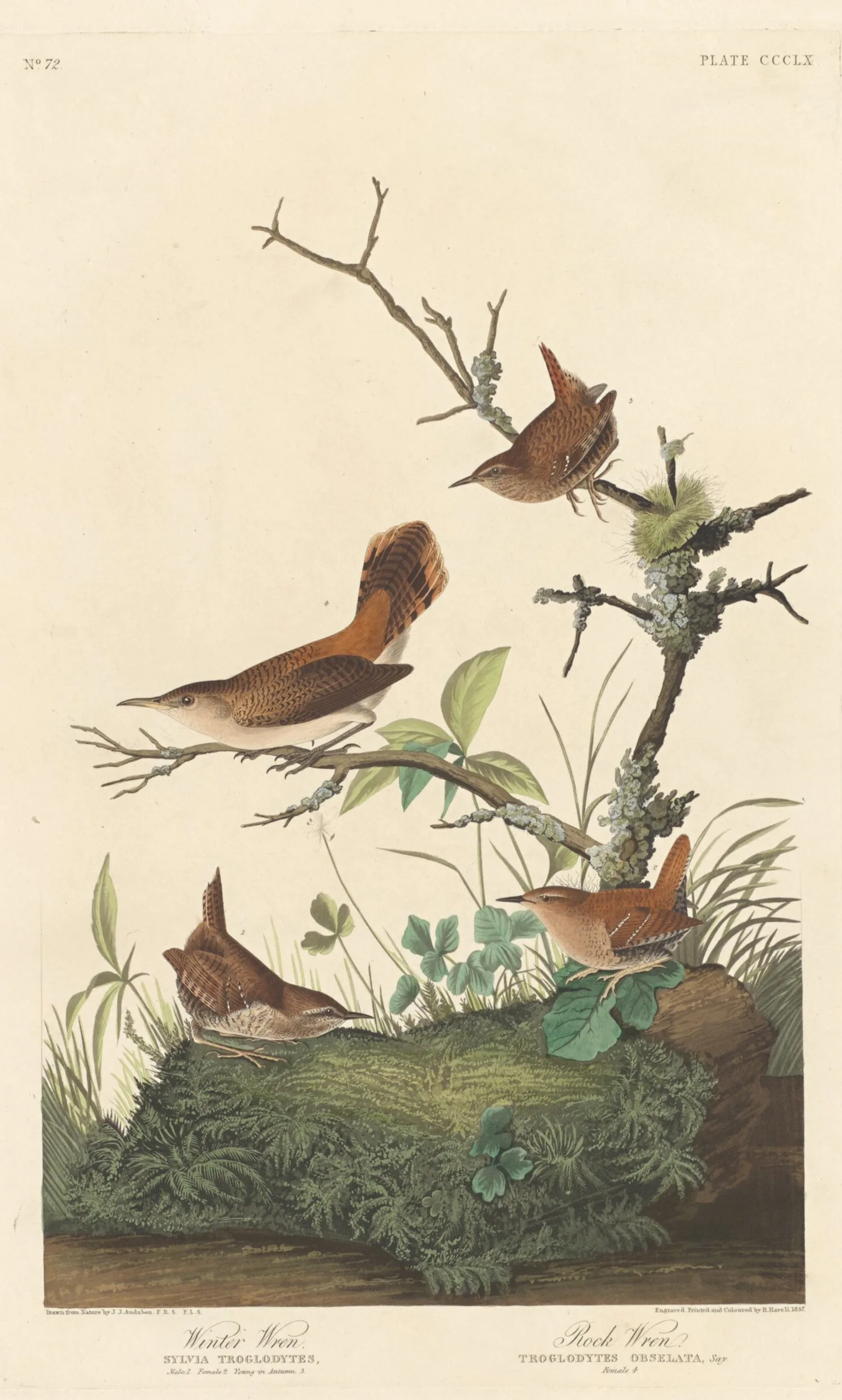
Audubon's “Winter Wren and Rock Wren”, The Birds of America, plate CCCLX
Click or press Enter to enlarge
Open the full-resolution image (2886 px, National Gallery of Art)
| Plate | 360 (CCCLX) |
|---|---|
| Audubon's name | Winter Wren and Rock Wren |
| Modern names | Winter Wren, Rock Wren |
| Scientific names | Troglodytes hiemalis, Salpinctes obsoletus |
| Status | Least Concern |
| Engraved by | Robert Havell, after Audubon's watercolor |
| Date | 1837 |
| Medium | Hand-colored engraving and aquatint on Whatman wove paper |
| Collections | Songbirds |
| This impression | National Gallery of Art, Washington, 1945.8.360; Gift of Mrs. Walter B. James |
About this plate
Plate 360 shows several Winter Wrens, males, a female and young, with a Rock Wren perched on a twig among them. The Winter Wren is a tiny, dark brown, short-tailed bird of forest undergrowth. The Rock Wren is larger and paler, grey-brown with fine speckles and buff tail tips.
The pairing is an editorial accident. Audubon drew the Rock Wren on a stone from a female given to him by Thomas Nuttall. For reasons he explained in his introduction, his son Victor Gifford Audubon attached it to the Winter Wren drawing, so it now sits on a twig. Audubon admitted that this is not a usual perch for the species.
The American Winter Wren was long treated as the same species as the Eurasian Wren. In 2010 it was split as Troglodytes hiemalis, and the western form became the Pacific Wren. The Rock Wren, Salpinctes obsoletus, lives in rocky slopes and canyons from western Canada to Central America. It was discovered on Major Long's expedition and described by Thomas Say. Both species are listed as Least Concern.
Audubon admired the Winter Wren's long migration. He found it in Louisiana and Florida in midwinter and in full song at Eastport, Maine, on 9 May 1833, with icicles on the rocks.
Birds on this plate
- Winter Wren Troglodytes hiemalis (males, female and young). Least Concern
- Rock Wren Salpinctes obsoletus (adult female). Least Concern
In Audubon's words
The extent of the migratory movements of this diminutive bird, is certainly the most remarkable fact connected with its history. At the approach of winter it leaves its northern retreats, perhaps in Labrador or Newfoundland, crosses the inlets of the Gulf of St Lawrence on tiny concave wings, and betakes itself to warmer regions, where it remains until the beginning of spring. Playfully and with alacrity it performs the task, hopping from one stump or fallen log to another, flitting from twig to twig, from bush to bush, here and there flying a few yards; feeding, singing, and bustling on, as if quite careless as to time or distance. It has reached the shore of some broad stream, and here a person ignorant of its habits might suppose it would be stopped; but no, it spreads its wings, and glides over like a meteor.
John James Audubon, Ornithological Biography, vol. 4 (1838), “Winter Wren”. Read the full chapter.



