Gull-billed Tern (Plate 410)
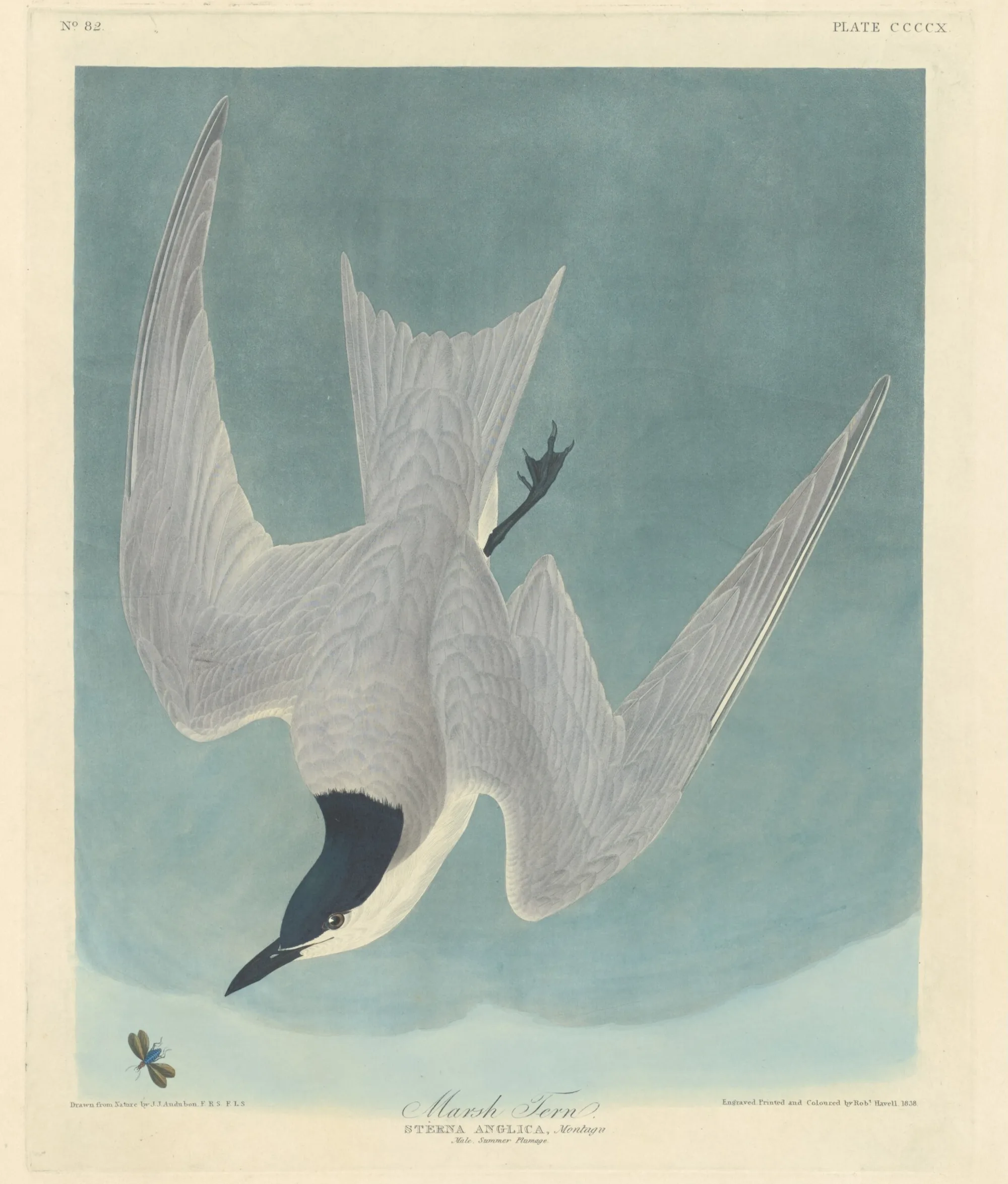
Audubon's “Marsh Tern”, The Birds of America, plate CDX
Click or press Enter to enlarge
Open the full-resolution image (2805 px, National Gallery of Art)
| Plate | 410 (CDX) |
|---|---|
| Audubon's name | Marsh Tern |
| Modern name | Gull-billed Tern |
| Scientific name | Gelochelidon nilotica |
| Status | Least Concern |
| Engraved by | Robert Havell, after Audubon's watercolor |
| Date | 1838 |
| Medium | Hand-colored engraving and aquatint on Whatman wove paper |
| Collections | Seabirds |
| This impression | National Gallery of Art, Washington, 1945.8.410; Gift of Mrs. Walter B. James |
About this plate
Plate 410 shows a male Gull-billed Tern in breeding plumage, with a black cap, pale grey back and a short, heavy black bill. Audubon chose it from three adults shot within a few hours of each other.
Wilson had called the American bird the Marsh Tern. Audubon took six specimens to the British Museum and compared them with Colonel Montagu's English Gull-billed Terns, Sterna anglica. He concluded they were the same species. He argued that differences in bill and leg length were due to age and sex, and that habits observed in life were a better guide than skins. The species is now Gelochelidon nilotica, a tern found on every continent except Antarctica.
Unlike most terns, the Gull-billed Tern seldom dives for fish. It hawks insects over marshes and fields and picks crabs, lizards and other prey from the ground. In the United States it nests in small colonies on sandy beaches and islands along the Atlantic and Gulf coasts and at the Salton Sea. It is listed as Least Concern.
Audubon watched the birds arrive along the Gulf coast in April. With Edward Harris he saw them catching insects over a stagnant pond, and over dry land at Barataria in Louisiana. He also described the paired flight of the birds in the breeding season.
In Audubon's words
To this power is added an elegant lightness that renders it most conspicuous and pleasing during the love season. Then "the happy pair" are seen to rise in elegant circling sweeps, almost in the manner of Hawks, and only a few feet apart, until they attain a height of about two hundred yards, when they come close together, and then glide with extended pinions through the air, the male over the female, both emitting tender and plaintive notes, while they vary their evolutions at the same height for five or six minutes. After this the winged lovers separate, plunge towards the earth with wonderful rapidity, resume their ordinary notes, and seek for food in concert.
John James Audubon, Ornithological Biography, vol. 5 (1839), “Marsh or Gull-Billed Tern”. Read the full chapter.



