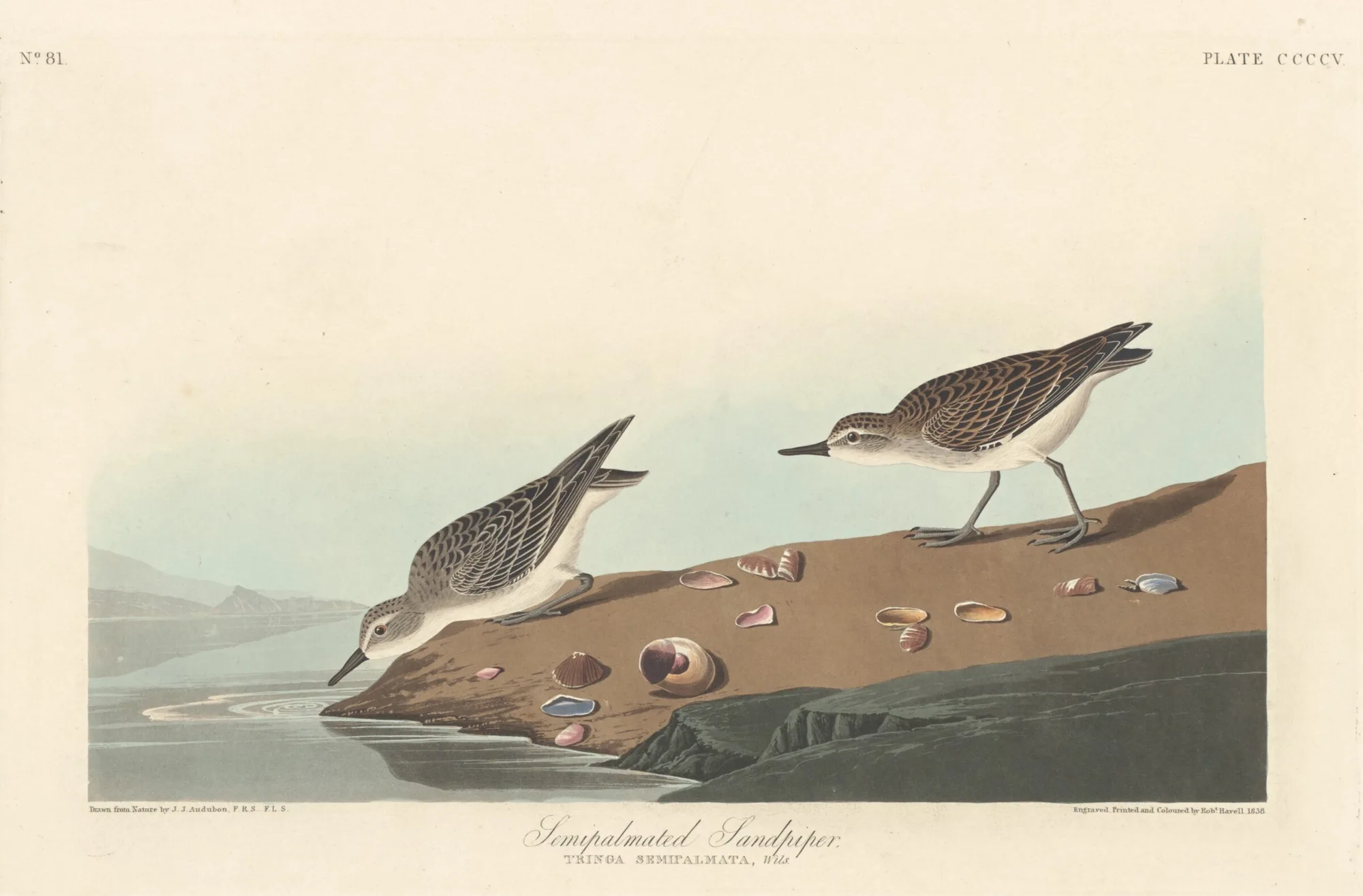
Semipalmated Sandpiper (Plate 405)
Audubon's “Semi-palmated Sandpiper”, The Birds of America, plate CDV
Click or press Enter to enlarge
Open the full-resolution image (2772 px, National Gallery of Art)
| Plate | 405 (CDV) |
|---|---|
| Audubon's name | Semi-palmated Sandpiper |
| Modern name | Semipalmated Sandpiper |
| Scientific name | Calidris pusilla |
| Status | Least Concern |
| Engraved by | Robert Havell, after Audubon's watercolor |
| Date | 1838 |
| Medium | Hand-colored engraving and aquatint on Whatman wove paper |
| Collections | Shorebirds, Rails and Cranes |
| This impression | National Gallery of Art, Washington, 1945.8.405; Gift of Mrs. Walter B. James |
About this plate
Plate 405 shows an adult Semipalmated Sandpiper, one of the small, grey-brown sandpipers known as 'peeps.' Its short, straight black bill and black legs distinguish it from the Least Sandpiper. The name refers to the small webs between its front toes.
Audubon used Wilson's name Tringa semipalmata. The species is now Calidris pusilla. Audubon noticed how much individuals varied in bill length and size. He warned that someone working only from skins might make several species out of one brood, and he concluded that the differences came from age and sex.
The Semipalmated Sandpiper breeds on Arctic tundra from Alaska to Labrador and winters mainly on the coasts of northern South America. In late summer it stops at a few key staging sites, especially the Bay of Fundy, where hundreds of thousands feed on mud shrimp before a nonstop flight of several days over the Atlantic. Its numbers have fallen in parts of its range.
Audubon found it entering Texas in April and saw it on the Florida Keys. In Labrador in June 1833 he found pairs with nests but could not locate any. The birds misled his party by squatting on the moss as if on eggs, then running off to repeat the trick.
In Audubon's words
In Labrador I shot a whole brood when just able to fly, together with several old birds, which kept apart. Among the latter I found differences as to size and proportions enough to induce persons having nothing better than skins, to imagine that several species might be made out of them. About the period when these birds prepare to return southward, they congregate in large flocks, the young separate from the old. In Labrador this takes place from the beginning to the middle of August. There I found this species dispersed in pairs, and having nests, early in June; but all our endeavours to procure any were fruitless, so cunningly had they disposed of them, and so effectually did they mislead us by squatting on the moss for several minutes at a time, as if sitting on their eggs. On our approaching them on such occasions, they would run or fly off to a short distance, in various directions, and renew their wiles.
John James Audubon, Ornithological Biography, vol. 5 (1839), “Semipalmated Sandpiper”. Read the full chapter.