Tundra Swan (Plate 411)
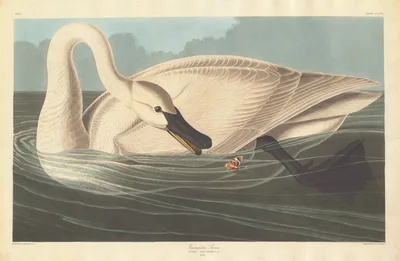
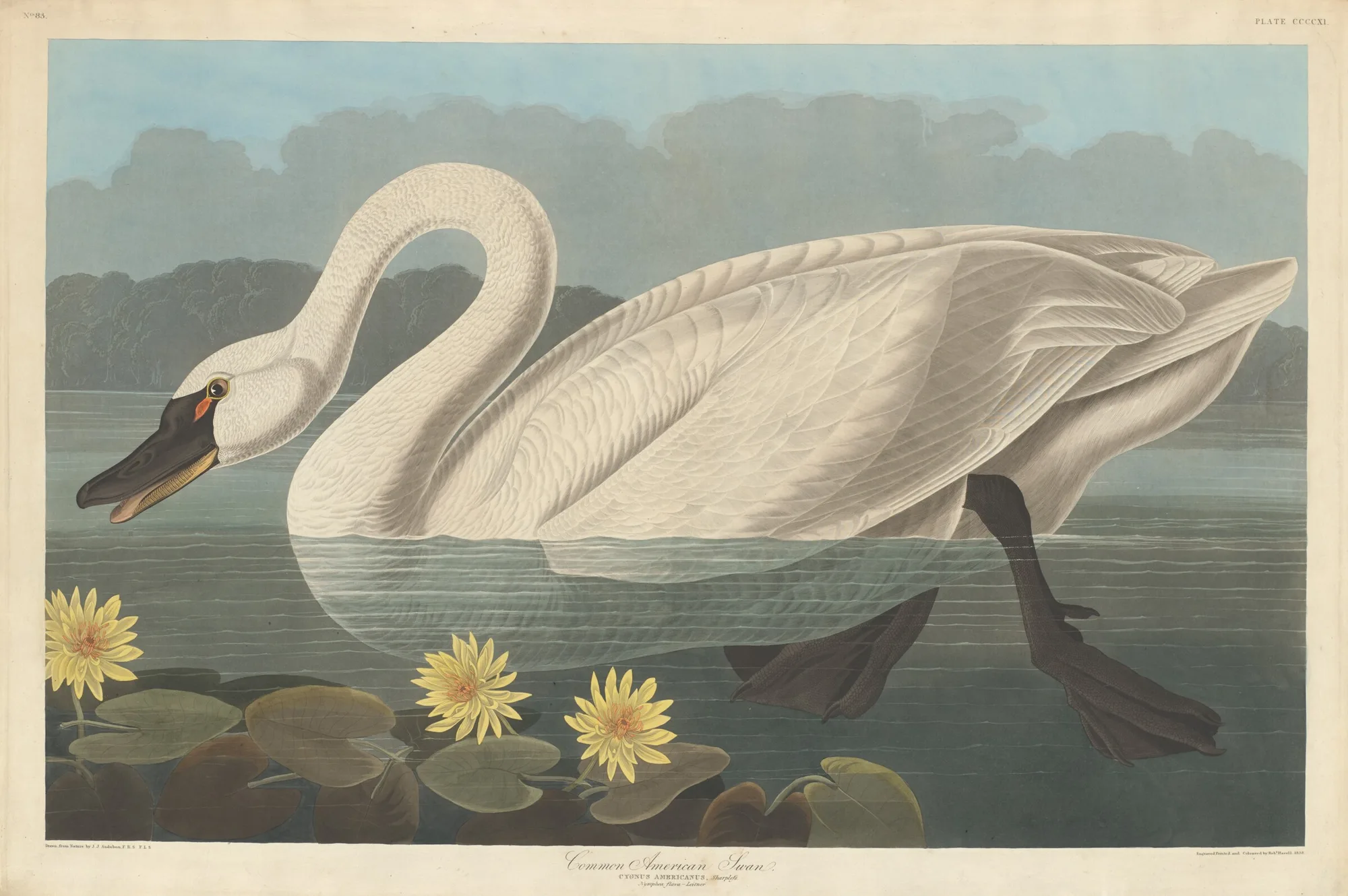
Audubon's “Common American Swan”, The Birds of America, plate CDXI
Click or press Enter to enlarge
Open the full-resolution image (5449 px, National Gallery of Art)
| Plate | 411 (CDXI) |
|---|---|
| Audubon's name | Common American Swan |
| Modern name | Tundra Swan (Whistling Swan) |
| Scientific name | Cygnus columbianus |
| Status | Least Concern |
| Engraved by | Robert Havell, after Audubon's watercolor |
| Date | 1838 |
| Medium | Hand-colored engraving and aquatint on Whatman wove paper |
| Collections | Ducks, Geese and Swans |
| This impression | National Gallery of Art, Washington, 1945.8.411; Gift of Mrs. Walter B. James |
About this plate
Plate 411 shows a single adult male of the smaller American swan, all white with a black bill. In most adults a small yellow spot shows in front of the eye. Audubon drew it as the Common American Swan, Cygnus americanus, the name given by Dr J. T. Sharpless of Philadelphia.
This is the Tundra Swan, Cygnus columbianus, known in North America for most of its history as the Whistling Swan. The scientific name comes from George Ord, who based it on the 'small swan' reported by Lewis and Clark on the Columbia River. Audubon spent much of the chapter showing that the American bird differed from the Whooper and Bewick's Swans of Europe. Bewick's Swan is now treated as the Eurasian subspecies of the Tundra Swan, so the two are the same species after all.
The Tundra Swan breeds on Arctic tundra from Alaska to Hudson Bay. Eastern birds winter mainly around Chesapeake Bay and the North Carolina sounds, and western birds in California's Central Valley. It is far more numerous than the Trumpeter Swan and is listed as Least Concern.
Audubon kept three specimens preserved in rum, and Townsend sent him another from the Columbia, where the Chinook called it Hiass-tkoop-kalakala. He noted that the swans flew in long lines forming a V, with the leader often dropping back.
In Audubon's words
When travelling to a distance they proceed at a great height, with a steady and well-sustained flight, though by no means so rapid as that of the Trumpeter Swan, this difference probably arising from the greater weight and alar extent of the latter. They usually move in long lines forming the acute angle of a baseless triangle, the leader often changing his position and falling into the rear. On several occasions I have seen seven or eight leading the long single files behind them in a kind of disorderly crowded manner, which was continued until the birds were out of sight.
John James Audubon, Ornithological Biography, vol. 5 (1839), “American Swan”. Read the full chapter.