Golden-winged Warbler and Cape May Warbler (Plate 414)
Audubon's “Golden-winged Warbler and Cape May Warbler”, The Birds of America, plate CDXIV
Click or press Enter to enlarge
Open the full-resolution image (2847 px, National Gallery of Art)
| Plate | 414 (CDXIV) |
|---|---|
| Audubon's name | Golden-winged Warbler and Cape May Warbler |
| Modern names | Golden-winged Warbler, Cape May Warbler |
| Scientific names | Vermivora chrysoptera, Setophaga tigrina |
| Status | Least Concern, Near Threatened |
| Engraved by | Robert Havell, after Audubon's watercolor |
| Date | 1838 |
| Medium | Hand-colored engraving and aquatint on Whatman wove paper |
| Collections | Songbirds |
| This impression | National Gallery of Art, Washington, 1945.8.414; Gift of Mrs. Walter B. James |
About this plate
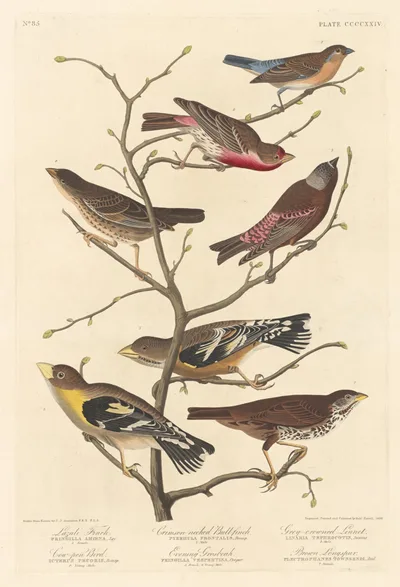
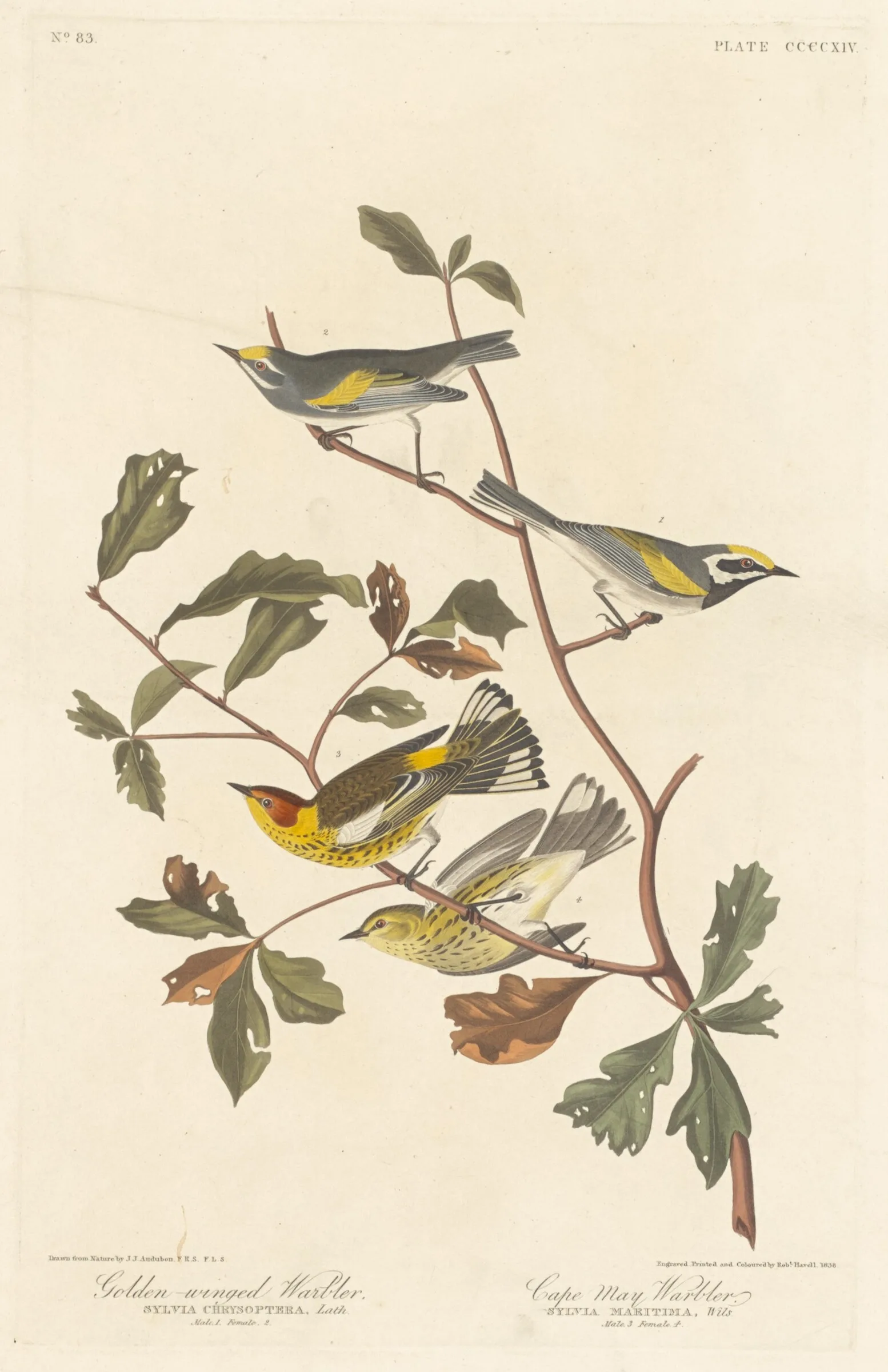
Plate 414 shows four warblers in spring plumage: a male and female Golden-winged Warbler and a male and female Cape May Warbler. The Golden-winged male has a yellow crown, yellow wing patch and black throat and mask. The Cape May male has chestnut cheeks and a tiger-striped yellow breast.
Both names are unchanged. The Golden-winged Warbler is Vermivora chrysoptera, and the Cape May Warbler is now Setophaga tigrina. In the text Audubon disputes Bonaparte and Sir William Jardine, who held that his Carbonated Warbler of the first volume was a Cape May Warbler. The Carbonated Warbler is still unidentified.
The Golden-winged Warbler breeds in young, shrubby forest openings from the Great Lakes to the Appalachians. Habitat loss and hybridization with the closely related Blue-winged Warbler have caused steep declines, and the IUCN lists it as Near Threatened. The Cape May Warbler breeds in spruce forests of Canada, where its numbers rise and fall with spruce budworm outbreaks. It is listed as Least Concern.
Audubon met the Golden-winged Warbler entering the country from Texas in April, and collected it in Kentucky, Louisiana and once in New Jersey, but never found its nest. He never saw a Cape May Warbler in the wild. He drew both sexes from specimens his friend Edward Harris shot near Moorestown, New Jersey.
Birds on this plate
- Golden-winged Warbler Vermivora chrysoptera (male and female). Near Threatened
- Cape May Warbler Setophaga tigrina (male and female). Least Concern
In Audubon's words
When it first makes its appearance in Louisiana or Kentucky, it usually resorts to the higher branches of trees, where, amid the opening leaflets and blossoms, it actively searches for its insect food, occasionally following its prey on wing to some distance, and moving by short leaps among the twigs, in the manner of Sylvia carbonata of my first volume, which, in its elongated and slender shape, it in some measure resembles; although the latter has been pointed out by the Prince of Musignano as identical with the Cape May Warbler, Sylvia maritima, in which erroneous opinion he has been supported by Sir William Jardine. I never could in the smallest degree assimilate the movements of the Golden-winged Warbler to those of the Titmice. Indeed in this respect these birds are quite different, as they are in their manner of flight, which, in the species now under consideration is elevated, swift, and irregularly undulated, until it is about to alight, when it dives toward the spot selected by it, as most Warblers are wont to do.
John James Audubon, Ornithological Biography, vol. 5 (1839), “Golden-Winged Warbler”. Read the full chapter.