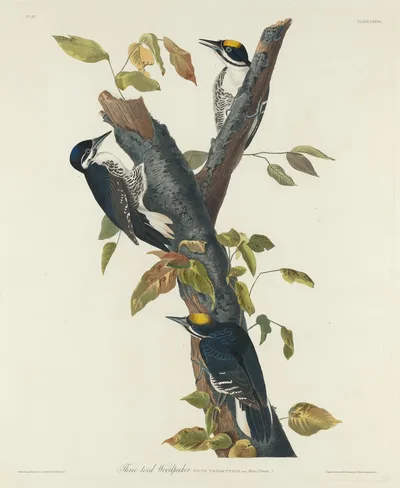
Hairy Woodpecker (four forms) and American Three-toed Woodpecker (Plate 417)
Audubon's “Maria's Woodpecker”, The Birds of America, plate CDXVII
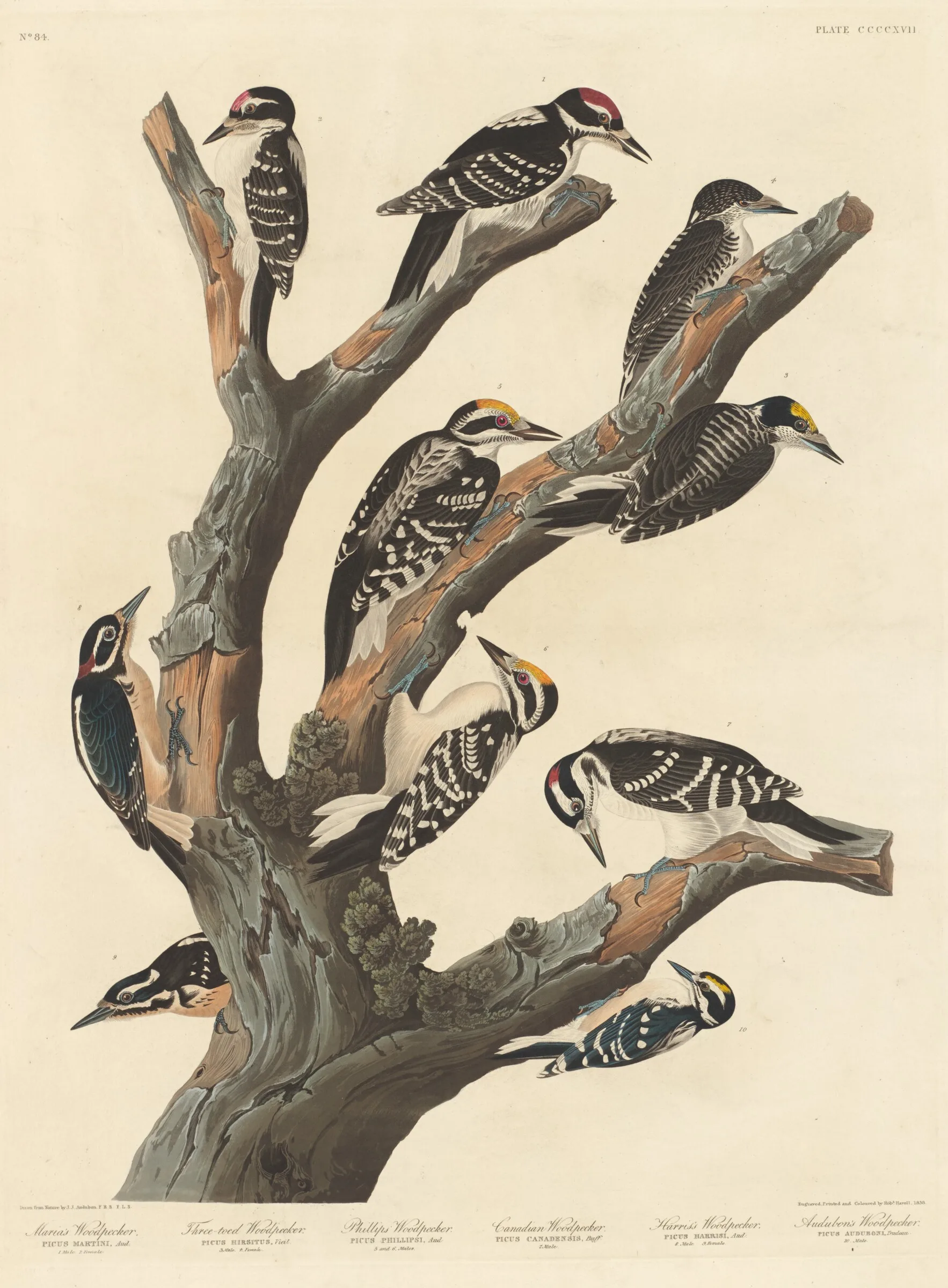
Click or press Enter to enlarge
Open the full-resolution image (4418 px, National Gallery of Art)
| Plate | 417 (CDXVII) |
|---|---|
| Audubon's name | Maria's Woodpecker |
| Modern names | Hairy Woodpecker, American Three-toed Woodpecker, Hairy Woodpecker, Hairy Woodpecker (northern form), Hairy Woodpecker (Pacific form), Audubon's Woodpecker (unidentified; probably an aberrant Hairy or Downy Woodpecker) |
| Scientific names | Dryobates villosus, Picoides dorsalis, Dryobates villosus, Dryobates villosus, Dryobates villosus harrisi, Picus auduboni (unresolved) |
| Status | Least Concern |
| Engraved by | Robert Havell, after Audubon's watercolor |
| Date | 1838 |
| Medium | Hand-colored engraving and aquatint on Whatman wove paper |
| Collections | Woodpeckers |
| This impression | National Gallery of Art, Washington, 1945.8.417; Gift of Mrs. Walter B. James |
About this plate
Plate 417 holds ten small woodpeckers, all black and white. Audubon named four of the six birds as new species. Maria's Woodpecker, a male and female from near Toronto, was named for Maria Martin of Charleston, who painted plants and backgrounds for many of his plates. Phillips' Woodpecker, a single male from Massachusetts sent by Nuttall, is shown in two figures and honours Benjamin Phillips, a friend of the Audubon family. Harris's Woodpecker, a pair from the Columbia River, honours Edward Harris.
None of these new names held up. Maria's, Phillips', Canadian and Harris's Woodpeckers are all Hairy Woodpeckers, Dryobates villosus, a species that varies in size and in the amount of white spotting across its range. Harris's name survives as the subspecies harrisi of the dark, buff-tinged Pacific coast birds. The Common Three-toed Woodpecker, drawn from Zoological Society specimens, is the American Three-toed Woodpecker. Audubon's Woodpecker was named by James Trudeau from one bird shot near New Orleans in April 1837. It has never been matched to a known species and was probably an unusual Hairy or Downy Woodpecker.
The Hairy Woodpecker lives in forests across North America and is listed as Least Concern. The American Three-toed Woodpecker lives in northern and mountain conifer forests and gathers where bark beetles have killed trees.
Audubon met the Canadian Woodpecker on a trip through Maine with his wife and sons. In the stomachs he examined he found large beetles and pieces of lichen.
Birds on this plate
- Hairy Woodpecker Dryobates villosus: Audubon's Maria's Woodpecker (male and female). Least Concern
- American Three-toed Woodpecker Picoides dorsalis: Audubon's Three-toed Woodpecker (male and female). Least Concern
- Hairy Woodpecker Dryobates villosus: Audubon's Phillips' Woodpecker (male, two figures). Least Concern
- Hairy Woodpecker (northern form) Dryobates villosus: Audubon's Canadian Woodpecker (male). Least Concern
- Hairy Woodpecker (Pacific form) Dryobates villosus harrisi: Audubon's Harris's Woodpecker (male and female). Least Concern
- Audubon's Woodpecker (unidentified; probably an aberrant Hairy or Downy Woodpecker) Picus auduboni (unresolved): Audubon's Audubon's Woodpecker (adult). Unknown
In Audubon's words
This well-marked species, which has not hitherto been described or figured, was procured in the neighbourhood of Toronto in Upper Canada, by a gentleman who presented me with two specimens of it, a male and a female, but who has requested me not to mention his name. I am informed by this close observer of nature that its habits are as nearly as possible the same as those of the Hairy Woodpecker, Picus villosus, of which you have already seen an account, and that its eggs, which rarely exceed six in number, are pure white and translucent. In honouring this species with the name of Miss Maria Martin, I cannot refrain from intimating the respect, admiration, and sincere friendship which I feel towards her, and stating that, independently of her other accomplishments, and our mutual goodwill, I feel bound to make some ornithological acknowledgment for the aid she has on several occasions afforded me in embellishing my drawings of birds, by adding to them beautiful and correct representations of plants and flowers.
John James Audubon, Ornithological Biography, vol. 5 (1839), “Maria's Woodpecker”. Read the full chapter.