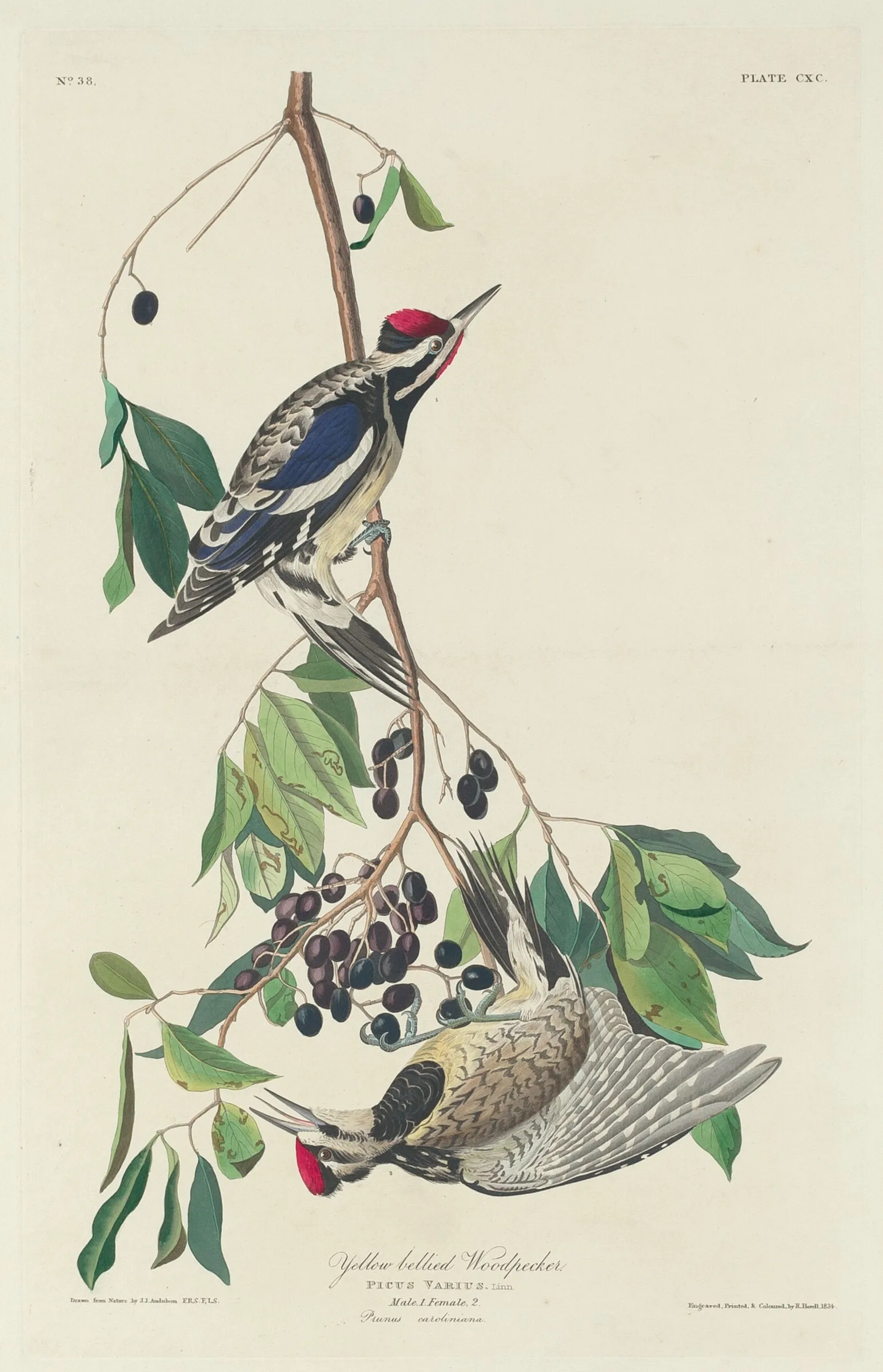
Yellow-bellied Sapsucker (Plate 190)
Audubon's “Yellow-bellied Woodpecker”, The Birds of America, plate CXC
Click or press Enter to enlarge
Open the full-resolution image (2442 px, National Gallery of Art)
| Plate | 190 (CXC) |
|---|---|
| Audubon's name | Yellow-bellied Woodpecker |
| Modern name | Yellow-bellied Sapsucker |
| Scientific name | Sphyrapicus varius |
| Status | Least Concern |
| Engraved by | Robert Havell, after Audubon's watercolor |
| Date | 1834 |
| Medium | Hand-colored engraving and aquatint on Whatman wove paper |
| Plants and setting | Wild almond |
| Collections | Woodpeckers |
| This impression | National Gallery of Art, Washington, 1945.8.190; Gift of Mrs. Walter B. James |
About this plate
Plate 190 shows a male and female Yellow-bellied Sapsucker on a fruiting branch Audubon called the wild almond. The male has a red crown and red throat framed in black and white. The female has a red crown and a white throat. Both show the long white wing stripe and the pale yellow wash on the belly that gave Audubon's name.
Audubon called it the Yellow-bellied Woodpecker, Picus varius. It is now the Yellow-bellied Sapsucker, Sphyrapicus varius. Its best-known habit is not in his chapter. Sapsuckers drill neat rows of small wells in tree bark and return to drink the sap and eat insects caught in it. Hummingbirds and other birds feed at the same wells. Audubon listed its food as wood-boring grubs, beetles, grapes and berries.
The species breeds in young mixed and deciduous forest across Canada, the northeastern United States and the Appalachians, and winters from the southern states to Central America and the Caribbean. It is listed as Least Concern.
Audubon wrote that it reached Louisiana and the other southern states in early October and left before April. He described a shy bird of dense foliage in summer, nesting in a hole dug by both sexes high in a sound trunk, under a branch and on the south side, with four to six white eggs laid on wood chips. He said he never saw one on the ground, and that it often hung upside down to eat grapes and berries.
In Audubon's words
The Yellow-bellied Woodpecker prefers the interior of the forest during spring and summer, seldom shewing itself near the habitations of man at those seasons. It is a sly and suspicious bird, spending most of its time in trees which have close branches and dense foliage. It generally bores its nest at a considerable height, and usually in the trunk of an undecayed tree, immediately beneath a large branch, and on its southern side. The hole is worked out by the male as well as the female, in the manner followed by other species, and to the depth of from fifteen to twenty-four inches. The aperture is just large enough to admit the birds, but the hole widens gradually towards the bottom, where it is large and roomy. The eggs, which are from four to six, and pure white, with a slight blush, are deposited on the chips without any nest.
John James Audubon, Ornithological Biography, vol. 2 (1834), “The Yellow-bellied Woodpecker”. Read the full chapter.