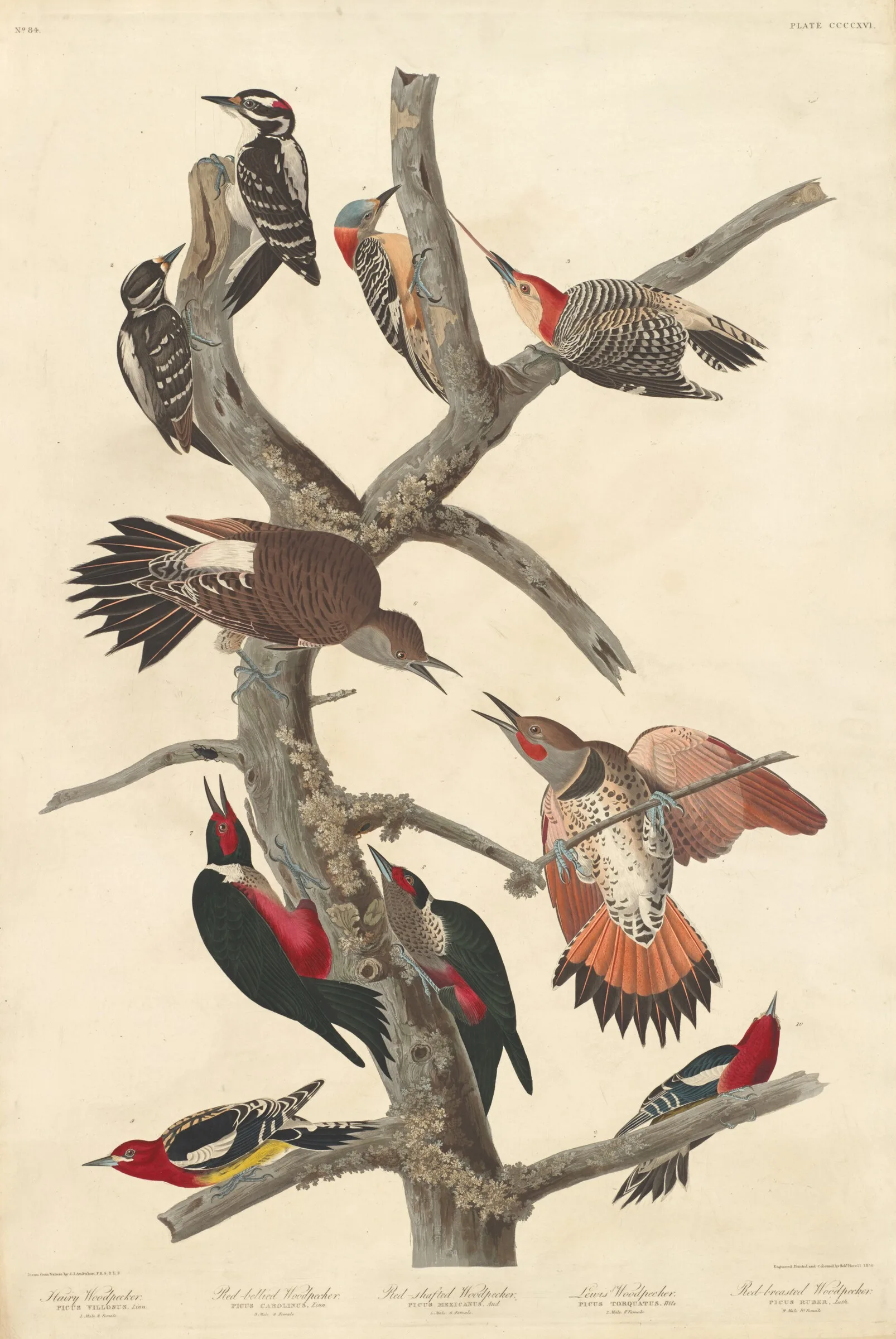
Hairy, Red-bellied, Lewis's Woodpeckers, Red-shafted Flicker and Red-breasted Sapsucker (Plate 416)
Audubon's “Hairy Woodpecker”, The Birds of America, plate CDXVI
Click or press Enter to enlarge
Open the full-resolution image (5463 px, National Gallery of Art)
| Plate | 416 (CDXVI) |
|---|---|
| Audubon's name | Hairy Woodpecker |
| Modern names | Hairy Woodpecker, Red-bellied Woodpecker, Northern Flicker (Red-shafted), Lewis's Woodpecker, Red-breasted Sapsucker |
| Scientific names | Dryobates villosus, Melanerpes carolinus, Colaptes auratus cafer, Melanerpes lewis, Sphyrapicus ruber |
| Status | Least Concern |
| Engraved by | Robert Havell, after Audubon's watercolor |
| Date | 1838 |
| Medium | Hand-colored engraving and aquatint on Whatman wove paper |
| Collections | Woodpeckers |
| This impression | National Gallery of Art, Washington, 1945.8.416; Gift of Mrs. Walter B. James |
About this plate
Plate 416 crowds a male and a female of five woodpeckers onto one sheet. Two are eastern birds Audubon knew well, the Hairy and the Red-bellied Woodpecker. The other three are western species from skins collected by Townsend and Nuttall: the Red-shafted Woodpecker, Lewis's Woodpecker and the Red-breasted Woodpecker. Audubon believed his female Hairy Woodpecker was the first to be figured.
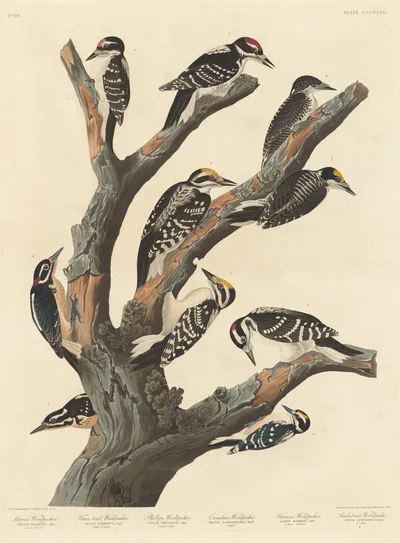
The Red-shafted Woodpecker is the western form of the Northern Flicker, with salmon-red rather than yellow under the wings and tail. It was once treated as a separate species. The Red-breasted Woodpecker is the Red-breasted Sapsucker. Lewis's Woodpecker was discovered on the Lewis and Clark expedition, and Wilson published the first figure of it, an immature male. The Hairy Woodpecker is now placed in Dryobates. In the text Audubon separates it from a larger northern bird he called the Canadian Woodpecker, shown on plate 417.
Lewis's Woodpecker is unusual: dark glossy green with a pink belly, it catches flying insects like a flycatcher and flies with slow, crow-like wingbeats. The sapsucker drills rows of small holes in bark and feeds on the sap. All five species are listed as Least Concern.
Nuttall described Lewis's Woodpeckers feeding young in the pine woods of Bear River in July and flocking like crows on the Willamette in August. Audubon found the Hairy Woodpecker even in the salt marshes at the mouths of the Mississippi.
Birds on this plate
- Hairy Woodpecker Dryobates villosus (male and female). Least Concern
- Red-bellied Woodpecker Melanerpes carolinus (male and female). Least Concern
- Northern Flicker (Red-shafted) Colaptes auratus cafer: Audubon's Red-shafted Woodpecker (male and female). Least Concern
- Lewis's Woodpecker Melanerpes lewis: Audubon's Lewis' Woodpecker (male and female). Least Concern
- Red-breasted Sapsucker Sphyrapicus ruber: Audubon's Red-breasted Woodpecker (male and female). Least Concern
In Audubon's words
Lively, noisy, and careless of man, the Hairy Woodpecker is found at all seasons in the orchards, among the trees of our cities, along the borders of plantations, on the fences, or on the trees left in the fields, as well as in the densest parts of the forests. Nay, Reader, I have found this species, when in company with my friend Harris and my youngest son, in the very midst of vast salt-marshes, about the mouths of the Mississippi, where here and there a straggling willow or cotton-tree bush occurred, as gay, busy, noisy, and contented, as if it had been in the midst of the woods.
John James Audubon, Ornithological Biography, vol. 5 (1839), “Hairy Woodpecker”. Read the full chapter.