American Three-toed Woodpecker (Plate 132)
Audubon's “Three-Toed Woodpecker”, The Birds of America, plate CXXXII
Click or press Enter to enlarge
Open the full-resolution image (3023 px, National Gallery of Art)
| Plate | 132 (CXXXII) |
|---|---|
| Audubon's name | Three-Toed Woodpecker |
| Modern name | American Three-toed Woodpecker |
| Scientific name | Picoides dorsalis |
| Status | Least Concern |
| Engraved by | Robert Havell, after Audubon's watercolor |
| Date | 1832 |
| Medium | Hand-colored engraving and aquatint on Whatman wove paper |
| Collections | Woodpeckers |
| This impression | National Gallery of Art, Washington, 1945.8.132; Gift of Mrs. Walter B. James |
About this plate
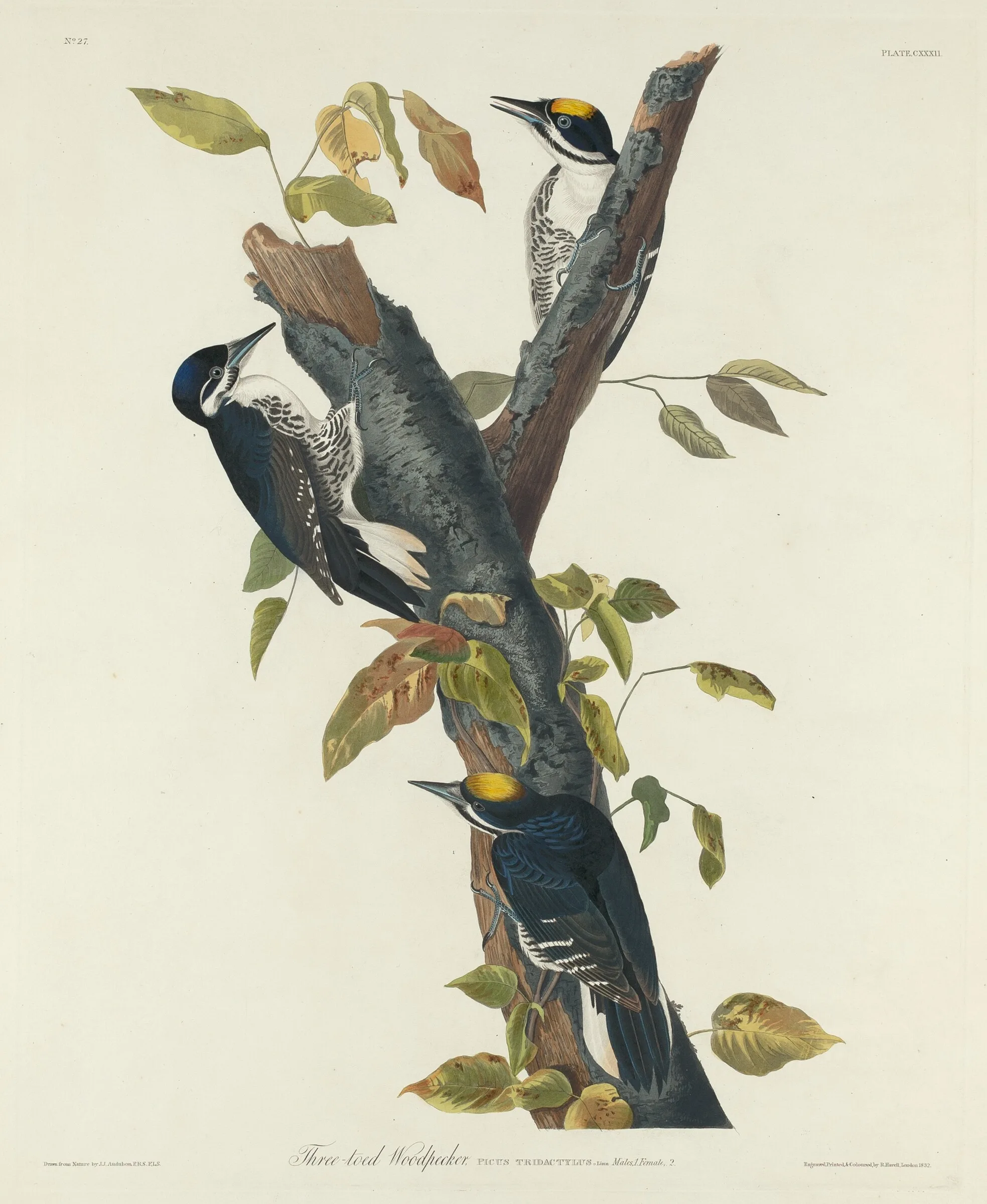
Plate 132 shows a male and a female three-toed woodpecker. Audubon noted that the female lacks the male's yellow crown patch and has a more obvious white line behind the eye. As the name says, the birds have only three toes, two forward and one back.
Audubon used Linnaeus's name Picus tridactylus, which then covered the three-toed woodpeckers of both Eurasia and North America. In 2003 the American birds were split as a separate species, the American Three-toed Woodpecker, Picoides dorsalis. The similar Black-backed Woodpecker of the same forests also has three toes.
The American Three-toed Woodpecker lives in spruce and other conifer forests across Canada, Alaska and the Rocky Mountains, with a few in the far Northeast. It flakes bark from dead and dying trees to reach bark beetles and gathers after fires and beetle outbreaks. It is listed as Least Concern.
Audubon wrote that the bird lived in northern Massachusetts and the forested parts of Maine, that he saw a few in the Great Pine Forest of Pennsylvania, and that John Bachman had seen four near Niagara Falls. He described it as restless, moving through the tops of tall trees and calling with cries like a small animal in pain.
In Audubon's words
It is a restlessly active bird, spending its time generally on the topmost branches of the tallest trees, without, however, confining itself to pines. Although it cannot be called shy, its habitual restlessness renders it difficult of approach. Its movements resemble those of the Red-cockaded Woodpecker, but it is still more petulant than that bird. Like it, it will alight, climb along a branch, seek for insects there, and in a very few moments remove to another part of the same tree, or to another tree at more or less distance, thus spending the day in rambling over a large extent of ground. Its cries also somewhat resemble those of the species above mentioned, but are louder and more shrill, like those of some small quadruped suffering great pain.
John James Audubon, Ornithological Biography, vol. 2 (1834), “The Three-toed Woodpecker”. Read the full chapter.