Red-cockaded Woodpecker (Plate 389)
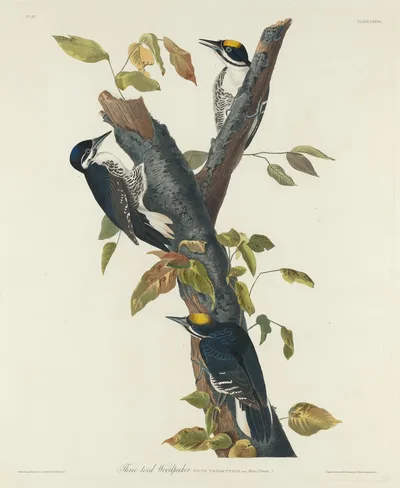
Audubon's “Red-cockaded Woodpecker”, The Birds of America, plate CCCLXXXIX
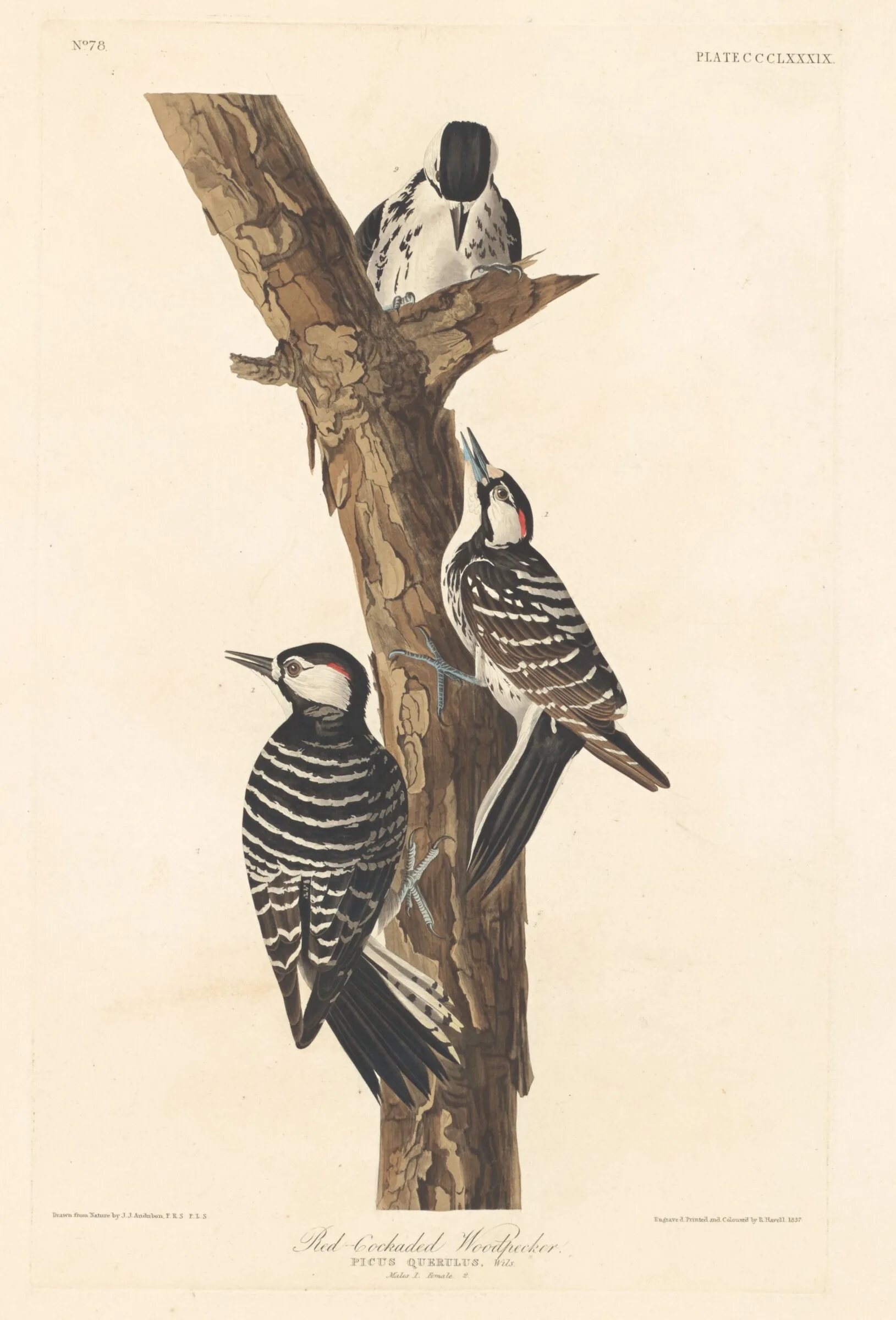
Click or press Enter to enlarge
Open the full-resolution image (2857 px, National Gallery of Art)
| Plate | 389 (CCCLXXXIX) |
|---|---|
| Audubon's name | Red-cockaded Woodpecker |
| Modern name | Red-cockaded Woodpecker |
| Scientific name | Dryobates borealis |
| Status | Near Threatened |
| Engraved by | Robert Havell, after Audubon's watercolor |
| Date | 1837 |
| Medium | Hand-colored engraving and aquatint on Whatman wove paper |
| Collections | Woodpeckers |
| This impression | National Gallery of Art, Washington, 1945.8.389; Gift of Mrs. Walter B. James |
About this plate
Plate 389 shows the male and female Red-cockaded Woodpecker. The red cockade that names the bird is only a few red feathers behind the male's eye and is hard to see in life. Both sexes have a black cap, a large white cheek patch and a barred black and white back.
Alexander Wilson first described the species as Picus querulus. It has since been moved between several genera and is now placed in Dryobates as Dryobates borealis, along with the Downy and Hairy Woodpeckers. Audubon compared its quick movements to those of the three-toed woodpeckers.
This is the only North American woodpecker that digs its nest and roost holes in living pines, usually old longleaf pines softened by heart-rot fungus. Each family group keeps a cluster of these cavities and coats the trunk around them with sticky resin that deters rat snakes. Clearing of the old pine forests of the Southeast reduced it to scattered populations. It was among the first species listed as endangered in the United States, and active management has since brought gains. The IUCN lists it as Near Threatened.
Audubon wrote that pine barrens suited it best and that it was most numerous in Florida, Georgia and South Carolina. Near Bayou Sara in Louisiana he wounded two males and carried them home in his hat. One later escaped from a cage by chipping its way out within minutes.
In Audubon's words
Near Bayou Sara in Louisiana, I once slightly wounded two males, which I put into my hat in order to carry them home. The first, on being brought to the ground, was easily secured, but the case was different with the other, for it at once hopped off toward the nearest tree, crying loudly all the while, and on reaching it ascended as if unhurt. However I obtained it by accidentally knocking off the bark with a clod of earth. It defended itself courageously, and pecked at my fingers with so much vigour that I was obliged to let it drop several times out of my hand. Confined in my hat, they remained still and sullen, and when I looked at them they both hid their heads, as if ashamed of their situation.
John James Audubon, Ornithological Biography, vol. 5 (1839), “Red-Cockaded Woodpecker”. Read the full chapter.