Hermit Thrush, Townsend's Solitaire and Canada Jay (Plate 419)
Audubon's “Little Tawny Thrush”, The Birds of America, plate CDXIX
Click or press Enter to enlarge
Open the full-resolution image (2853 px, National Gallery of Art)
| Plate | 419 (CDXIX) |
|---|---|
| Audubon's name | Little Tawny Thrush |
| Modern names | Hermit Thrush, Townsend's Solitaire, Canada Jay |
| Scientific names | Catharus guttatus, Myadestes townsendi, Perisoreus canadensis |
| Status | Least Concern |
| Engraved by | Robert Havell, after Audubon's watercolor |
| Date | 1838 |
| Medium | Hand-colored engraving and aquatint on Whatman wove paper |
| Collections | Songbirds |
| This impression | National Gallery of Art, Washington, 1945.8.419; Gift of Mrs. Walter B. James |
About this plate
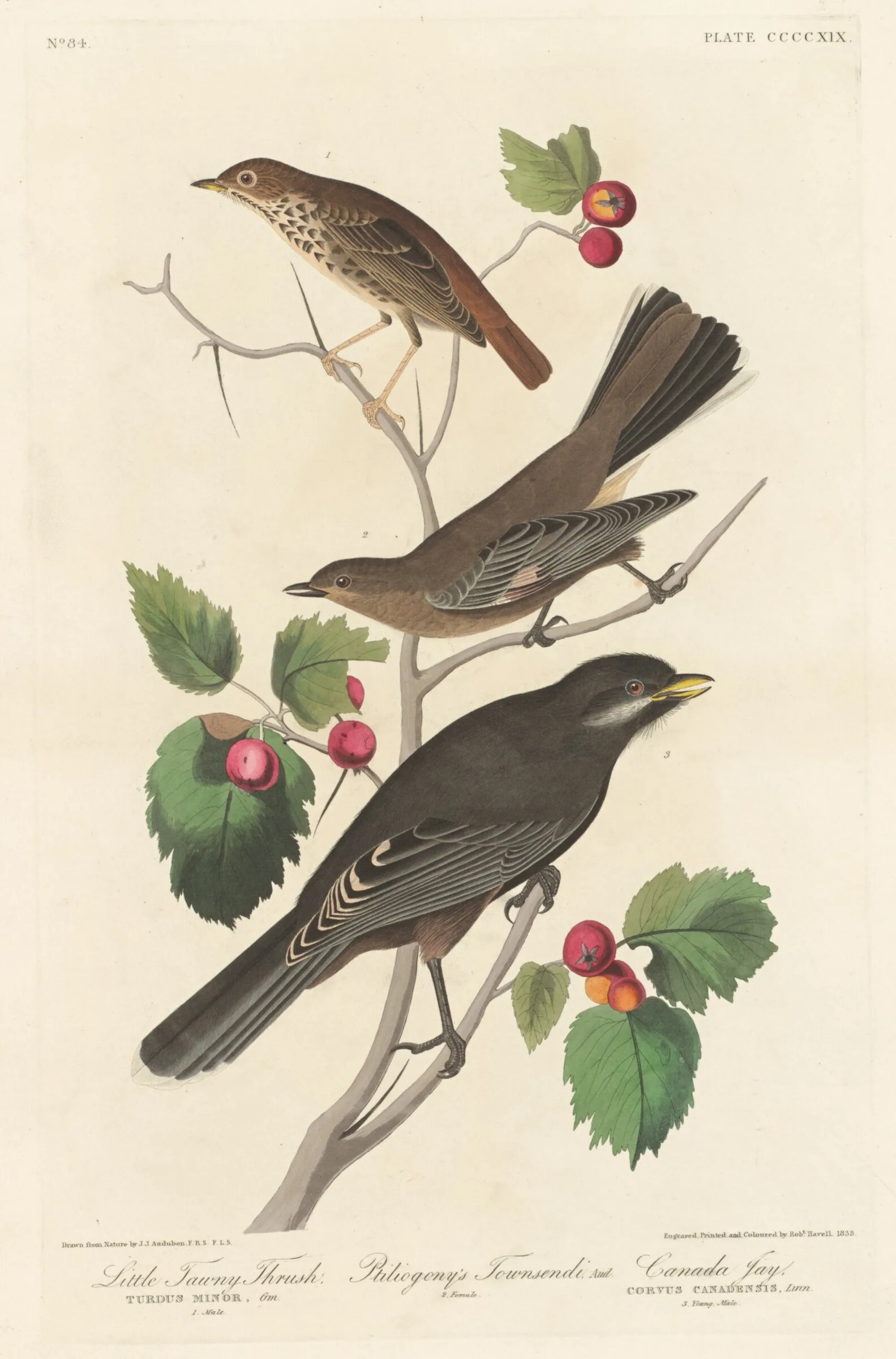
Plate 419 shows three birds: a small spotted thrush engraved as the Little Tawny Thrush, a female Townsend's Solitaire, and a young Canada Jay in its sooty first plumage.
Audubon engraved the thrush as Turdus minor but changed his mind in the text and named it a new species, the Dwarf Thrush, Turdus nanus. It is the Hermit Thrush, Catharus guttatus, and nanus survives as the name of one of its western subspecies. Townsend's Ptilogonys was a female shot near the Columbia River by Townsend, the only one Audubon ever saw, and he named it for its collector. It is Townsend's Solitaire, a thrush. Audubon figured the young Canada Jay because Swainson had described a juvenile as a new species, the Short-billed Jay. Audubon had seen such young birds fed by Canada Jay parents.
The Hermit Thrush breeds in forests across Canada and the western mountains and is known for its flute-like song. Townsend's Solitaire nests on banks in western mountain forests and defends juniper berries through the winter. The Canada Jay, renamed Gray Jay for decades, had its old name restored by the AOS in 2018. It stores food in bark crevices with sticky saliva and nests in late winter. All are listed as Least Concern.
The jay chapter quotes Richardson on the 'Whisky-Jack' coming boldly to travellers' winter camps in the Fur Countries for scraps of frozen fish.
Birds on this plate
- Hermit Thrush Catharus guttatus: Audubon's Little Tawny Thrush (Dwarf Thrush) (male). Least Concern
- Townsend's Solitaire Myadestes townsendi: Audubon's Ptiliogony's Townsendi (female). Least Concern
- Canada Jay Perisoreus canadensis (young). Least Concern
In Audubon's words
Scarcely has the winter traveller in the Fur Countries chosen a suitable place of repose in the forest, cleared away the snow, lighted his fire, and prepared his bivouac, when the Whisky-Jack pays him a visit, and boldly descends into the circle to pick up any crumbs of frozen fish or morsels of pemmican that have escaped the mouths of the hungry and weary sledge-dogs. This confidence compensates for the want of many of those qualities which endear others of the feathered tribes to man. There is nothing pleasing in the voice, plumage, form, or attitudes of the Whisky-Jack; but it is the only inhabitant of those silent and pathless forests which, trusting in the generosity of man, fearlessly approaches him; and its visits were, therefore, always hailed by us with satisfaction.
John James Audubon, Ornithological Biography, vol. 5 (1839), “Canada Jay”. Read the full chapter.