Brown Creeper and Pygmy Nuthatch (Plate 415)
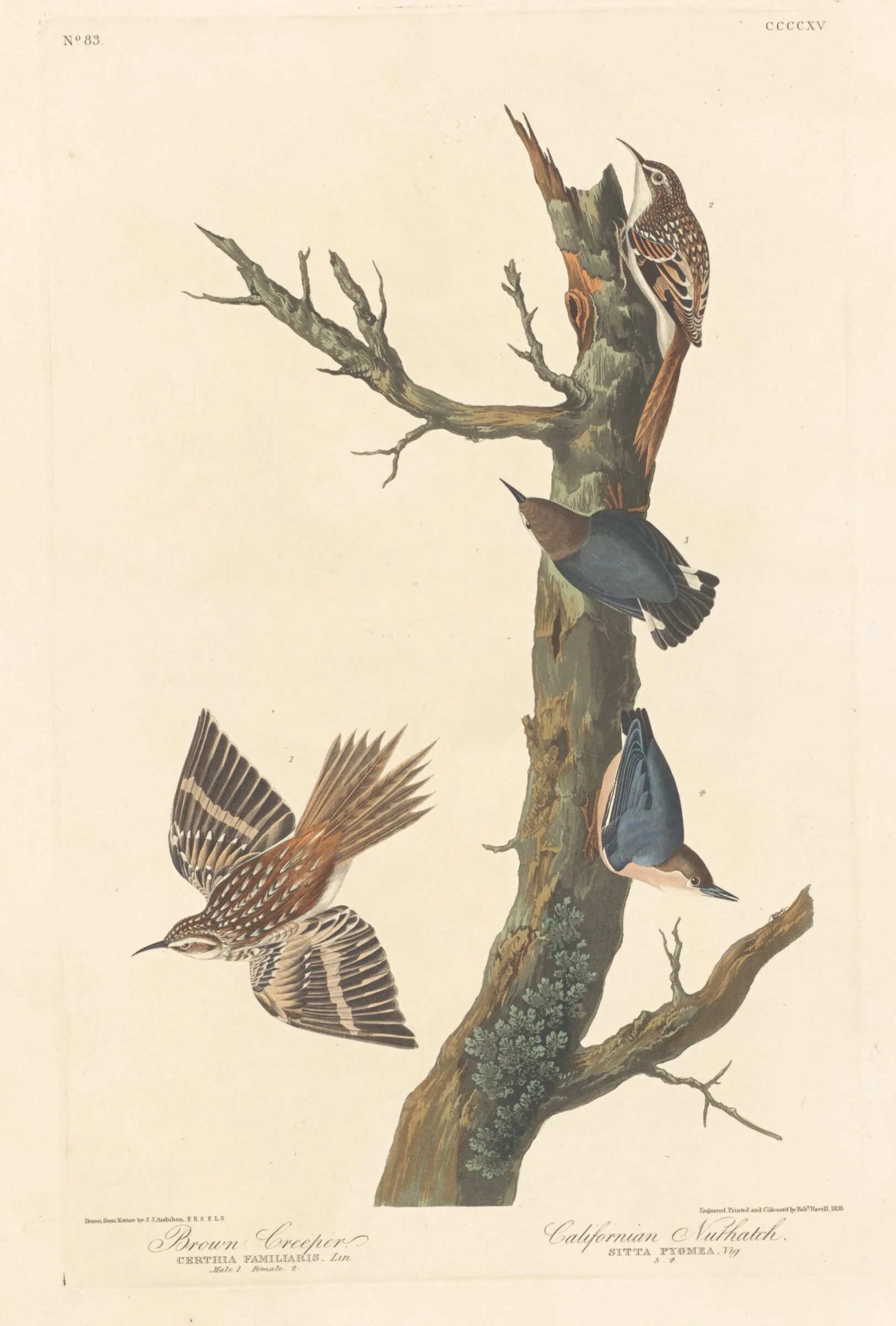
Audubon's “Brown Creeper and Californian Nuthatch”, The Birds of America, plate CDXV
Click or press Enter to enlarge
Open the full-resolution image (2860 px, National Gallery of Art)
| Plate | 415 (CDXV) |
|---|---|
| Audubon's name | Brown Creeper and Californian Nuthatch |
| Modern names | Brown Creeper, Pygmy Nuthatch |
| Scientific names | Certhia americana, Sitta pygmaea |
| Status | Least Concern |
| Engraved by | Robert Havell, after Audubon's watercolor |
| Date | 1838 |
| Medium | Hand-colored engraving and aquatint on Whatman wove paper |
| Collections | Songbirds |
| This impression | National Gallery of Art, Washington, 1945.8.415; Gift of Mrs. Walter B. James |
About this plate
Plate 415 shows a male and female Brown Creeper and two figures of a small grey nuthatch. Audubon drew the male creeper on the wing so that it could be compared with the European Treecreeper. He drew both nuthatch figures from a single specimen lent by the Zoological Society of London, collected in Upper California on Captain Frederick Beechey's voyage. Its sex was unknown.
Audubon was sure the American creeper was the same species as the European Certhia familiaris, having compared fresh birds shot near Edinburgh with American skins. The two are now treated as separate species, and the American bird is Certhia americana. The Californian Nuthatch is the Pygmy Nuthatch, Sitta pygmaea, described by Nicholas Vigors.
The Brown Creeper breeds in mature forests across much of North America. It spirals up tree trunks probing the bark, then flies down to the base of the next tree, and it tucks its hammock-like nest behind loose bark. The Pygmy Nuthatch lives in western pine forests, especially ponderosa pine. It travels in noisy flocks, and in winter many birds roost huddled together in one cavity. Both are listed as Least Concern.
Audubon met the creeper in every state he visited except eastern and northern Florida. He saw it on pines in the Carolinas, maples in Maine and hickories and oaks in Kentucky.
Birds on this plate
- Brown Creeper Certhia americana (male and female). Least Concern
- Pygmy Nuthatch Sitta pygmaea: Audubon's Californian Nuthatch (two figures of one adult). Least Concern
In Audubon's words
This bird alights on trees of all kinds, in the Carolinas on pines, in Maine on maples, in Kentucky on hickories, oaks, or ash-trees; and as, from the time when it is first able to fly, it is one of the most constant roamers of the forest, you may meet with it in almost any part of the woods. The taller trees, however, are generally preferred by it, perhaps on account of its reluctance to fly from one tree to another at a distance. It seldom leaves a tree without searching all its crannies, from near the roots to the tops of the larger branches, which it does with incomparable assiduity and care, yet by movements so rapid that a person unacquainted with it might be inclined to think that it runs up the trunk and branches, directly or spirally, above or beneath the latter, without any other intention than that of reaching the end of its journey as quickly as possible.
John James Audubon, Ornithological Biography, vol. 5 (1839), “Brown Creeper”. Read the full chapter.