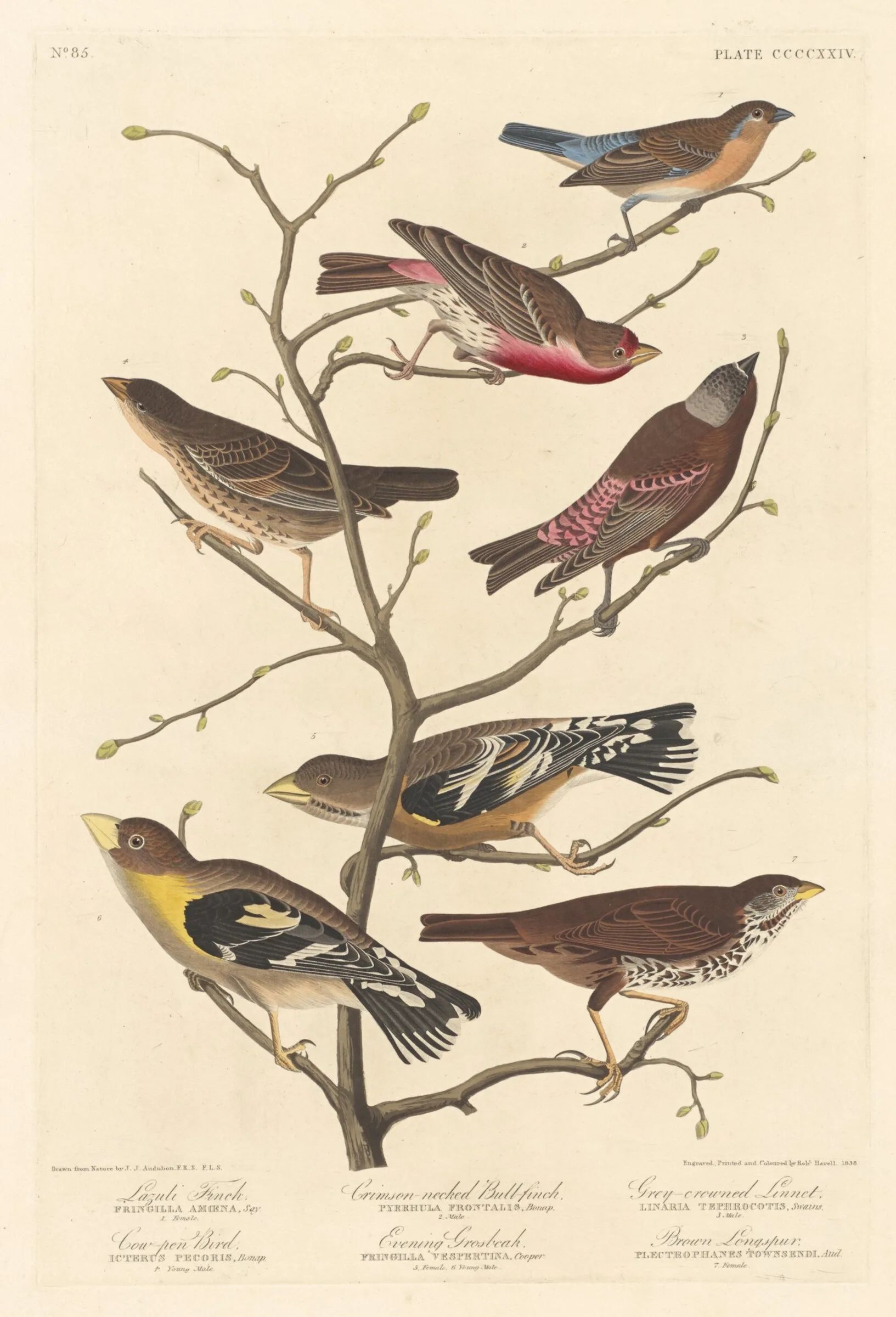
Lazuli Bunting, House Finch, Gray-crowned Rosy-Finch, Cowbird, Evening Grosbeak and Fox Sparrow (Plate 424)
Audubon's “Lazuli Finch”, The Birds of America, plate CDXXIV
Click or press Enter to enlarge
Open the full-resolution image (3007 px, National Gallery of Art)
| Plate | 424 (CDXXIV) |
|---|---|
| Audubon's name | Lazuli Finch |
| Modern names | Lazuli Bunting, House Finch, Gray-crowned Rosy-Finch, Brown-headed Cowbird, Evening Grosbeak, Fox Sparrow (Sooty) |
| Scientific names | Passerina amoena, Haemorhous mexicanus, Leucosticte tephrocotis, Molothrus ater, Coccothraustes vespertinus, Passerella iliaca |
| Status | Least Concern, Vulnerable |
| Engraved by | Robert Havell, after Audubon's watercolor |
| Date | 1838 |
| Medium | Hand-colored engraving and aquatint on Whatman wove paper |
| Collections | Songbirds |
| This impression | National Gallery of Art, Washington, 1945.8.424; Gift of Mrs. Walter B. James |
About this plate
Plate 424 gathers seven figures of six species: a female Lazuli Bunting, a male Crimson-necked Finch, a male Grey-crowned Linnet, a young Cow-pen Bird, a female and young male Evening Grosbeak, and a female Townsend's Finch. Most are additions to birds already figured. The Lazuli Bunting female goes with the male on plate 398, and the Evening Grosbeaks with the adult male of the fourth volume.
The Crimson-necked Finch is the House Finch, drawn from a specimen John Gould said came from California. The Grey-crowned Linnet is the Gray-crowned Rosy-Finch, drawn from Richardson's single specimen taken on the Saskatchewan in May 1827. Townsend's Finch, engraved as the Brown Longspur, is a dark western Fox Sparrow, shot on the Columbia on 15 February 1836. The young Cow-pen Bird was Nuttall's 'Ambiguous Sparrow', which Audubon recognized as a fledgling Brown-headed Cowbird. He figured it to prevent further mistakes.
The House Finch was confined to the West until caged birds released on Long Island in the 1940s spread across the East. The Gray-crowned Rosy-Finch breeds on alpine cliffs and snowfields. The Evening Grosbeak has declined steeply since the 1970s and is listed as Vulnerable. The other species are listed as Least Concern.
Thomas Brewer wrote to Audubon of cowbirds roosting by tens of thousands in the reeds of Fresh Pond near Boston.
Birds on this plate
- Lazuli Bunting Passerina amoena: Audubon's Lazuli Finch (female). Least Concern
- House Finch Haemorhous mexicanus: Audubon's Crimson-necked Bull-Finch (male). Least Concern
- Gray-crowned Rosy-Finch Leucosticte tephrocotis: Audubon's Gray-crowned Linnet (male). Least Concern
- Brown-headed Cowbird Molothrus ater: Audubon's Cow-pen Bird (young). Least Concern
- Evening Grosbeak Coccothraustes vespertinus (female and young male). Vulnerable
- Fox Sparrow (Sooty) Passerella iliaca: Audubon's Brown Longspur (Townsend's Finch) (female). Least Concern
In Audubon's words
The bird from which I made the present figure was sent to me by my friend Thomas Nuttall, Esq., through Dr Trudeau. It is the same as that described by the former gentleman under the name of "Ambiguous Sparrow, Fringilla ambigua," at p. 485 of his Manual of the Ornithology of the United States and of Canada. On inspecting it, however, I at once felt convinced that it was nothing else than a young Cow-pen Bird, scarcely fledged, it having been found "in the early part of the summer of 1830." With the view, therefore, of preventing further mistakes I have thought it well to figure it.
John James Audubon, Ornithological Biography, vol. 5 (1839), “Cow-Pen Bird”. Read the full chapter.



