Red-winged Blackbird (Plate 420)
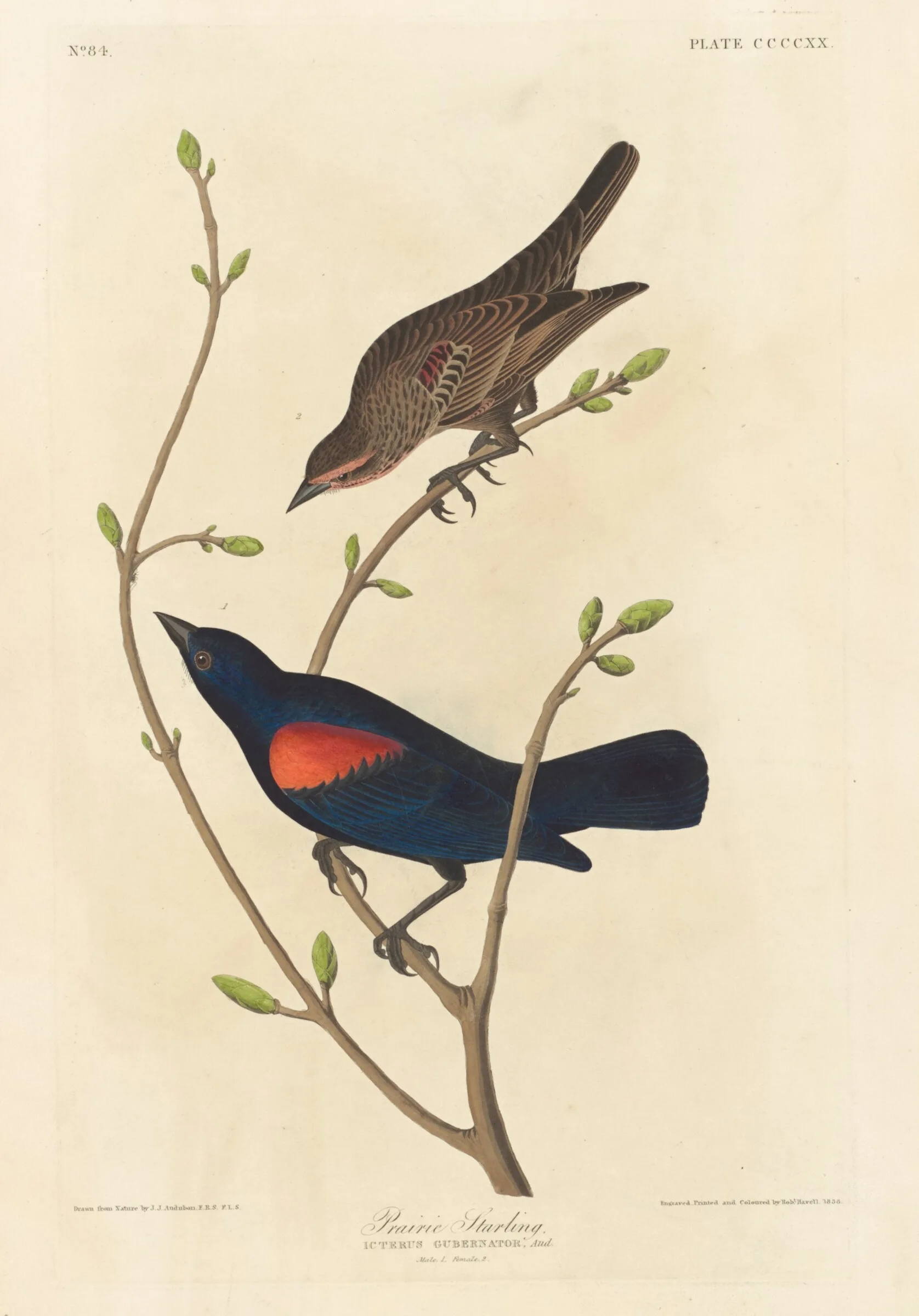
Audubon's “Prairie Starling”, The Birds of America, plate CDXX
Click or press Enter to enlarge
Open the full-resolution image (2882 px, National Gallery of Art)
| Plate | 420 (CDXX) |
|---|---|
| Audubon's name | Prairie Starling |
| Modern name | Red-winged Blackbird |
| Scientific name | Agelaius phoeniceus |
| Status | Least Concern |
| Engraved by | Robert Havell, after Audubon's watercolor |
| Date | 1838 |
| Medium | Hand-colored engraving and aquatint on Whatman wove paper |
| Collections | Songbirds |
| This impression | National Gallery of Art, Washington, 1945.8.420; Gift of Mrs. Walter B. James |
About this plate
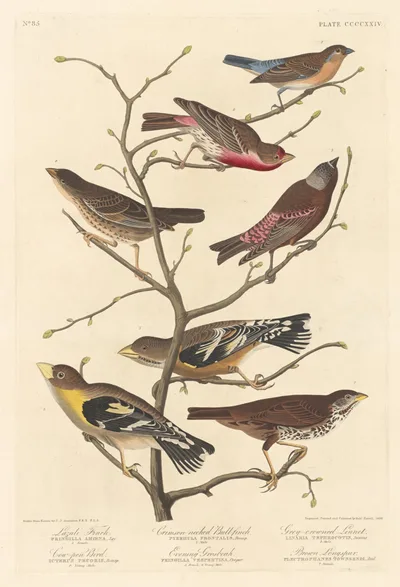
Plate 420 shows a glossy black blackbird with scarlet shoulder patches. Audubon engraved it as the Prairie Starling, but in the text he called it the Crimson-winged Troopial, Icterus gubernator. He drew it from two specimens that Townsend collected on the Columbia River.
The name Agelaius gubernator was given by Johann Wagler to a Mexican blackbird. It is now treated as a subspecies of the Red-winged Blackbird, Agelaius phoeniceus. Audubon thought his Columbia birds matched specimens he had seen from Mexico, and guessed that the species wintered there. The Red-winged Blackbird varies across the West. Some birds show little or no yellow edge on the red shoulder. These 'bicolored' forms explain why western birds were long described as separate species.
The Red-winged Blackbird is one of the most numerous birds in North America. It nests in marshes, wet ditches and hayfields from Alaska to Central America. Males defend territories by spreading their red epaulets and singing a gurgling konk-la-ree. In winter they gather in roosts that can hold millions of birds. The species is listed as Least Concern. Audubon had already figured the eastern bird as the Red-winged Starling on plate 67.
The chapter is short. Audubon admits he knew nothing of the bird's habits.
In Audubon's words
Of this species, which appears to be abundant about the Columbia River, I have received two specimens from Dr Townsend, who procured them there. Having seen individuals from Mexico, I think it probable that it returns to that country to spend the winter. Of its habits however I regret that I am entirely ignorant.
John James Audubon, Ornithological Biography, vol. 5 (1839), “Crimson-Winged Troopial”. Read the full chapter.