Zenaida Dove (Plate 162)
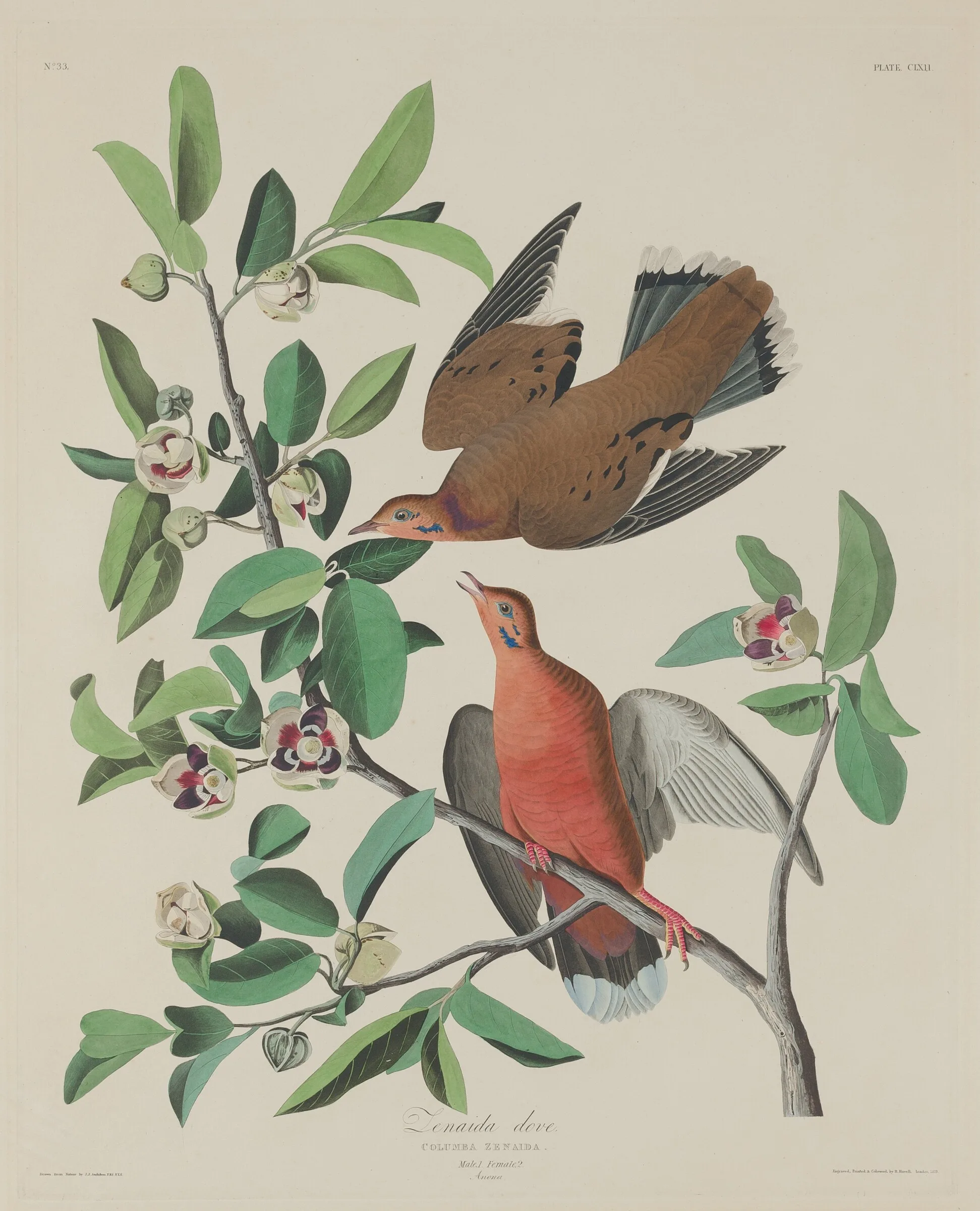
Audubon's “Zenaida Dove”, The Birds of America, plate CLXII
Click or press Enter to enlarge
Open the full-resolution image (3216 px, National Gallery of Art)
| Plate | 162 (CLXII) |
|---|---|
| Audubon's name | Zenaida Dove |
| Modern name | Zenaida Dove |
| Scientific name | Zenaida aurita |
| Status | Least Concern |
| Engraved by | Robert Havell, after Audubon's watercolor |
| Date | 1833 |
| Medium | Hand-colored engraving and aquatint on Whatman wove paper |
| Collections | Turkeys, Grouse and Game Birds, Florida and Wading Birds |
| This impression | National Gallery of Art, Washington, 1945.8.162; Gift of Mrs. Walter B. James |
About this plate
Plate 162 shows a male and a female Zenaida Dove, warm brown doves with a white trailing edge to the wing, black spots on the wings and an iridescent patch on the neck. Audubon drew them from birds of the Florida Keys.
Audubon used Bonaparte's name Columba zenaida. Bonaparte named the bird, and later the genus Zenaida, after his wife, Princess Zénaïde. The species is now Zenaida aurita, a close relative of the Mourning Dove.
The Zenaida Dove lives in the Caribbean and on the coast of the Yucatán Peninsula. In Audubon's time it bred on some of the Florida Keys, but it is now only a rare visitor to South Florida. It is common within its range and listed as Least Concern.
Audubon opens with his father's memory that his first attempt at drawing was of a dove. He tells of a former pirate who said the cooing of these doves at wells on a Key had moved him to repent and escape his ship. Audubon wrote that the dove arrives in the islands near Indian Key about 15 April, nests on the ground on particular Keys known as Dove Keys, and he described a female trembling with distress beside her nest.
In Audubon's words
He said he never left the place without increased fears of futurity, associated as he was, although I believe by force, with a band of the most desperate villains that ever annoyed the navigation of the Florida coasts. So deeply moved was he by the notes of any bird, and especially by those of a dove, the only soothing sounds he ever heard during his life of horrors, that through these plaintive notes, and them alone, he was induced to escape from his vessel, abandon his turbulent companions, and return to a family deploring his absence. After paying a parting visit to those wells, and listening once more to the cooings of the Zenaida Dove, he poured out his soul in supplications for mercy, and once more became what one has said to be "the noblest work of God," an honest man.
John James Audubon, Ornithological Biography, vol. 2 (1834), “The Zenaida Dove”. Read the full chapter.