Crested Caracara (Plate 161)
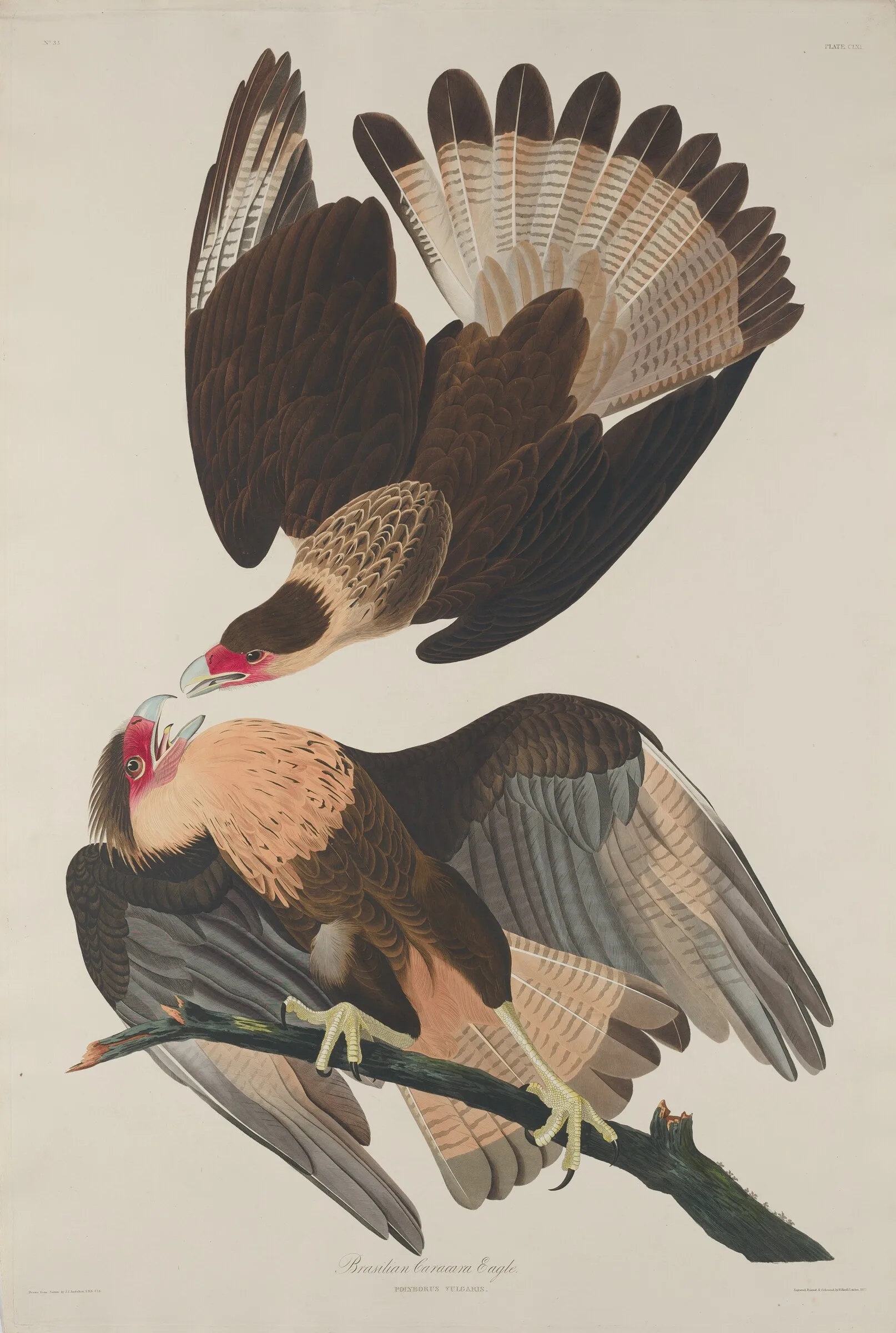
Audubon's “Brasilian Caracara Eagle”, The Birds of America, plate CLXI
Click or press Enter to enlarge
Open the full-resolution image (4683 px, National Gallery of Art)
| Plate | 161 (CLXI) |
|---|---|
| Audubon's name | Brasilian Caracara Eagle |
| Modern name | Crested Caracara |
| Scientific name | Caracara plancus |
| Status | Least Concern |
| Engraved by | Robert Havell, after Audubon's watercolor |
| Date | 1833 |
| Medium | Hand-colored engraving and aquatint on Whatman wove paper |
| Collections | Hawks, Eagles and Falcons, Florida and Wading Birds |
| This impression | National Gallery of Art, Washington, 1945.8.161; Gift of Mrs. Walter B. James |
About this plate
Plate 161 shows the Crested Caracara twice. Audubon wrote that he made a double drawing of one bird to show all its feathers, so the plate gives a front and a back view of the same individual, with its black cap, bare red face, barred neck and long yellow legs.
Audubon called it the Caracara or Brazilian Eagle and used Vieillot's name Polyborus vulgaris. It is not an eagle but a falcon, one of the caracaras that feed largely on carrion and walk on the ground. The northern birds have at times been treated as a separate species, Caracara cheriway; most current lists treat them as part of the Crested Caracara, Caracara plancus.
The Crested Caracara lives from the southern United States to Tierra del Fuego. In the United States it is found in Texas, southern Arizona and central Florida. The isolated Florida population, in prairies and ranchland north of Lake Okeechobee, is listed as threatened under the US Endangered Species Act. Worldwide the species is Least Concern.
Audubon first saw the bird on 24 November 1831 near St Augustine, Florida. He followed it for nearly a mile to a dead horse where vultures were feeding, crawled along a ditch and across a muddy savanna to get within range, missed one shot and watched it tear at meat like a vulture before it flew off. He later obtained the specimen he drew.
In Audubon's words
I moved circuitously, until I came to a deep ditch, along which I crawled, and went as near to the bird as I possibly could; but finding the distance much too great for a sure shot, I got up suddenly, when the whole of the birds took to flight. The eagle, as if desirous of forming acquaintance with me, took a round and passed over me. I shot, but to my great mortification missed it. However it alighted a few hundred yards off, in an open savanna, on which I laid myself flat on the ground, and crawled towards it, pushing my gun before me, amid burs and mud-holes, until I reached the distance of about seventy-five yards from it, when I stopped to observe its attitudes. The bird did not notice me; he stood on a lump of flesh, tearing it to pieces, in the manner of a Vulture, until he had nearly swallowed the whole.
John James Audubon, Ornithological Biography, vol. 2 (1834), “The Caracara Eagle”. Read the full chapter.