Palm Warbler (Plate 163)
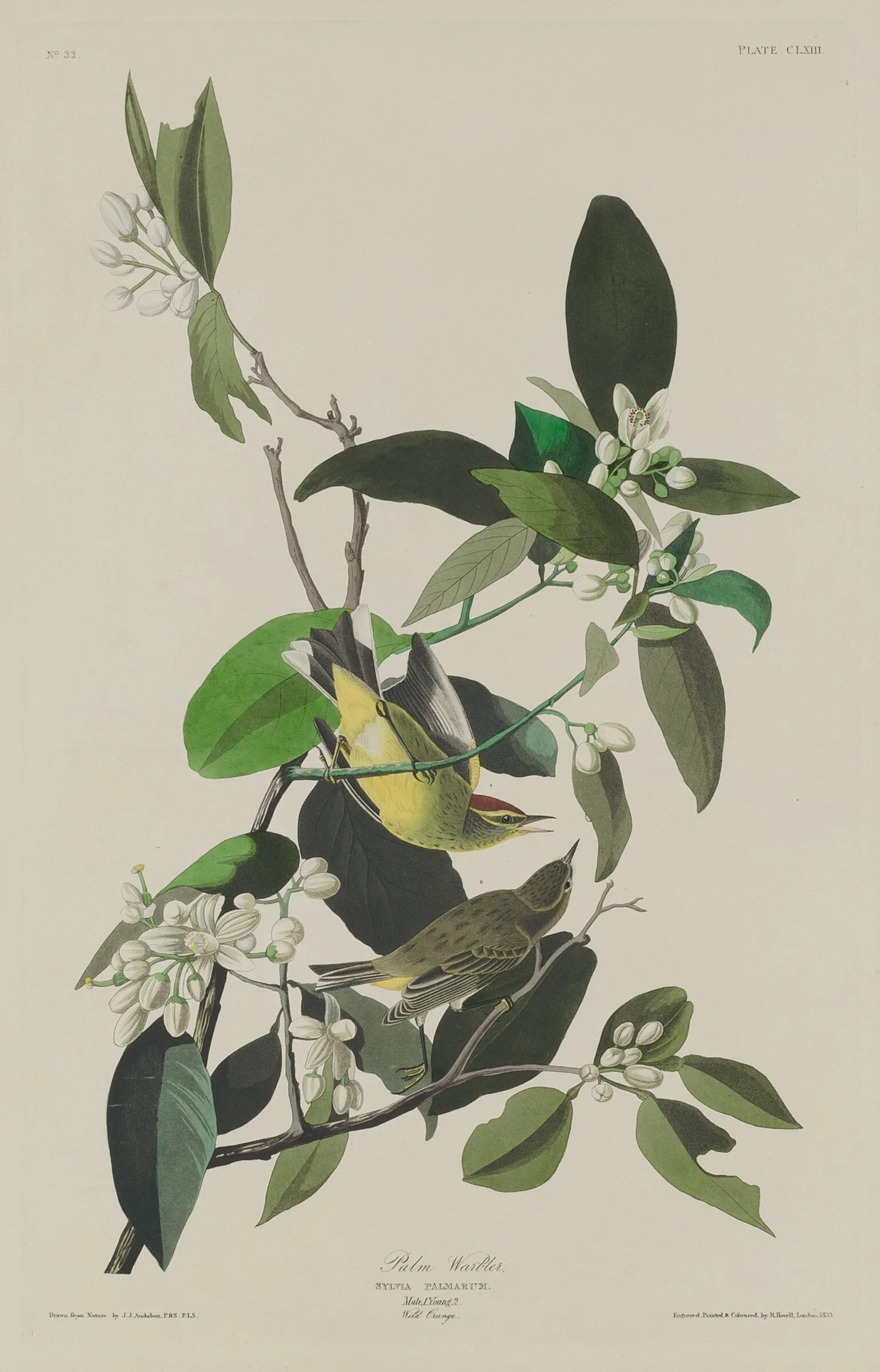
Audubon's “Palm Warbler”, The Birds of America, plate CLXIII
Click or press Enter to enlarge
Open the full-resolution image (2432 px, National Gallery of Art)
| Plate | 163 (CLXIII) |
|---|---|
| Audubon's name | Palm Warbler |
| Modern name | Palm Warbler |
| Scientific name | Setophaga palmarum |
| Status | Least Concern |
| Engraved by | Robert Havell, after Audubon's watercolor |
| Date | 1833 |
| Medium | Hand-colored engraving and aquatint on Whatman wove paper |
| Plants and setting | Wild orange in flower (sour orange, Citrus aurantium) |
| Collections | Songbirds, Florida and Wading Birds |
| This impression | National Gallery of Art, Washington, 1945.8.163; Gift of Mrs. Walter B. James |
About this plate
Plate 163 shows an adult Palm Warbler in spring plumage, with a chestnut cap and yellow underparts streaked with red-brown, and a young bird without the red cap. They perch on a branch of wild orange in flower. Audubon wrote that the birds were drawn in Florida a few days before the species left for the north.
The plate was issued as the Palm Warbler, using Bonaparte's name Sylvia palmarum. By the time Audubon wrote this text he had decided, with John Bachman's help, that it was the same bird as his Yellow Red-poll Warbler in plate 145, shown in autumn plumage. He was right that they are one species. The name palmarum survives, and the bird is now Setophaga palmarum.
The Palm Warbler breeds in bogs of Canada and the far northeastern United States and winters in the Southeast and the Caribbean, where it often feeds on the ground in open places. It wags its tail almost constantly. It is listed as Least Concern.
Most of the chapter describes St Augustine, Florida, where the bird was abundant, and where Audubon spent time in the winter of 1831 to 1832. He wrote about the difficult sand bar, the Spanish fort, the fish market and the oranges. He believed the wild orange, a tree brought by the Spanish, was nearly native in the wildest parts of Florida.
In Audubon's words
To reach St Augustine, the navigator has first to pass over a difficult sand-bar, which frequently changes its position; he then, however, finds a deep channel leading to a safe and commodious harbour. The appearance of the town is rather romantic, especially when the Spanish Fort, which is quite a monument of ancient architecture, opens to the view. The place itself is quite Spanish, the streets narrow, the church not very remarkable, and the market-place the resort of numerous idlers, whether resident or from other parts. It is supplied with, I believe, the best fish in America, the "sheep-head" and "mullet" being the finest I have ever seen; and its immediate neighbourhood produces as good oranges as can any where be found.
John James Audubon, Ornithological Biography, vol. 2 (1834), “The Yellow Red-poll Warbler”. Read the full chapter.