Key West Quail-Dove (Plate 167)
Audubon's “Key-west Dove”, The Birds of America, plate CLXVII
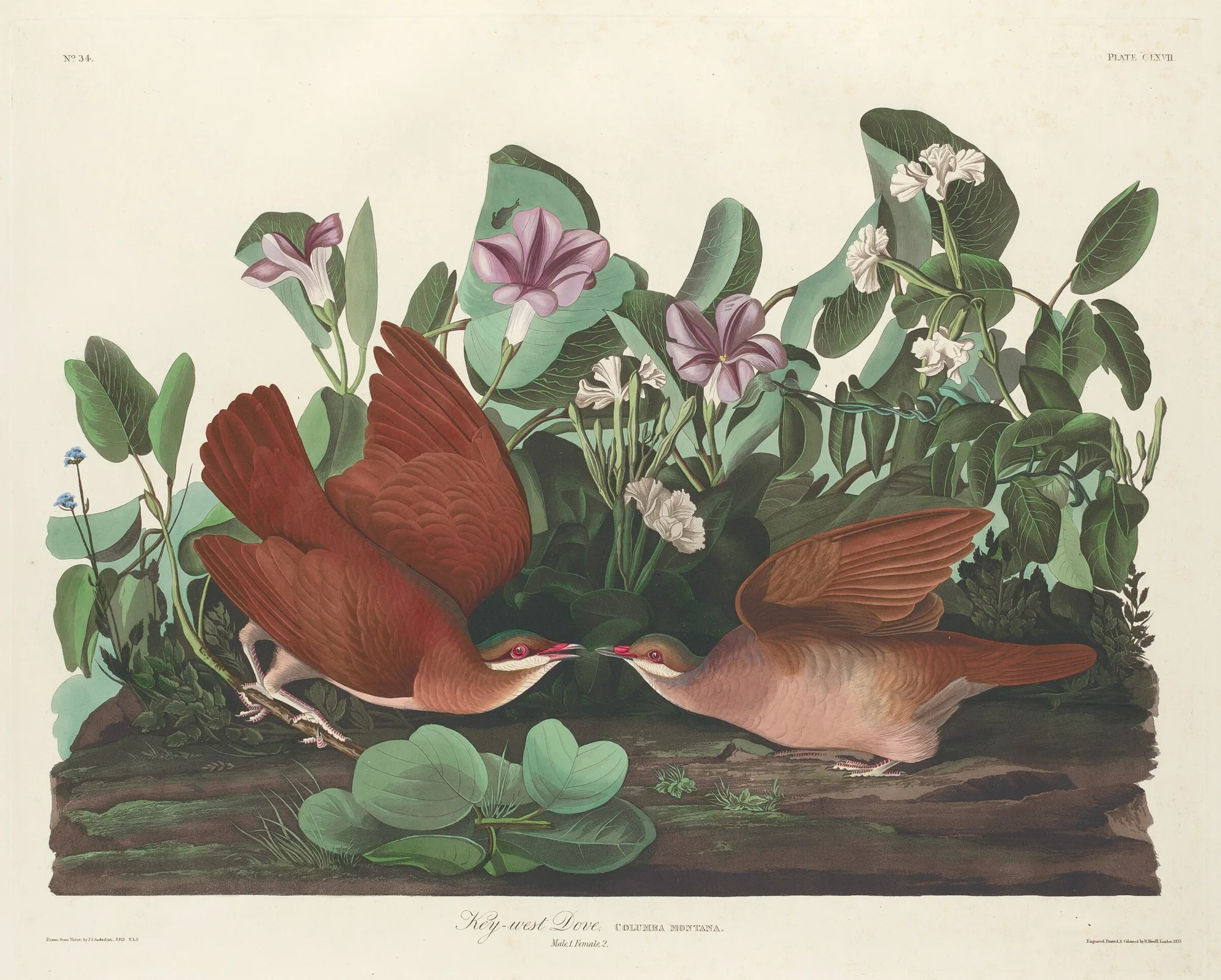
Click or press Enter to enlarge
Open the full-resolution image (3212 px, National Gallery of Art)
| Plate | 167 (CLXVII) |
|---|---|
| Audubon's name | Key-west Dove |
| Modern name | Key West Quail-Dove |
| Scientific name | Geotrygon chrysia |
| Status | Least Concern |
| Engraved by | Robert Havell, after Audubon's watercolor |
| Date | 1833 |
| Medium | Hand-colored engraving and aquatint on Whatman wove paper |
| Size | plate: 51.3 x 65.4 cm (20 3/16 x 25 3/4 in.) sheet: 67.6 x 99.7 cm (26 5/8 x 39 1/4 in.) |
| Collections | Turkeys, Grouse and Game Birds, Florida and Wading Birds |
| This impression | National Gallery of Art, Washington, 1945.8.167; Gift of Mrs. Walter B. James |
About this plate
Plate 167 shows a male and female Key West Quail-Dove, which Audubon called the Key West Pigeon in his text and the Key-West Dove on the plate. Quail-doves are plump, short-tailed pigeons that live on the forest floor, and this one has a white stripe below the eye and a coppery back with a purple and green gloss.
Audubon gave it the Latin name Columba montana, which belongs to a different bird, the Ruddy Quail-Dove. The species he drew is now Geotrygon chrysia. It lives in dry forest and thickets in the Bahamas, Cuba, Hispaniola and Puerto Rico, and is only a rare visitor to southern Florida today. It is listed as Least Concern.
Audubon reached Key West in May 1832 aboard the revenue cutter Marion. He had already seen the head of a strange pigeon at John Bachman's house in Charleston, sent by Dr Benjamin Strobel of Key West. On the island, Major Glassel of the United States Artillery lent him Sergeant Sykes as a guide. Audubon printed his journal entry for May 6, 1832, describing how the two men crept through cactus and thorn thickets until Sykes spotted the doves on the ground.
He noted that the bird flew into the thickest woods when alarmed, landed on the ground and ran off, and that its cooing was less soft than that of the Zenaida Dove.
In Audubon's words
We soon reached the thickets, and found it necessary to move in truth very slowly, one foot warily advanced before the other, one hand engaged in opening a passage, and presently after occupied in securing the cap on the head, in smashing some dozens of hungry musquitoes, or in drawing the sharp thorn of a cactus from a leg or foot, in securing our gun-locks, or in assisting ourselves to rise after a fall occasioned by stumbling against the projecting angle of a rock. But we pushed on, squeezed ourselves between the stubborn branches, and forced our way as well as we could, my guide of course having the lead.
John James Audubon, Ornithological Biography, vol. 2 (1834), “The Key West Pigeon”. Read the full chapter.