Fork-tailed Flycatcher (Plate 168)
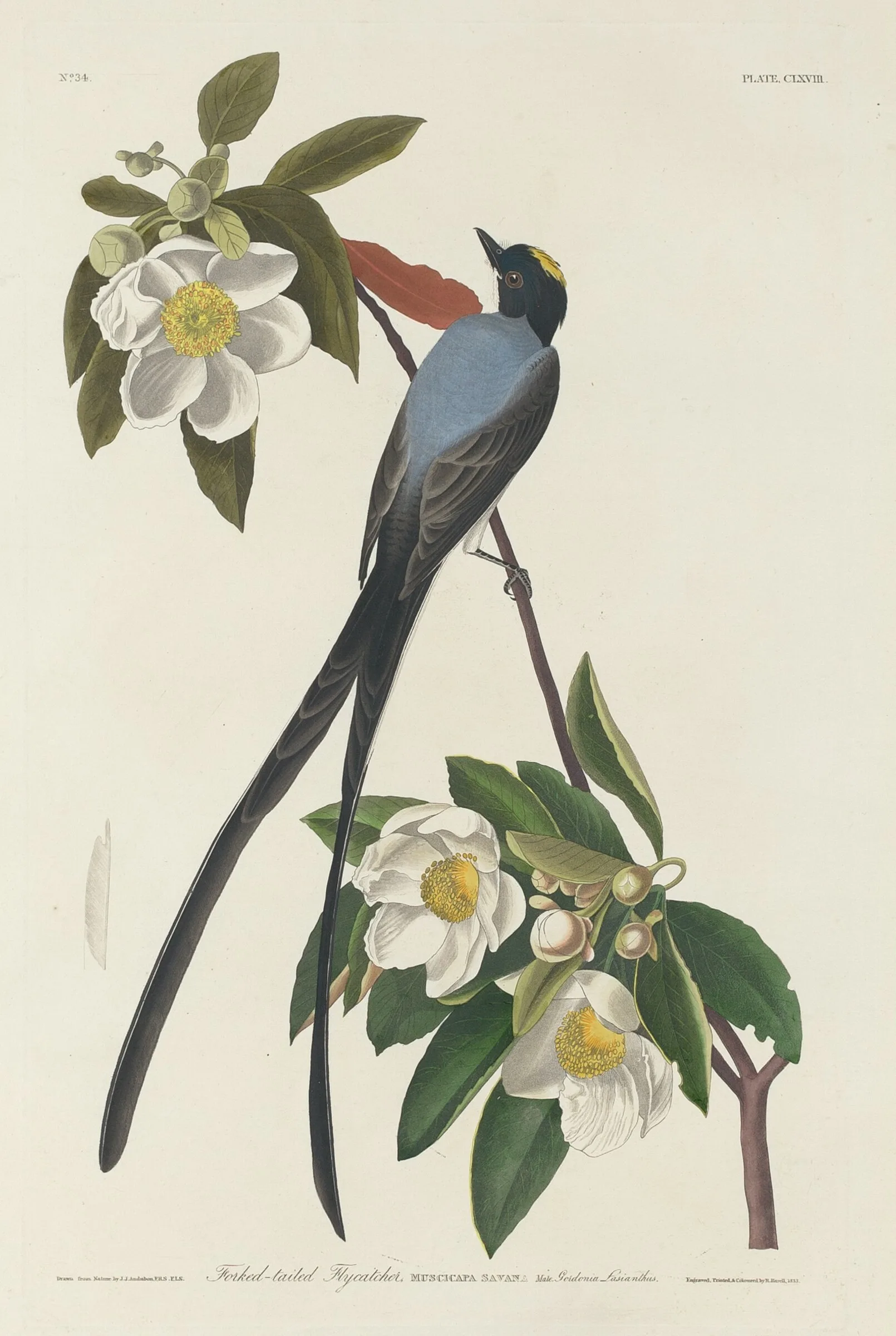
Audubon's “Forked-tail Flycatcher”, The Birds of America, plate CLXVIII
Click or press Enter to enlarge
Open the full-resolution image (2437 px, National Gallery of Art)
| Plate | 168 (CLXVIII) |
|---|---|
| Audubon's name | Forked-tail Flycatcher |
| Modern name | Fork-tailed Flycatcher |
| Scientific name | Tyrannus savana |
| Status | Least Concern |
| Engraved by | Robert Havell, after Audubon's watercolor |
| Date | 1833 |
| Medium | Hand-colored engraving and aquatint on Whatman wove paper |
| Size | plate: 49.5 x 31.8 cm (19 1/2 x 12 1/2 in.) sheet: 99.7 x 67.3 cm (39 1/4 x 26 1/2 in.) |
| Plants and setting | Loblolly Bay (Gordonia lasianthus), painted by Maria Martin |
| Collections | Songbirds |
| This impression | National Gallery of Art, Washington, 1945.8.168; Gift of Mrs. Walter B. James |
About this plate
Plate 168 shows a single male Fork-tailed Flycatcher perched on a flowering branch of Loblolly Bay. The bird's outer tail feathers are several times the length of its body, and Audubon noted that it used them for sudden turns while chasing insects.
The plant was painted by the sister of Audubon's friend John Bachman, almost certainly Maria Martin, who painted many of the botanical backgrounds for the later plates. The twig came from the Charleston garden of the nurseryman Philippe Noisette. Loblolly Bay, Gordonia lasianthus, is an evergreen tree of wet coastal ground in the Southeast with large white flowers.
The bird itself is a South American tyrant flycatcher, now Tyrannus savana. It breeds from southern Mexico to Argentina, and southern populations migrate north in the austral winter. Strays reach North America rarely, mostly on the Atlantic coast. It is listed as Least Concern.
Audubon saw only four in the United States. He shot the plate's model near Camden, New Jersey, at the end of June 1832, and drew it from the bird, which lived only a few minutes. Years earlier at Henderson, Kentucky, he was given one caught by hand in the Barrens, and in August 1822 he saw two high over Natchez, Mississippi.
In Audubon's words
In the end of June 1832, I observed one of these birds a few miles below the city of Camden, flying over a meadow in pursuit of insects, after, which it alighted on the top of a small detached tree, where I followed it and succeeded in obtaining it. The bird appeared to have lost itself: it was unsuspicious, and paid no attention to me as I approached it. While on the wing, it frequently employed its long tail, when performing sudden turns in following its prey, and when alighted, it vibrated it in the manner of the Sparrow-Hawk. The bird fell to the ground wounded, and uttering a sharp squeak, which it repeated, and accompanied with smart clicks of its bill, when I went up to it. It lived only a few minutes, and from it the drawing transferred to the plate was made.
John James Audubon, Ornithological Biography, vol. 2 (1834), “The Forked-tailed Flycatcher”. Read the full chapter.



