Rough-legged Hawk (Plate 166)
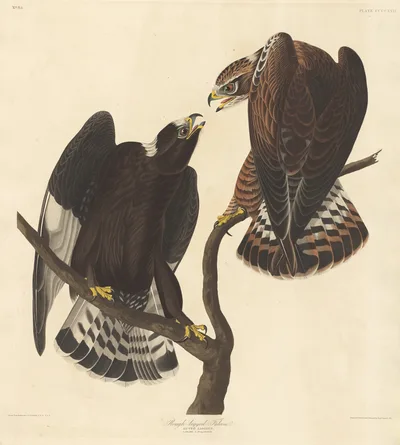
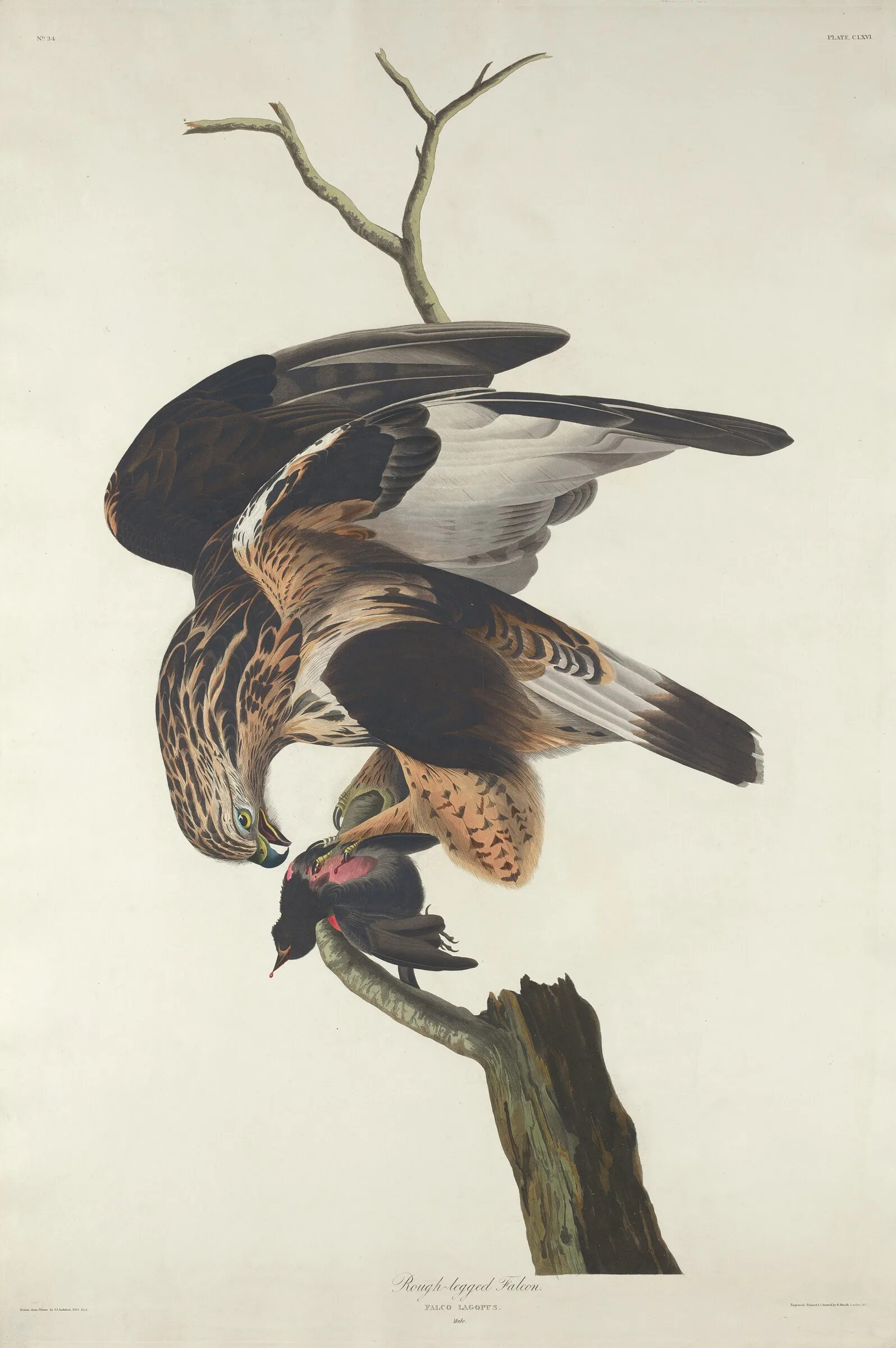
Audubon's “Rough-legged Falcon”, The Birds of America, plate CLXVI
Click or press Enter to enlarge
Open the full-resolution image (4660 px, National Gallery of Art)
| Plate | 166 (CLXVI) |
|---|---|
| Audubon's name | Rough-legged Falcon |
| Modern name | Rough-legged Hawk |
| Scientific name | Buteo lagopus |
| Status | Least Concern |
| Engraved by | Robert Havell, after Audubon's watercolor |
| Date | 1833 |
| Medium | Hand-colored engraving and aquatint on Whatman wove paper |
| Collections | Hawks, Eagles and Falcons |
| This impression | National Gallery of Art, Washington, 1945.8.166; Gift of Mrs. Walter B. James |
About this plate
Plate 166 shows one male Rough-legged Hawk, the bird Audubon called the Rough-legged Falcon. The name refers to the legs, which are feathered down to the toes, an adaptation to the cold of its Arctic breeding grounds.
Audubon used this chapter to argue a point of identity. Alexander Wilson had described a dark bird as a separate species, Falco niger, the Black Hawk. Audubon examined Wilson's own specimen at the Academy of Natural Sciences in Philadelphia and concluded it was the same species. He was right, though for the wrong reason. He thought the dark birds were older, but the Rough-legged Hawk has light and dark color morphs that are not tied to age. He also suspected the European and American birds were one species, which is now accepted: Buteo lagopus breeds across the Arctic of both hemispheres.
The species nests on tundra cliffs and outcrops and winters in open country across southern Canada and much of the United States. It hunts small mammals, often hovering over fields, and its numbers rise and fall with lemming and vole cycles. It is listed as Least Concern.
Audubon's evidence came from Boston in the winter of 1832, where he paid premiums for hawks and received eight at once, all shot on salt marshes within about five miles of the city. He described the bird as sluggish, watching from stakes for mice and moles and often hunting after sunset.
In Audubon's words
It is a sluggish bird, and confines itself to the meadows and low grounds bordering the rivers and salt-marshes, along our bays and inlets. In such places you may see it perched on a stake, where it remains for hours at a time, unless some wounded bird comes in sight, when it sails after it, and secures it without manifesting much swiftness of flight. It feeds principally on moles, mice, and other small quadrupeds, and never attacks a duck on the wing, although now and then it pursues a wounded one. When not alarmed, it usually flies low and sedately, and does not exhibit any of the courage and vigour so conspicuous in most other hawks, suffering thousands of birds to pass without pursuing them. The greatest feat I have seen them perform was scrambling at the edge of the water, to secure a lethargic frog.
John James Audubon, Ornithological Biography, vol. 2 (1834), “The Rough-legged Falcon”. Read the full chapter.