Mourning Dove (Plate 17)
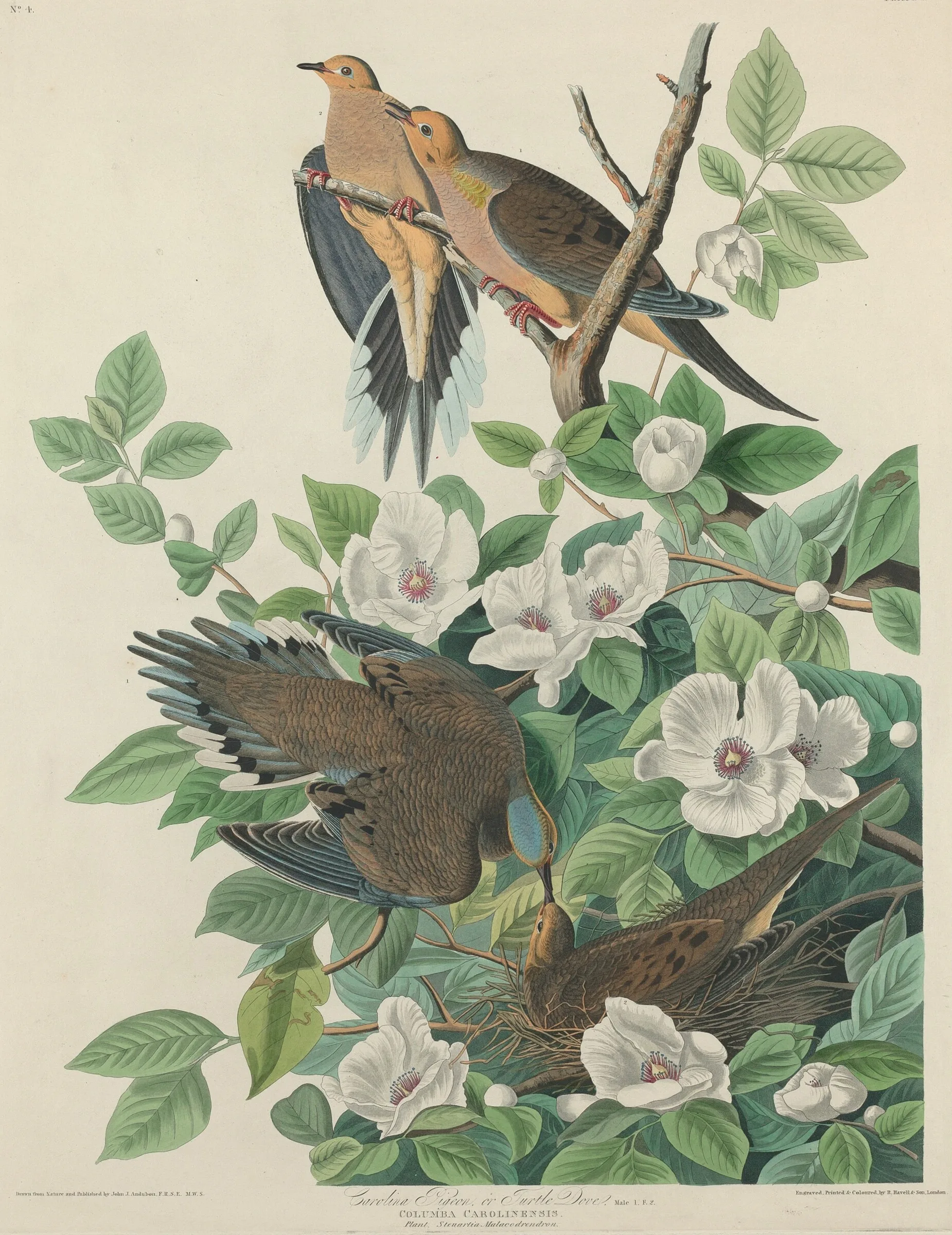
Audubon's “Carolina Pigeon or Turtle Dove”, The Birds of America, plate XVII
Click or press Enter to enlarge
Open the full-resolution image (3210 px, National Gallery of Art)
| Plate | 17 (XVII) |
|---|---|
| Audubon's name | Carolina Pigeon or Turtle Dove |
| Modern name | Mourning Dove |
| Scientific name | Zenaida macroura |
| Status | Least Concern |
| Engraved by | Robert Havell, after Audubon's watercolor |
| Date | 1827 |
| Medium | Hand-colored engraving and aquatint on Whatman wove paper |
| Plants and setting | Silky Camellia (Stuartia malacodendron) in bloom |
| Collections | Turkeys, Grouse and Game Birds |
| This impression | National Gallery of Art, Washington, 1945.8.17; Gift of Mrs. Walter B. James |
About this plate
Plate 17 shows two pairs of Mourning Doves on a flowering branch of Silky Camellia, Stuartia malacodendron. Audubon described the scene. Below, a female sits on her eggs among the leaves and takes food from the bill of her mate. Above, a courtship is starting: the female has moved to the end of the branch, wings and tail opening, ready to fly off, with the male following. The plate was engraved by Robert Havell in 1827.
Audubon wrote that the dove bred in every part of the United States he had visited. It laid two white eggs in a nest of a few loose sticks, and raised two broods in Louisiana but usually one in Connecticut. He thought young birds in season as good to eat as Snipe or Woodcock. He also noted that doves shed feathers at the slightest touch.
Audubon's Carolina Pigeon or Turtle Dove is the Mourning Dove, Zenaida macroura. The name comes from its soft, sad cooing, which Audubon also mentions. Like other pigeons, both parents feed the young on crop milk.
The Mourning Dove is one of the most widespread and abundant birds in North America, found from southern Canada to Panama. It is also the most hunted game bird in the United States, with millions shot each year, yet it remains listed as Least Concern. The Stuartia is a small tree of rich ground near streams in the southeastern states.
In Audubon's words
Look at the female, as she assiduously sits on her eggs, embosomed among the thick foliage, receiving food from the bill of her mate, and listening with delight to his assurances of devoted affection. Nothing is wanting to render the moment as happy as could be desired by any couple on a similar occasion.
On the branch above, a love scene is just commencing. The female, still coy and undetermined, seems doubtful of the truth of her lover, and virgin-like resolves to put his sincerity to the test, by delaying the gratification of his wishes. She has reached the extremity of the branch, her wings and tail are already opening, and she will fly off to some more sequestered spot, where, if her lover should follow her with the same assiduous devotion, they will doubtless become as blessed as the pair beneath them.
John James Audubon, Ornithological Biography, vol. 1 (1831), “The Carolina Turtle Dove”. Read the full chapter.