Peregrine Falcon (Plate 16)
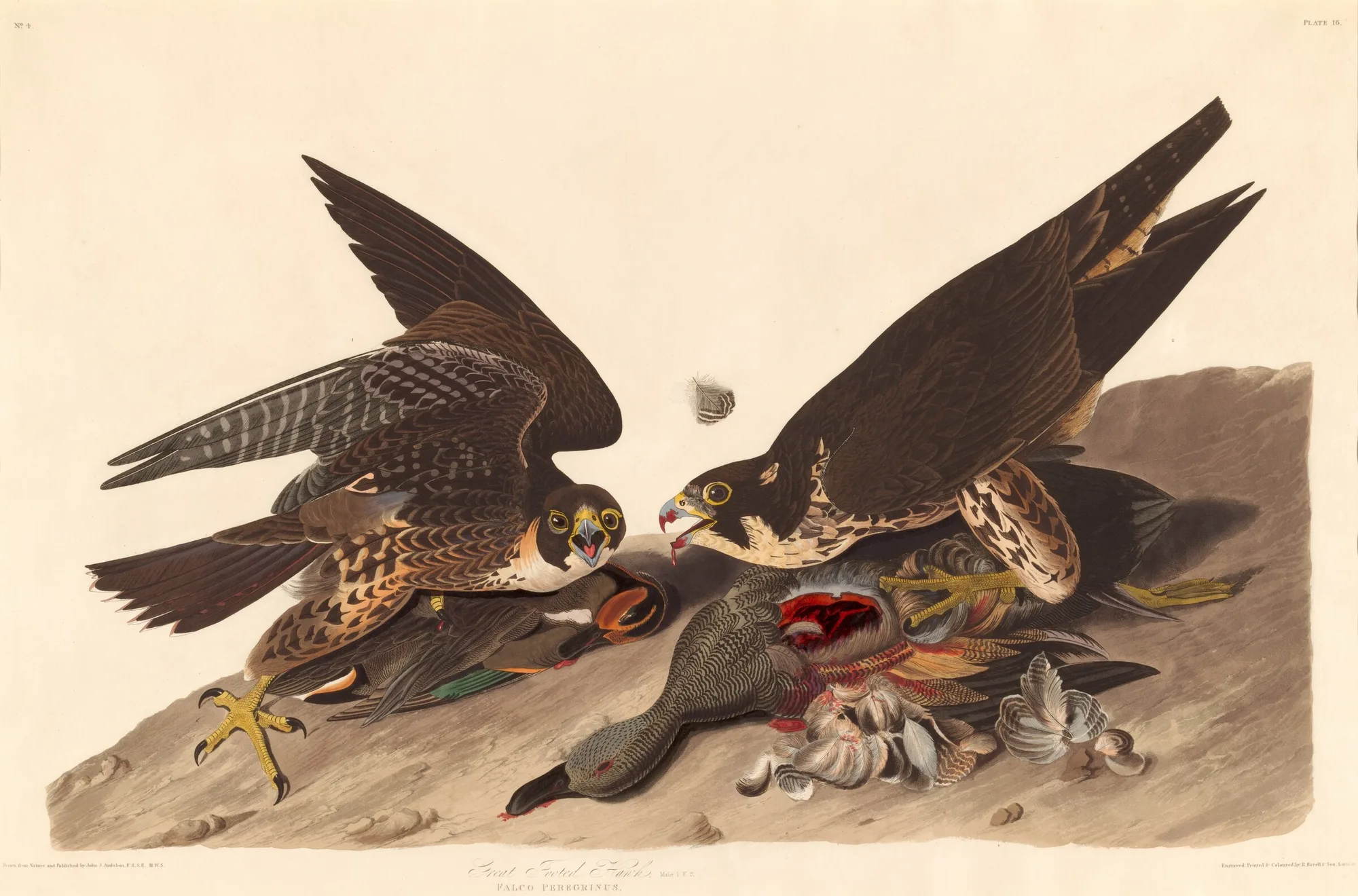
Audubon's “Great Footed Hawk”, The Birds of America, plate XVI
Click or press Enter to enlarge
Open the full-resolution image (5137 px, National Gallery of Art)
| Plate | 16 (XVI) |
|---|---|
| Audubon's name | Great Footed Hawk |
| Modern name | Peregrine Falcon |
| Scientific name | Falco peregrinus |
| Status | Least Concern |
| Engraved by | Robert Havell, after Audubon's watercolor |
| Date | 1827 |
| Medium | Hand-colored engraving and aquatint on Whatman wove paper |
| Size | plate: 64.8 x 96.5 cm (25 1/2 x 38 in.) sheet: 67.2 x 99.7 cm (26 7/16 x 39 1/4 in.) |
| Collections | Hawks, Eagles and Falcons |
| This impression | National Gallery of Art, Washington, 1945.8.16; Gift of Mrs. Walter B. James |
About this plate
Plate 16 shows a pair of Peregrine Falcons at a kill, both with bloodied bills. Audubon wrote that the male holds a Green-winged Teal and the female a Gadwall. He called the pair two pirates at their breakfast. The plate was engraved by Robert Havell in 1827.
The female in the plate was shot on 26 December 1820 during Audubon's journey down the Mississippi, which lasted four months as he floated a few miles a day collecting birds. He and his companion counted more than fifty of these falcons on the trip. Its stomach held bird bones, the gizzard of a teal, and the eyes and scales of a fish. His companion on that journey was his young assistant Joseph Mason.
Audubon's Great-footed Hawk is the Peregrine Falcon, Falco peregrinus. In North America it was long called the Duck Hawk. Audubon noted that it had grown more common in his lifetime. He also described it watching from a dead branch near marshes and diving on Snipe.
In the twentieth century DDT caused eggshell thinning and breeding failure, and by the mid 1960s the peregrine had disappeared as a breeding bird from the eastern United States. Captive breeding and release, many birds on city buildings and bridges, restored it. It was removed from the US Endangered Species list in 1999. It occurs on every continent except Antarctica and is listed as Least Concern.
In Audubon's words
They occasionally feed on dead fish that have floated to the shores or sand bars. I saw several of them thus occupied while descending the Mississippi on a journey undertaken expressly for the purpose of observing and procuring different specimens of birds, and which lasted four months, as I followed the windings of that great river, floating down it only a few miles daily. During that period, I and my companion counted upwards of fifty of these Hawks, and killed several, among which was the female represented in the plate now before you, and which was found to contain in its stomach bones of birds, a few downy feathers, the gizzard of a Teal, and the eyes and many scales of a fish. It was shot on the 26th December 1820. The ovary contained numerous eggs, two of which were as large as pease.
John James Audubon, Ornithological Biography, vol. 1 (1831), “The Great-footed Hawk”. Read the full chapter.