Bewick's Wren (Plate 18)
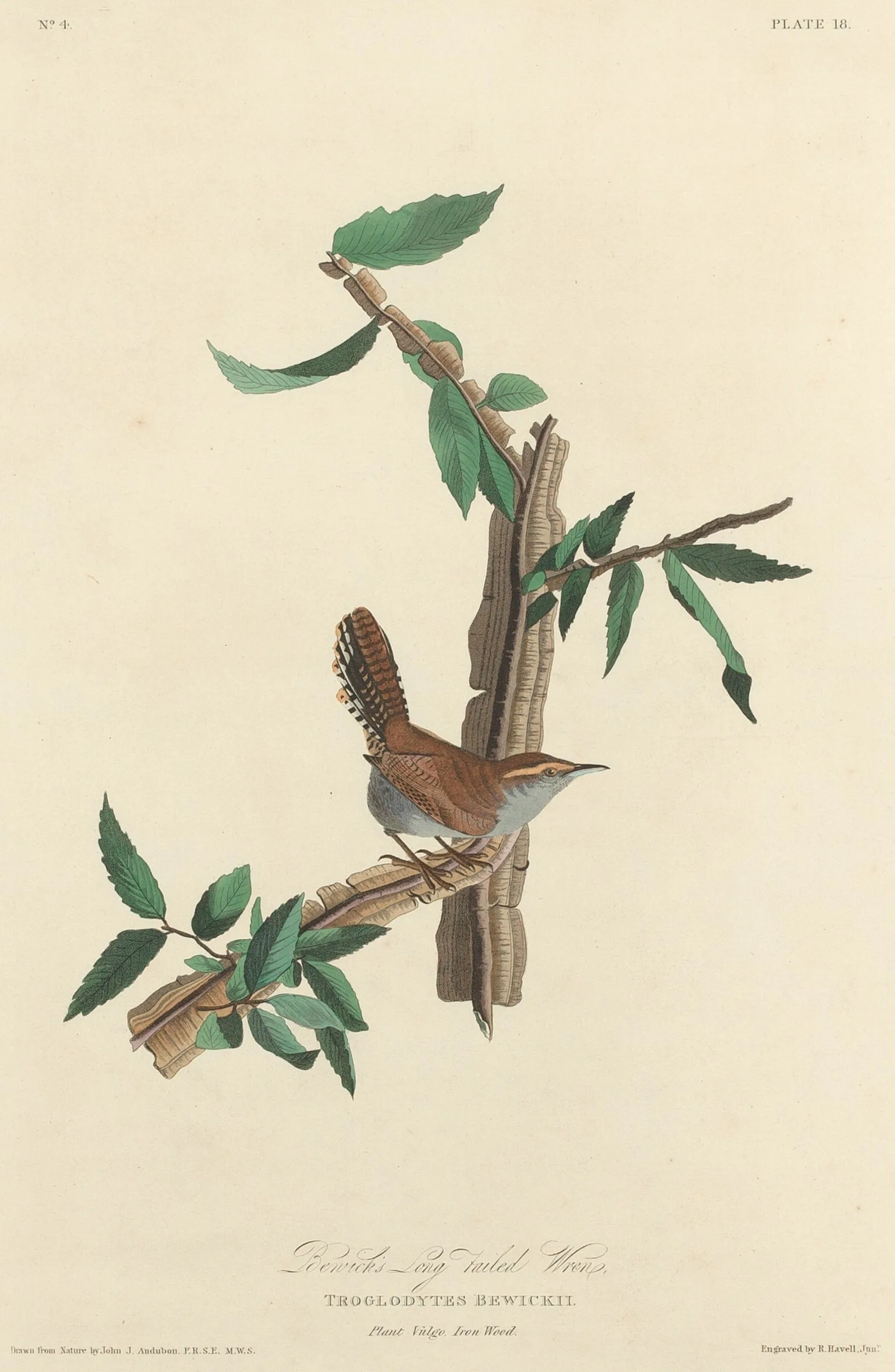
Audubon's “Bewick's Long-tailed Wren”, The Birds of America, plate XVIII
Click or press Enter to enlarge
Open the full-resolution image (2231 px, National Gallery of Art)
| Plate | 18 (XVIII) |
|---|---|
| Audubon's name | Bewick's Long-tailed Wren |
| Modern name | Bewick's Wren |
| Scientific name | Thryomanes bewickii |
| Status | Least Concern |
| Engraved by | Robert Havell, after Audubon's watercolor |
| Date | 1827 |
| Medium | Hand-colored engraving and aquatint on Whatman wove paper |
| Plants and setting | Iron-wood, a corky-winged elm (probably Winged Elm, Ulmus alata) |
| Collections | Songbirds |
| This impression | National Gallery of Art, Washington, 1945.8.18; Gift of Mrs. Walter B. James |
About this plate
Plate 18 shows a single Bewick's Wren with its long tail cocked, perched on a twig whose branches carry corky ridges. Audubon called the tree the Iron-wood, a kind of elm with hard, close wood. The twig matches Winged Elm. The plate was engraved by Robert Havell in 1827.
Audubon described the species as new. He shot the bird on 19 October 1821 about five miles from St Francisville, Louisiana, standing on a fallen tree trunk near a fence, and made the drawing on the spot. His young assistant Joseph R. Mason shot a second bird a few days later. In November 1829 he watched another near a house where he was staying and chose not to kill it. It ran along fence rails picking spiders, with its tail erect.
He named the bird after Thomas Bewick, the English wood engraver and author of A History of British Birds, whom he had met and liked. The name stands: Bewick's Wren, Thryomanes bewickii. Audubon admitted he did not know where it bred.
Bewick's Wren is common in the western United States and Mexico. The eastern population, which once bred widely in the Appalachians and Midwest, collapsed during the twentieth century and is now nearly gone east of the Mississippi. The spread of the House Wren, which destroys the eggs of other cavity nesters, is often cited as one cause. The species overall is listed as Least Concern.
In Audubon's words
The bird represented under the name of Bewick's Wren I shot on the 19th October 1821, about five miles from St Francisville, in the State of Louisiana. It was standing as nearly as can be represented in the position in which you now see it, and upon the prostrate trunk of a tree not far from a fence. My drawing of it was made on the spot. Another individual was shot a few days after, by a young friend, JOSEPH R. MASON, who accompanied me on my rambles. In the month of November 1829, I had the pleasure of meeting with another of the same species, about fifteen miles from the place above mentioned, and as it was near the house at which I was then on a visit, I refrained from killing it, in order to observe its habits.
John James Audubon, Ornithological Biography, vol. 1 (1831), “Bewick's Wren”. Read the full chapter.



