Blue-headed Quail-Dove (Plate 172)
Audubon's “Blue-headed Pigeon”, The Birds of America, plate CLXXII
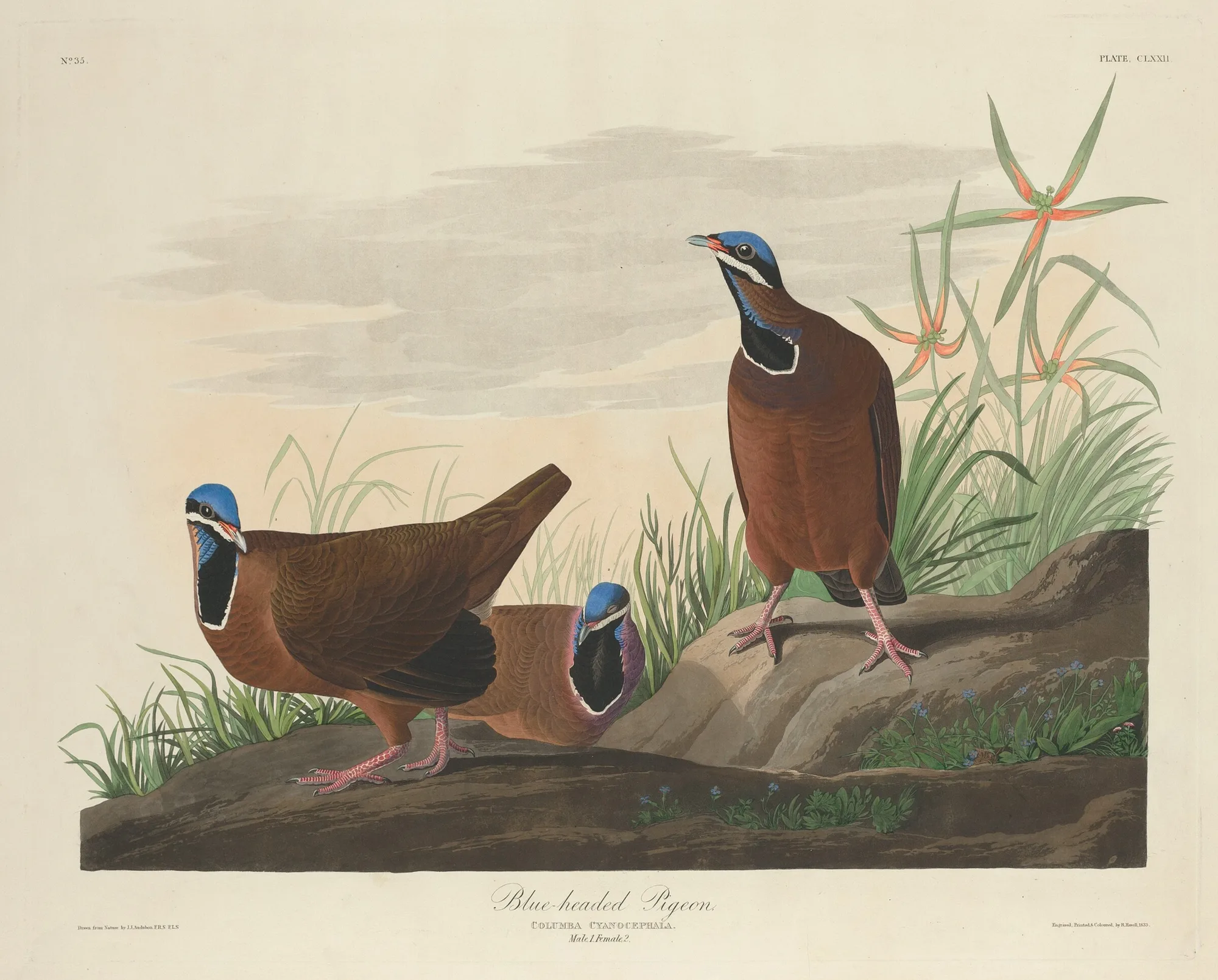
Click or press Enter to enlarge
Open the full-resolution image (3313 px, National Gallery of Art)
| Plate | 172 (CLXXII) |
|---|---|
| Audubon's name | Blue-headed Pigeon |
| Modern name | Blue-headed Quail-Dove |
| Scientific name | Starnoenas cyanocephala |
| Status | Endangered |
| Engraved by | Robert Havell, after Audubon's watercolor |
| Date | 1833 |
| Medium | Hand-colored engraving and aquatint on Whatman wove paper |
| Plants and setting | Cyperus sedge and creeping plants of the Florida Keys |
| Collections | Turkeys, Grouse and Game Birds, Florida and Wading Birds |
| This impression | National Gallery of Art, Washington, 1945.8.172; Gift of Mrs. Walter B. James |
About this plate
Plate 172 shows Blue-headed Quail-Doves on the ground among low creeping plants and a Cyperus sedge. Audubon wrote that he represented three birds, though the figures are listed as male and female. The birds have a bright blue crown edged in black, a white stripe below the eye and a black bib bordered with white.
The species is now Starnoenas cyanocephala, the only member of its genus. It is found only in Cuba, where it lives on the floor of lowland and foothill forest. It is listed as Endangered because of forest loss and hunting. Audubon believed a few crossed each spring to the Florida Keys, but his report is the main basis for its place on early North American lists, and it is not accepted as a regular visitor today.
Audubon wrote that early in May 1832, while shooting with the commander of the revenue cutter Marion, he saw a pair picking up gravel near the water on the western side of Key West. They ran back into the thickets. Fishermen and wreckers told him the birds were more common on the Mule Keys, but a large party searched those islands for a full day and found none.
He also saw a pair said to have been taken young on the Mule Keys and kept in captivity on cracked corn and rice. The sedge in the plate, he noted, was common on the dry Keys and in the interior of the peninsula.
In Audubon's words
Early in May 1832, while on a shooting excursion with the commander of the United States Revenue Cutter, the Marion, I saw a pair of them on the western side of Key West. They were near the water, picking gravel, but on our approaching them they ran back into the thickets, which were only a few yards distant. Several fishermen and wreckers informed us that they were more abundant on the "Mule Keys;" but although a large party and myself searched these islands for a whole day, not one did we discover there. I saw a pair which I was told had been caught when young on the latter Keys, but I could not obtain any other information respecting them, than that they were fed on cracked corn and rice, which answered the purpose well. I have represented three of these Pigeons on the ground, with some of the creeping plants which grew in the place where I saw the pair mentioned above.
John James Audubon, Ornithological Biography, vol. 2 (1834), “The Blue-headed Pigeon”. Read the full chapter.