Barn Owl (Plate 171)
Audubon's “Barn Owl”, The Birds of America, plate CLXXI
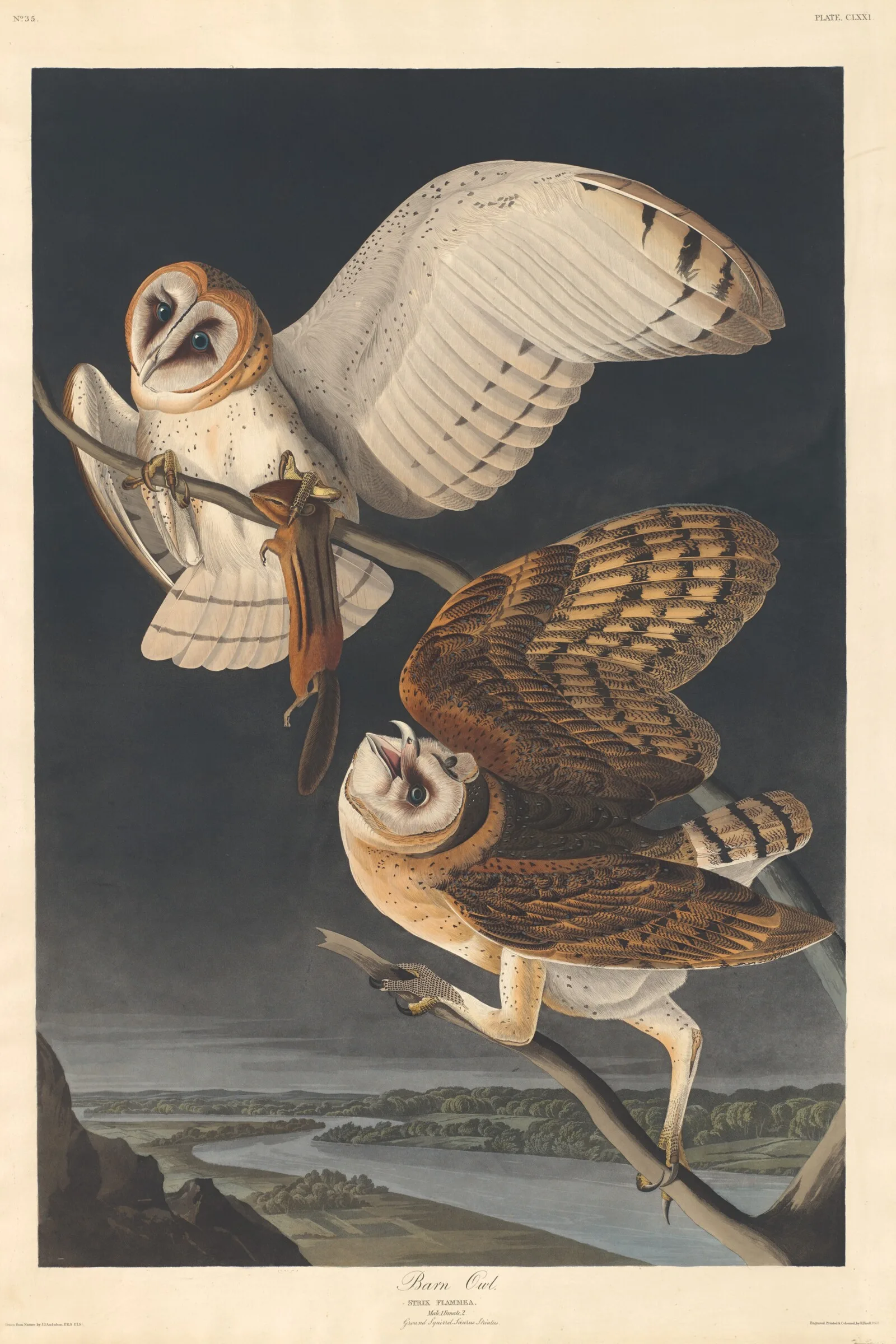
Click or press Enter to enlarge
Open the full-resolution image (5390 px, National Gallery of Art)
| Plate | 171 (CLXXI) |
|---|---|
| Audubon's name | Barn Owl |
| Modern name | Barn Owl |
| Scientific name | Tyto alba |
| Status | Least Concern |
| Engraved by | Robert Havell, after Audubon's watercolor |
| Date | 1833 |
| Medium | Hand-colored engraving and aquatint on Whatman wove paper |
| Size | plate: 97.5 x 65.5 cm (38 3/8 x 25 13/16 in.) sheet: 100.5 x 68.3 cm (39 9/16 x 26 7/8 in.) |
| Collections | Owls |
| This impression | National Gallery of Art, Washington, 1945.8.171; Gift of Mrs. Walter B. James |
About this plate
Plate 171 shows a male and female Barn Owl. Both show the pale heart-shaped face, long legs and golden-buff upperparts of the species.
Audubon called the bird Strix flammea. It is now Tyto alba under the American Ornithological Society, while the IOC list treats the American birds as a separate species, the American Barn Owl, Tyto furcata. Barn owls hunt rodents at night by sound and nest in cavities, barns, church towers and old buildings. In North America they are most common in the South and West. The species is listed as Least Concern, though it has declined in parts of the Midwest and Northeast.
Audubon complained that earlier writers knew nothing of the bird's habits, and he built his chapter from his journals. At St Augustine, East Florida, on 8 November 1832, the fort keeper Mr Simmons, whom he had known in Henderson, Kentucky, told him boys had taken five young owls from a chimney. Audubon climbed up with a ladder and found one fresh egg on bare stone among pellets and bones.
In October 1833 in Charleston, staying with John Bachman, he watched a pair nesting in the upper story of an abandoned sugar-house. He judged the species far more common in the southern coastal states than in the North, and reported that it was abundant in Cuba.
In Audubon's words
Mr SIMMONS, the Keeper of the Fort, whom I had known at Henderson in Kentucky, having informed me that some boys had taken five young Barn Owls from a hole in one of the chimneys, I went with a ladder to see if I could procure some more. After much search I found only a single egg, which had been recently laid. It was placed on the bare stone of the wall, surrounded by fragments of small quadrupeds of various kinds. During our search I found a great number of the disgorged pellets of the Owl, among which some were almost fresh. They contained portions of skulls and bones of small quadrupeds unknown to me.
John James Audubon, Ornithological Biography, vol. 2 (1834), “The Barn Owl”. Read the full chapter.
Barn Owl (Plate 171): the story behind one of the most famous plates in the collection →