Barn Swallow (Plate 173)
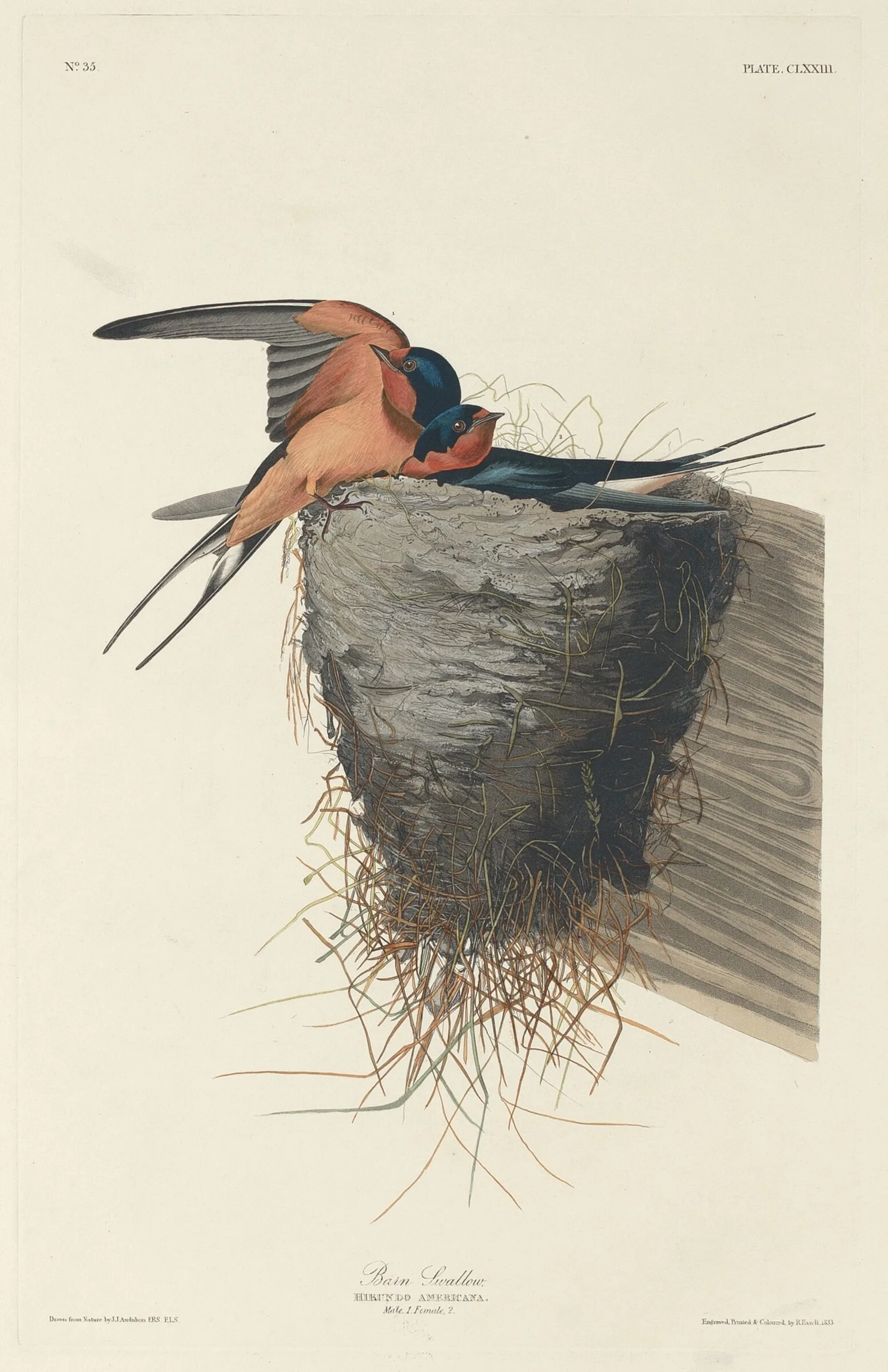
Audubon's “Barn Swallow”, The Birds of America, plate CLXXIII
Click or press Enter to enlarge
Open the full-resolution image (2441 px, National Gallery of Art)
| Plate | 173 (CLXXIII) |
|---|---|
| Audubon's name | Barn Swallow |
| Modern name | Barn Swallow |
| Scientific name | Hirundo rustica |
| Status | Least Concern |
| Engraved by | Robert Havell, after Audubon's watercolor |
| Date | 1833 |
| Medium | Hand-colored engraving and aquatint on Whatman wove paper |
| Collections | Songbirds |
| This impression | National Gallery of Art, Washington, 1945.8.173; Gift of Mrs. Walter B. James |
About this plate
Plate 173 shows a male and female Barn Swallow with their nest, the mud cup the species builds against beams and rafters. The adult birds show the deep forked tail with long outer streamers, the dark blue back and the rusty throat and underparts of the North American form.
Audubon called it Hirundo rustica, the name it still carries. It is the most widespread swallow in the world, breeding across North America, Europe and Asia, and wintering south to South America, Africa and Australia. In North America it now nests almost entirely on buildings, bridges and other structures rather than caves and cliffs. It is listed as Least Concern, although North American numbers have fallen in recent decades.
The chapter is one of Audubon's most lyrical. He opens with a summer noon on a farm and then follows a swallow into a barn, where he lies on new-mown hay to watch nests on every rafter, a female being fed on her eggs, and pairs building with layers of damp earth mixed with grass. He describes parents passing flies to young on the wing.
He also recorded migration. He wrote that the species first appeared at New Orleans between mid-February and the first of March, arriving in pairs or small parties rather than flocks, and that arrival dates farther north could vary by a whole month with the weather.
In Audubon's words
Observe that passing Swallow, how swiftly she glides around us, how frequently she comes and goes, how graceful her flight, how pleasant her musical twitterings, how happy she seems to be! Now she has again entered the barn. I will follow her into her summer abode, and laying myself down on the fragrant new-mown hay, watch her motions in silence. Ah! over my head a nest is firmly fixed to each rafter; nay on this and that are placed several, and the barn is filled with swallows and their melodies. Happy and charming little creatures! There a female sits on her eggs, and is receiving a store of insects from the mouth of her mate. Having fed her, he solaces her with a soft chattering voice, and away he goes in search of more food.
John James Audubon, Ornithological Biography, vol. 2 (1834), “The Barn Swallow”. Read the full chapter.



