Spruce Grouse (Plate 176)
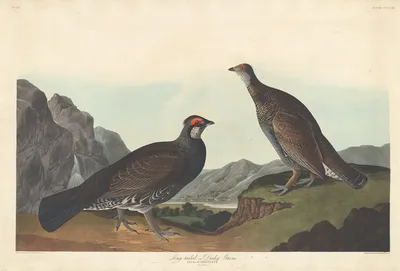
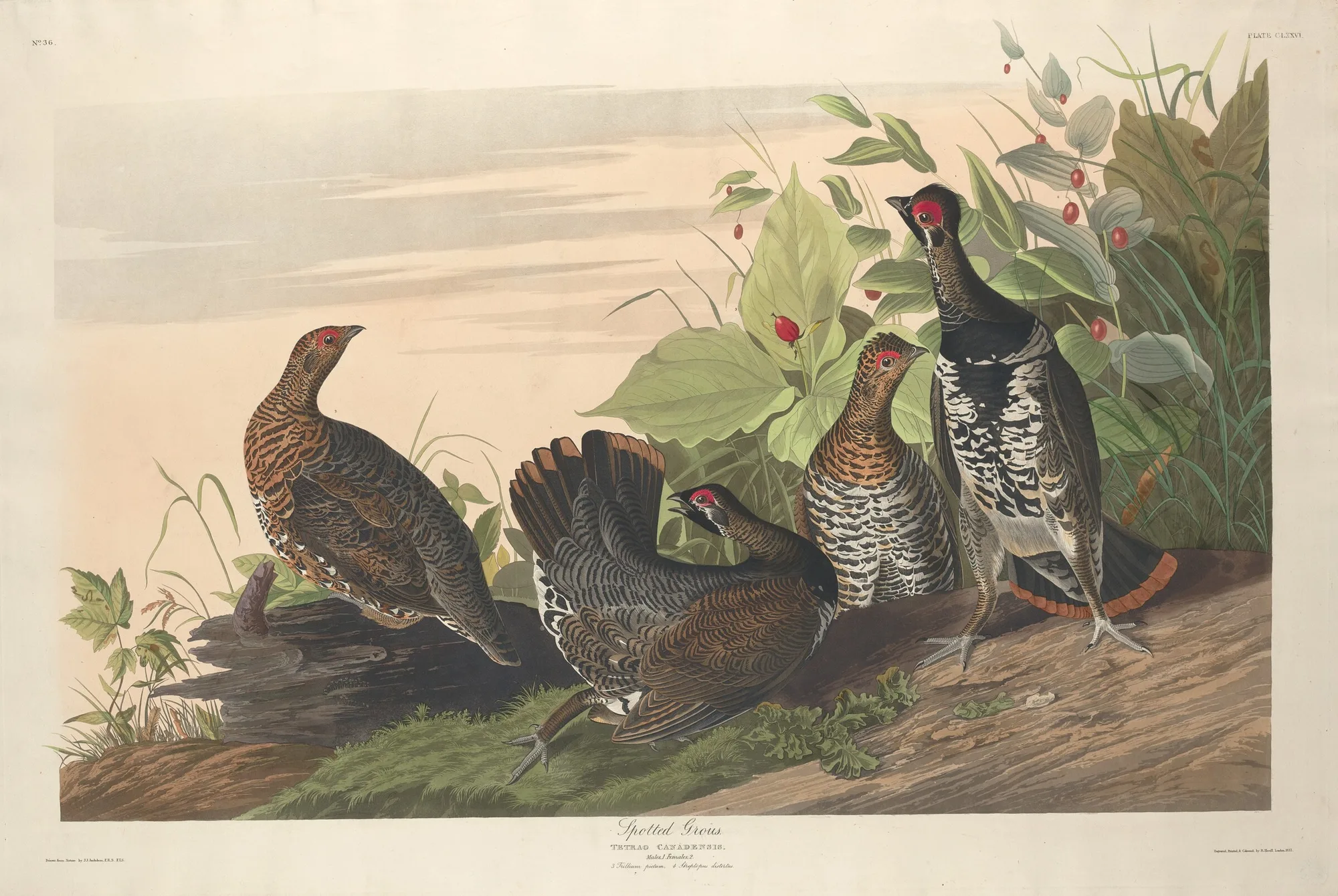
Audubon's “Spotted Grous”, The Birds of America, plate CLXXVI
Click or press Enter to enlarge
Open the full-resolution image (4683 px, National Gallery of Art)
| Plate | 176 (CLXXVI) |
|---|---|
| Audubon's name | Spotted Grous |
| Modern name | Spruce Grouse |
| Scientific name | Canachites canadensis |
| Status | Least Concern |
| Engraved by | Robert Havell, after Audubon's watercolor |
| Date | 1833 |
| Medium | Hand-colored engraving and aquatint on Whatman wove paper |
| Collections | Turkeys, Grouse and Game Birds |
| This impression | National Gallery of Art, Washington, 1945.8.176; Gift of Mrs. Walter B. James |
About this plate
Plate 176 shows a male and female Spruce Grouse, which Audubon engraved as the Spotted Grous and also called the Canada Grous. The male is grey and black with a black throat and a red comb over the eye. The female is barred brown, rust and white for camouflage on the forest floor.
Audubon called it Tetrao canadensis. It is now Canachites canadensis. It lives in boreal spruce, fir and jack pine forest from Alaska across Canada to northern New England and the northern Great Lakes. It is famous for its tameness, which earned it the name "fool hen". It eats mostly conifer needles in winter. It is listed as Least Concern.
Audubon described finding it as one of the hardest tasks he ever undertook. In August 1832 he stayed at Dennisville, Maine, about eighteen miles from Eastport, with the family of Judge Lincoln. On 27 August the judge's son Thomas Lincoln led Audubon and his two sons through tangled woods and bogs all day without seeing a bird. On their return, haymakers in the Lincoln meadow told them a covey had been seen half an hour after they left.
Thomas Lincoln later went with Audubon to Labrador in 1833, and Lincoln's Sparrow is named after him. Audubon also noted that grouse go to roost hours early before rain or snow, which he called a better forecast than a barometer.
In Audubon's words
THOMAS, being a perfect woodsman, advanced at our head, and I can assure you, reader, that to follow him through the dense and tangled woods of his native country, or over the deep mosses of Labrador, where, you know, he accompanied me afterwards, would be an undertaking not easily accomplished with credit. The weather was warm, and the musquitoes and moose flies did their best to render us uncomfortable. We however managed to follow our guide the whole day, over fallen trees, among tangled brushwood, and through miry ponds; yet not a single Grous did we find, even in places where he had before seen them, and great was my mortification, when, on our return towards sunset, as we were crossing a meadow belonging to his father, not more than a quarter of a mile from the village, the people employed in making hay informed us that about half an hour after our departure they had seen a fine covey. We were too much fatigued to go in search of them, and therefore made for home.
John James Audubon, Ornithological Biography, vol. 2 (1834), “The Spotted or Canada Grous”. Read the full chapter.