White-crowned Pigeon (Plate 177)
Audubon's “White-crowned Pigeon”, The Birds of America, plate CLXXVII
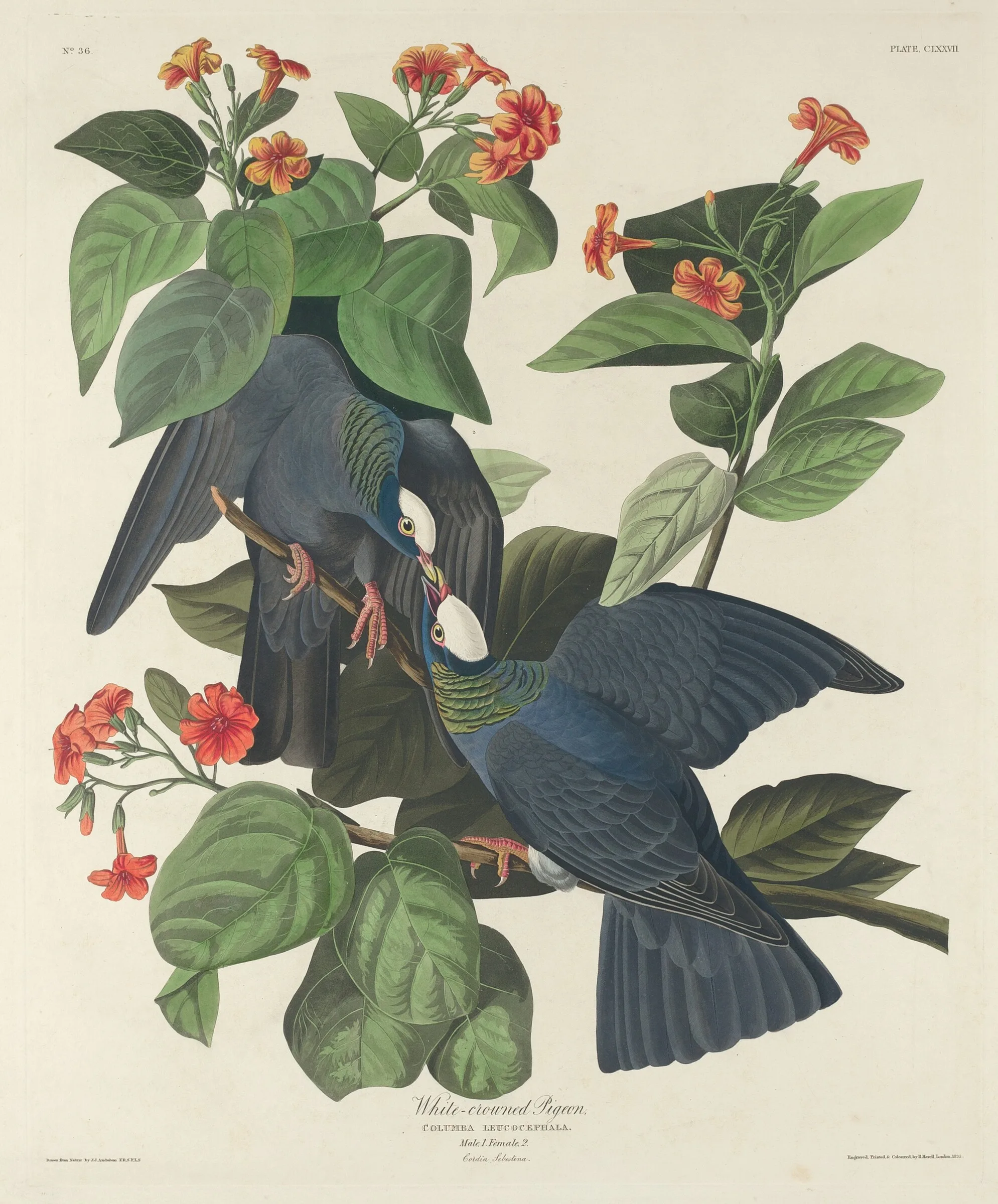
Click or press Enter to enlarge
Open the full-resolution image (3184 px, National Gallery of Art)
| Plate | 177 (CLXXVII) |
|---|---|
| Audubon's name | White-crowned Pigeon |
| Modern name | White-crowned Pigeon |
| Scientific name | Patagioenas leucocephala |
| Status | Near Threatened |
| Engraved by | Robert Havell, after Audubon's watercolor |
| Date | 1833 |
| Medium | Hand-colored engraving and aquatint on Whatman wove paper |
| Plants and setting | Geiger tree (Cordia sebestena) |
| Collections | Turkeys, Grouse and Game Birds, Florida and Wading Birds |
| This impression | National Gallery of Art, Washington, 1945.8.177; Gift of Mrs. Walter B. James |
About this plate
Plate 177 shows a male and female White-crowned Pigeon on a flowering branch with large orange blossoms, generally identified as the Geiger tree. The birds are dark slate grey with a bright white cap, and the male has an iridescent green nape.
Audubon called it the White-headed Pigeon, Columba leucocephala. It is now Patagioenas leucocephala. It lives in the Bahamas, Greater Antilles and other Caribbean islands, and in south Florida and the Keys, where it nests in mangroves and flies out daily to feed on the fruit of hardwood hammock trees such as poisonwood. It is listed as Near Threatened because of hunting and habitat loss.
Audubon watched the birds arrive on the southern Florida Keys from Cuba in spring 1832. He wrote that they came in about 20 April to 1 May, and that on 30 April he shot several just after they had crossed the Gulf Stream, skimming low over the water, then rising to circle before dropping into the mangroves.
He thought them the shyest birds he knew, because they were hunted heavily for their tender flesh. When approached they slipped to the ground and ran through the thickets. He described nests of twigs lined with roots and grass, set in mangroves high up or just above the water, with two white eggs, and noted that none were found on the mainland.
In Audubon's words
On the 30th of April, I shot several immediately after their arrival from across the Gulf Stream. I saw them as they approached the shore, skimming along the surface of the waters, flying with great rapidity, much in the manner of the common house species, but not near each other like the Passenger Pigeon. On nearing the land, they rose to the height of about a hundred yards, surveyed the country in large circles, then with less velocity gradually descended, and alighted in the thickest parts of the mangroves and other low trees. None of them could be easily seen in those dark retreats, and we were obliged to force them out, in order to shoot them, which we did at this time on the wing.
John James Audubon, Ornithological Biography, vol. 2 (1834), “The White-headed Pigeon”. Read the full chapter.