Sedge Wren (Plate 175)
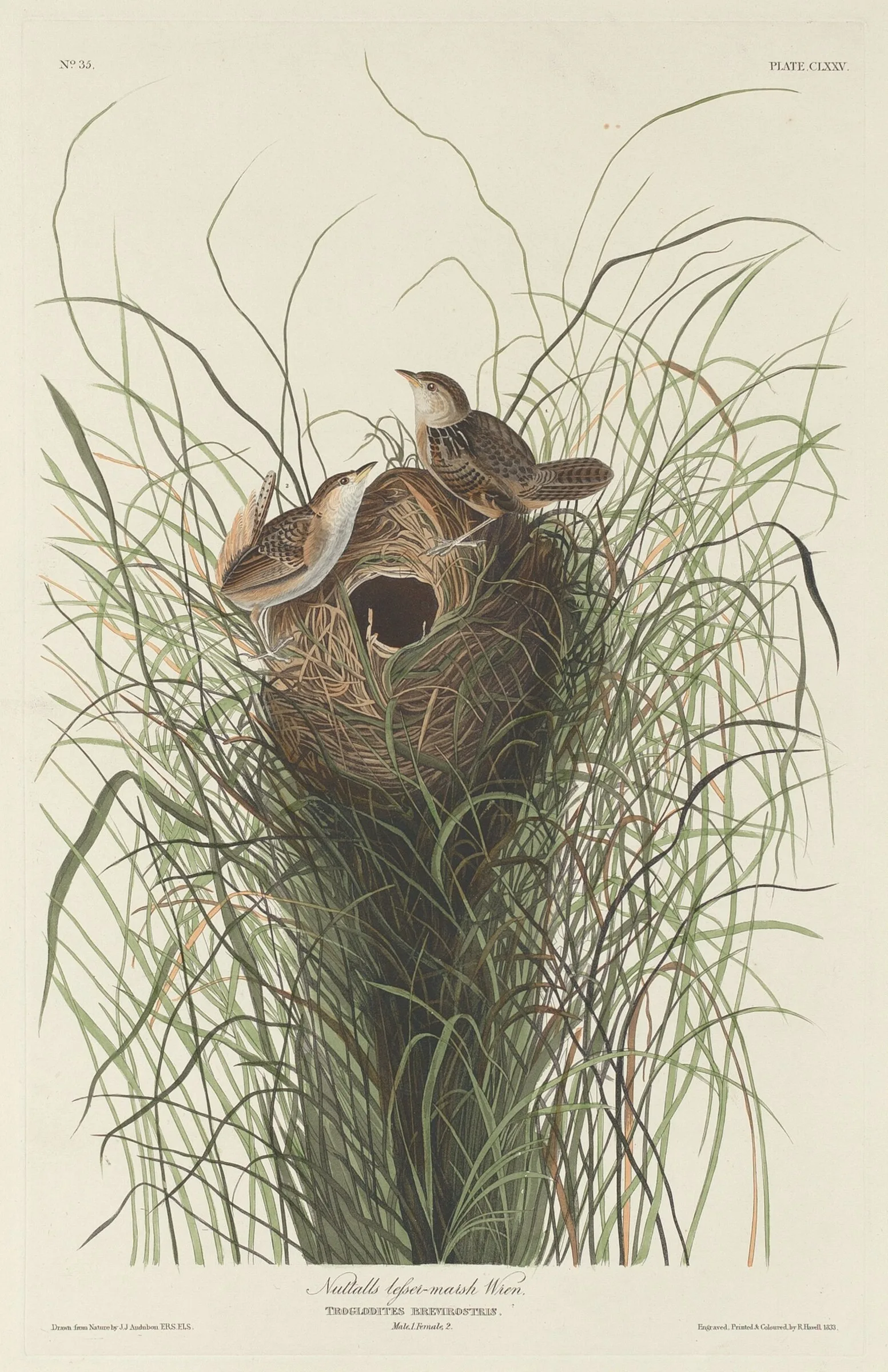
Audubon's “Nuttall's Lesser Marsh Wren”, The Birds of America, plate CLXXV
Click or press Enter to enlarge
Open the full-resolution image (2445 px, National Gallery of Art)
| Plate | 175 (CLXXV) |
|---|---|
| Audubon's name | Nuttall's Lesser Marsh Wren |
| Modern name | Sedge Wren |
| Scientific name | Cistothorus stellaris |
| Status | Least Concern |
| Engraved by | Robert Havell, after Audubon's watercolor |
| Date | 1833 |
| Medium | Hand-colored engraving and aquatint on Whatman wove paper |
| Size | plate: 49.5 x 31.1 cm (19 1/2 x 12 1/4 in.) sheet: 100.3 x 67.3 cm (39 1/2 x 26 1/2 in.) |
| Collections | Songbirds |
| This impression | National Gallery of Art, Washington, 1945.8.175; Gift of Mrs. Walter B. James |
About this plate
Plate 175 shows a male and female Sedge Wren with their nest, a ball of woven sedge with a side entrance. Audubon engraved it as Nuttall's Lesser Marsh Wren and wrote the chapter as Nuttall's Short-billed Marsh Wren, naming it after Thomas Nuttall, who had studied it near Cambridge, Massachusetts.
The bird was long called the Short-billed Marsh Wren. It is now the Sedge Wren, Cistothorus stellaris. It was recently separated from the South American Grass Wren, which explains why Audubon's chapter discusses a similar bird from the banks of the Rio de la Plata. It breeds in wet sedge meadows and grassy marshes of the northern Midwest and southern Canada and winters along the Gulf and southern Atlantic coasts. It is nomadic, often nesting late in summer wherever conditions suit. It is listed as Least Concern.
Most of the chapter is Nuttall's own account, which Audubon printed as a mark of friendship while Nuttall was travelling toward the Pacific. Nuttall described a shy bird of the lowest marshy meadows that arrived in Massachusetts in early May and left by mid-September. He wrote out its song as a hurried "tsh, tship" followed by a trill, with the bird bobbing its head and tail as if on a pivot.
Nuttall also noted the key difference from the Marsh Wren: that species hangs its nest in reeds, while the Sedge Wren builds directly in a sedge tussock.
In Audubon's words
This amusing and not unmusical little species inhabits the lowest marshy meadows, but does not frequent the reed flats. It never visits cultivated grounds, and is at all times shy, timid, and suspicious. It arrives in this part of Massachusetts about the close of the first week in May, and retires to the south by the middle of September at farthest, probably by night, as it is never seen in progress, so that its northern residence is only prolonged about four months. Its presence is announced by its lively and quaint song of tsh, tship, ă dăy, dăy, dăy, dăy, delivered in haste and earnest at short intervals, either when he is mounted on a tuft of sedge, or while perched on some low bush near the skirt of the marsh. The tsh, tship is uttered with a strong aspiration, and the remainder with a guttural echo. While thus engaged, his head and tail are alternately depressed and elevated, as if the little odd performer were fixed on a pivot.
John James Audubon, Ornithological Biography, vol. 2 (1834), “Nuttall's Short-billed Marsh Wren”. Read the full chapter.



