Orange-crowned Warbler (Plate 178)
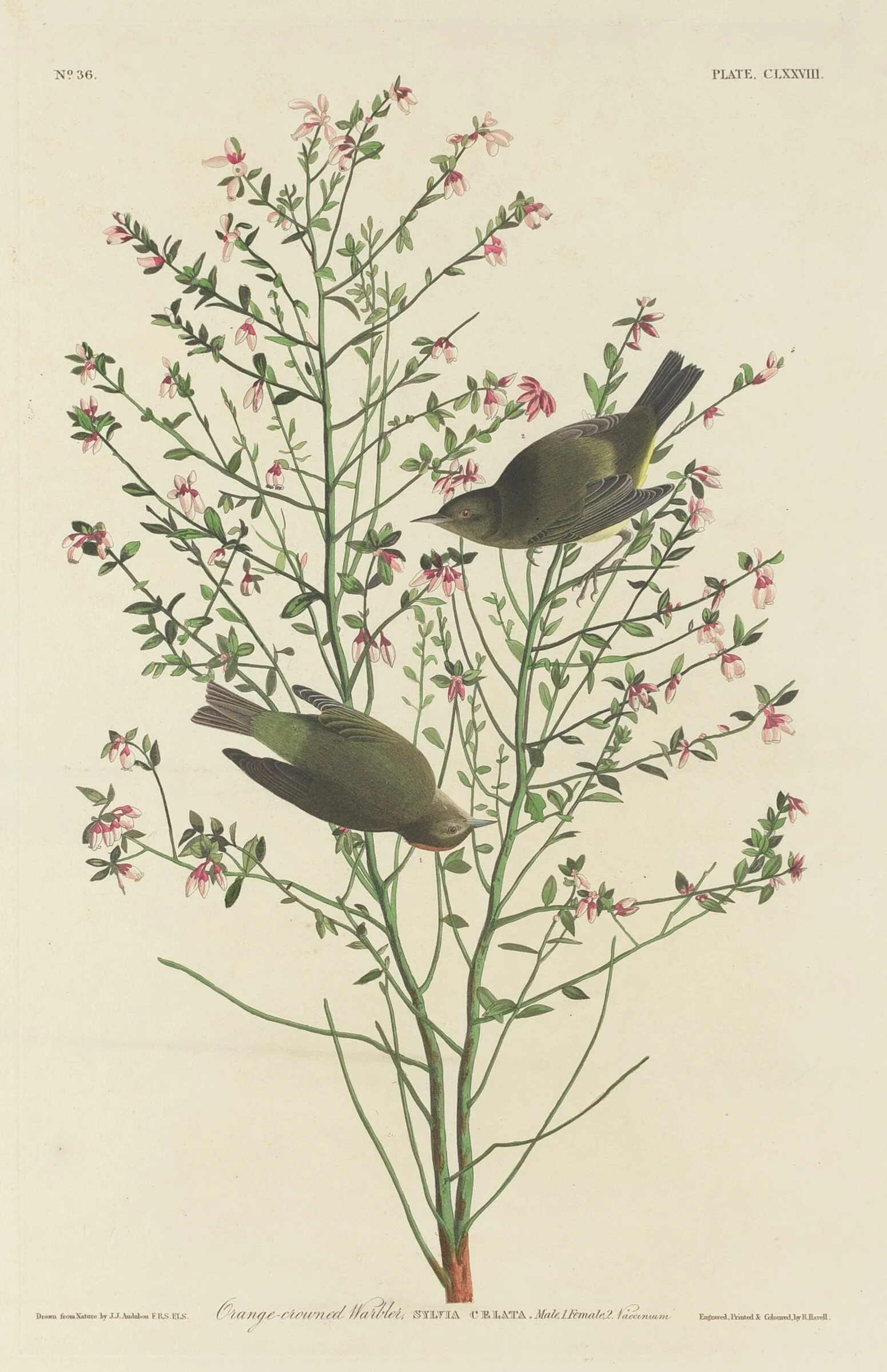
Audubon's “Orange-crowned Warbler”, The Birds of America, plate CLXXVIII
Click or press Enter to enlarge
Open the full-resolution image (2455 px, National Gallery of Art)
| Plate | 178 (CLXXVIII) |
|---|---|
| Audubon's name | Orange-crowned Warbler |
| Modern name | Orange-crowned Warbler |
| Scientific name | Leiothlypis celata |
| Status | Least Concern |
| Engraved by | Robert Havell, after Audubon's watercolor |
| Date | 1833 |
| Medium | Hand-colored engraving and aquatint on Whatman wove paper |
| Plants and setting | Huckleberry (Vaccinium frondosum, now Gaylussacia frondosa) |
| Collections | Songbirds |
| This impression | National Gallery of Art, Washington, 1945.8.178; Gift of Mrs. Walter B. James |
About this plate
Plate 178 shows a male and female Orange-crowned Warbler on a twig of a huckleberry from East Florida. The birds are plain olive-yellow with faint streaks on the breast. The orange crown patch that names the species is usually hidden, and Audubon noted that it is brightest in breeding males and absent in young birds until the following spring.
Audubon used Thomas Say's name Sylvia celata, meaning hidden, after the concealed crown. The species is now Leiothlypis celata. It breeds across Alaska, Canada and the western United States and winters in the southern and southwestern states and Mexico. It is one of the hardiest warblers, often lingering into winter. It is listed as Least Concern.
Audubon knew it best as a winter bird of the South, especially in East Florida, where he saw it in orange groves, gardens and the Pride-of-China trees along town streets. He described it catching insects in front of clapboard houses and around piazzas in the company of Yellow-rumped and Palm Warblers, and roosting at dusk among evergreen wild orange and wild peach.
He thought it bred in the northeastern districts, but he found none between Halifax and Labrador. Its main breeding range lies farther north and west. The plant is Vaccinium frondosum in Audubon's text, now Gaylussacia frondosa, the dangleberry, a shrub of pine barrens that flowers in Florida in February.
In Audubon's words
While in the south, however, where it is rather common near the sea-shore, it is less cautious, and is seen, in considerable numbers, in the orange groves around the plantations, or even in the gardens, especially in East Florida. Like the Sylvia petechia, it plays about the piazzas, skipping on wing in front of the clapboarded house, in quest of its prey, which it expertly seizes without alighting, or without snapping its bill, except during the disputes that occur among the males, as the spring advances. You find it among the branches of the Pride-of-China, that ornaments the streets of the southern cities and villages, as well as on those bordering the roads. From these it descends into the smilaxes, rose-bushes, and other shrubs, all of which yield it food and shelter. At the approach of darkness, it enters among the foliage of the evergreen wild orange and wild peach, where, with the Sylvia petechia and Sylvia coronata, it quietly passes the night.
John James Audubon, Ornithological Biography, vol. 2 (1834), “The Orange-crowned Warbler”. Read the full chapter.



