Common Ground Dove (Plate 182)
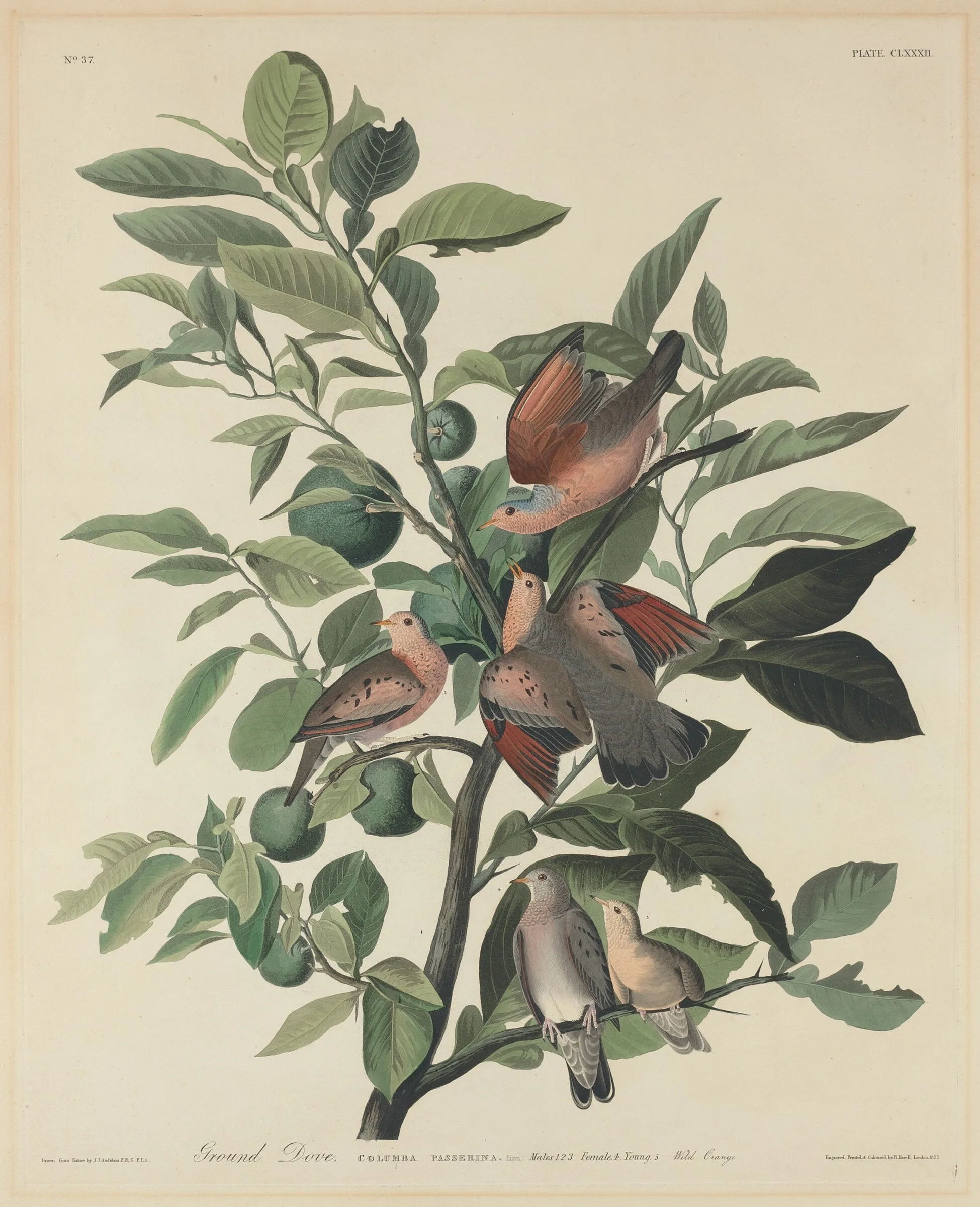
Audubon's “Ground Dove”, The Birds of America, plate CLXXXII
Click or press Enter to enlarge
Open the full-resolution image (3268 px, National Gallery of Art)
| Plate | 182 (CLXXXII) |
|---|---|
| Audubon's name | Ground Dove |
| Modern name | Common Ground Dove |
| Scientific name | Columbina passerina |
| Status | Least Concern |
| Engraved by | Robert Havell, after Audubon's watercolor |
| Date | 1833 |
| Medium | Hand-colored engraving and aquatint on Whatman wove paper |
| Collections | Turkeys, Grouse and Game Birds |
| This impression | National Gallery of Art, Washington, 1945.8.182; Gift of Mrs. Walter B. James |
About this plate
Plate 182 shows Common Ground Doves, including a male, a female and a young bird. These are the smallest doves in the United States, about the size of a sparrow, with scaly-looking heads and breasts and bright rufous wing patches that show in flight. The male has a pinkish breast and a blue-grey crown.
Audubon called it Columba passerina, Linnaeus's name, which means sparrow-like. It is now Columbina passerina. It lives in open sandy ground, scrub, farmland and towns across the southern edge of the United States, from South Carolina and Florida to Texas and California, and south through Mexico and the Caribbean to South America. It is listed as Least Concern, though numbers in the Southeast have fallen.
Audubon opened the chapter with an invitation to the sea islands of the Carolinas, Georgia and Florida at sunrise, where under a live oak the reader could hear the soft cooing of the male. He then set out the ranges of all the pigeons and doves he knew in the United States, from the Passenger Pigeon to the Carolina Dove, as a short guide to the family.
He described a compact nest of twigs lined with grass, placed in low bushes, hedges or orange trees, with two white eggs laid early in April, and two or three broods a year. He also noted that the male struts before the female, and that captive Ground Doves were fed on rice and small grain.
In Audubon's words
Stop there, kind reader, and seat yourself beneath the broadly extended arms of the thickly-leaved evergreen oak, and at that joyous moment when the first beams of the sun reach your eye, see the Owl passing low and swiftly over the ground, in haste to reach his diurnal retreat before the increasing light render all things dim to his sight; observe the leathern-winged Bat, pursuing his undulating course through the dewy air, now deflecting downwards to seize the retiring nocturnal-insect, now upwards to pursue another species, as it rises to meet the genial warmth emitted by the orb of day. Listen,—for at such a moment your soul will be touched by sounds,—to the soft, the mellow, the melting accents, which one might suppose inspired by Nature's self, and which she has taught the Ground Dove to employ in conveying the expression of his love to his mate, who is listening to them with delight.
John James Audubon, Ornithological Biography, vol. 2 (1834), “The Ground Dove”. Read the full chapter.