Golden Eagle (Plate 181)
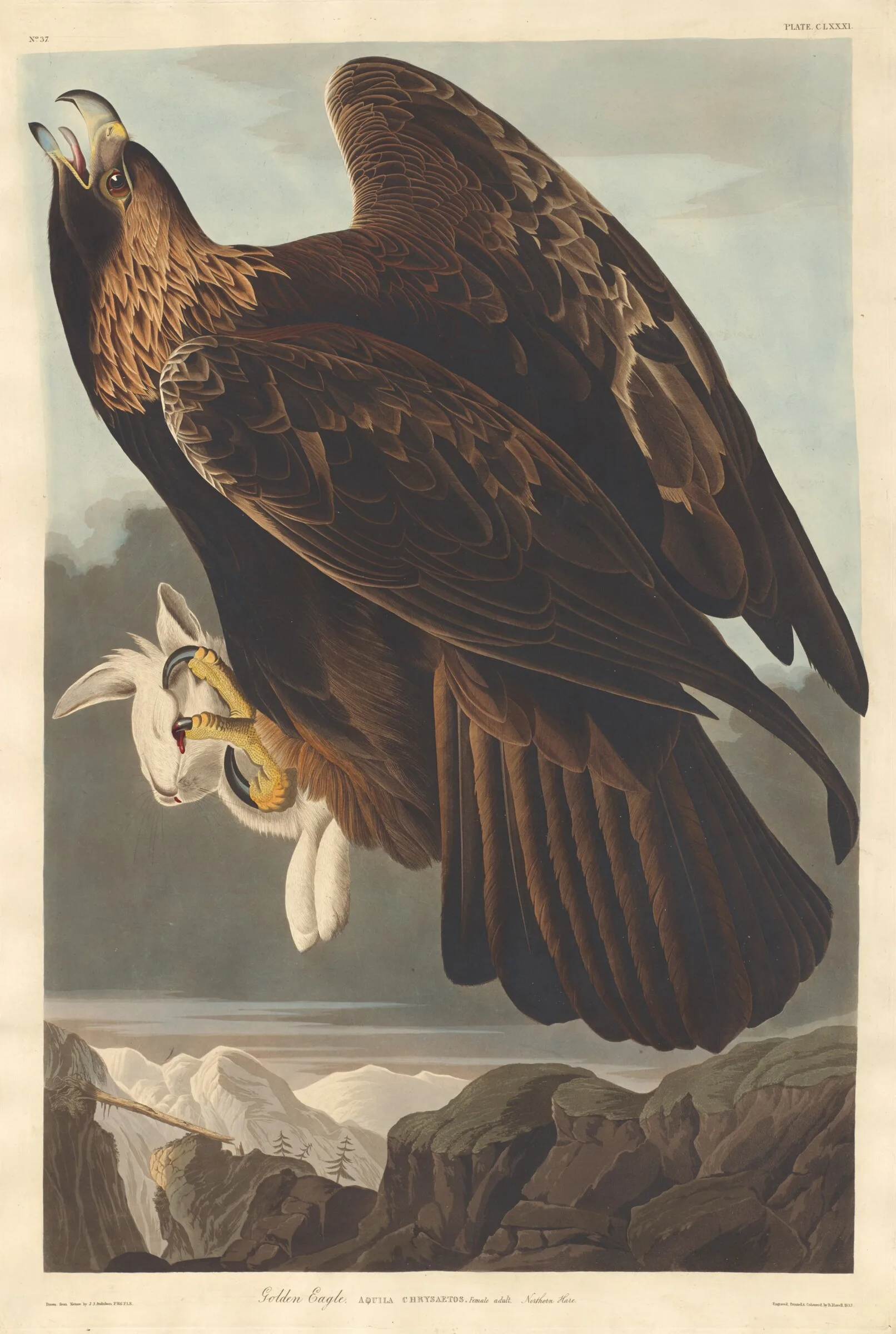
Audubon's “Golden Eagle”, The Birds of America, plate CLXXXI
Click or press Enter to enlarge
Open the full-resolution image (5455 px, National Gallery of Art)
| Plate | 181 (CLXXXI) |
|---|---|
| Audubon's name | Golden Eagle |
| Modern name | Golden Eagle |
| Scientific name | Aquila chrysaetos |
| Status | Least Concern |
| Engraved by | Robert Havell, after Audubon's watercolor |
| Date | 1833 |
| Medium | Hand-colored engraving and aquatint on Whatman wove paper |
| Collections | Hawks, Eagles and Falcons |
| This impression | National Gallery of Art, Washington, 1945.8.181; Gift of Mrs. Walter B. James |
About this plate
Plate 181 shows a Golden Eagle rising from a mountain ledge with a hare gripped in its talons. Below, in a mountain gorge, a tiny hunter crosses a ravine on a fallen log with a dead eagle strapped to his back. The figure is generally read as Audubon himself, one of the few places he put a person in a plate.
The model came from Boston. In early February 1833 Audubon visited Mr Greenwood, proprietor of the city museum, who had bought a live eagle caught by one toe in a fox trap in the White Mountains of New Hampshire. Audubon bought it and kept it covered in its cage at his lodgings. He wrote that he was tempted to free it, but chose to take its portrait instead. He consulted Dr George Parkman and tried to suffocate it with charcoal fumes, but after ten hours the eagle was unharmed, and he had to kill it by other means. He then spent about two weeks on the drawing. The strain was followed by an illness that his family described as a kind of seizure.
The Golden Eagle, Aquila chrysaetos, is the most widespread eagle in the world, found across North America, Europe, Asia and North Africa. In North America it is mainly a bird of the West and of Canada, with small numbers in the East, especially in winter. It hunts rabbits, hares, ground squirrels and other mammals in open and mountain country. It is listed as Least Concern.
Audubon wrote that it nests on inaccessible cliff ledges and never, so far as he knew, in trees.
In Audubon's words
The Eagle was immediately conveyed to my place of residence, covered by a blanket, to save him, in his adversity, from the gaze of the people. I placed the cage so as to afford me a good view of the captive, and I must acknowledge that as I watched his eye, and observed his looks of proud disdain, I felt towards him not so generously as I ought to have done. At times I was half inclined to restore to him his freedom, that he might return to his native mountains; nay, I several times thought how pleasing it would be to see him spread out his broad wings and sail away towards the rocks of his wild haunts; but then, reader, some one seemed to whisper that I ought to take the portrait of the magnificent bird, and I abandoned the more generous design of setting him at liberty, for the express purpose of shewing you his semblance.
John James Audubon, Ornithological Biography, vol. 2 (1834), “The Golden Eagle”. Read the full chapter.
Golden Eagle (Plate 181): the story behind one of the most famous plates in the collection →