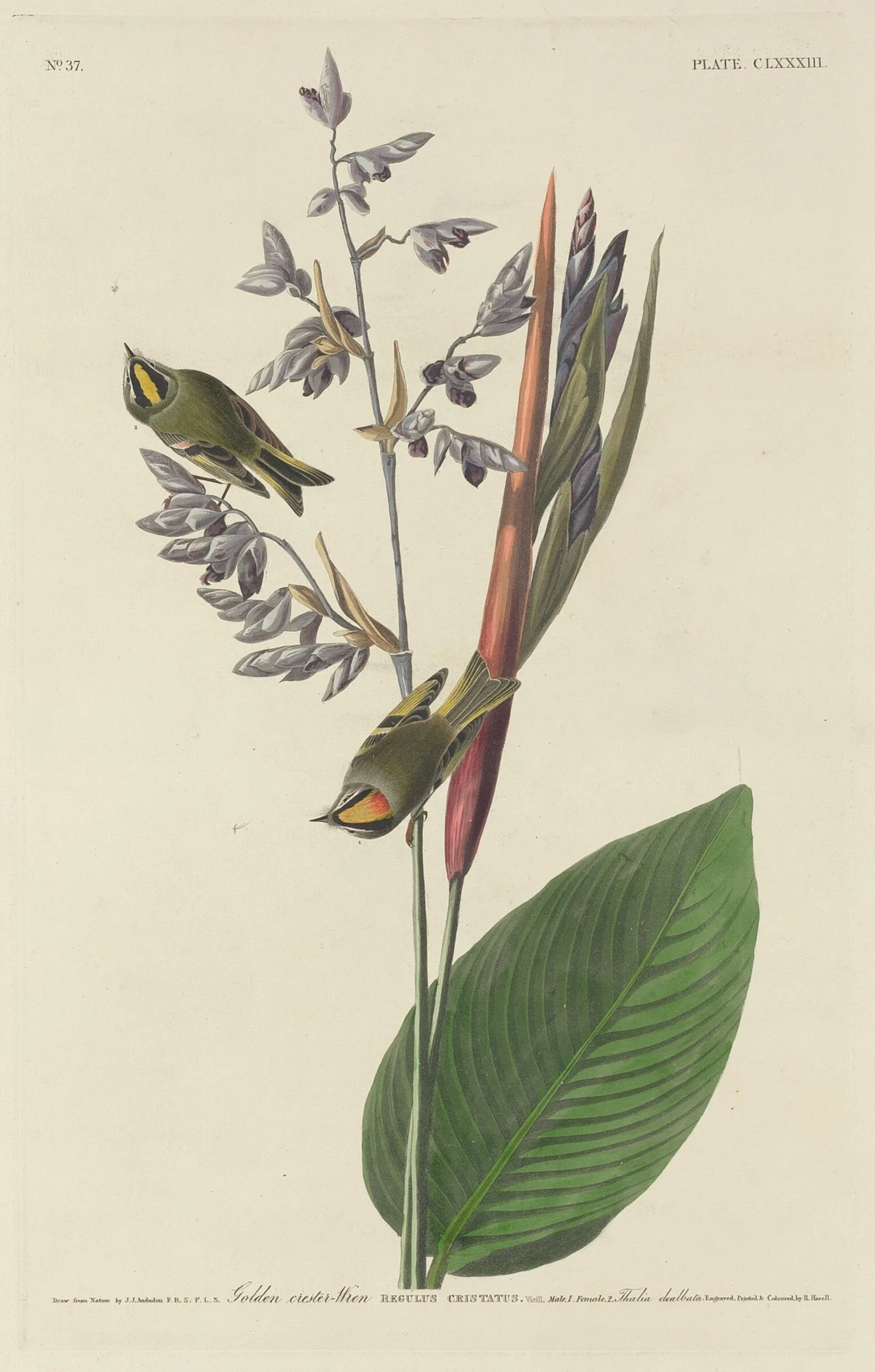
Golden-crowned Kinglet (Plate 183)
Audubon's “Golden-Crested Wren”, The Birds of America, plate CLXXXIII
Click or press Enter to enlarge
Open the full-resolution image (2426 px, National Gallery of Art)
| Plate | 183 (CLXXXIII) |
|---|---|
| Audubon's name | Golden-Crested Wren |
| Modern name | Golden-crowned Kinglet |
| Scientific name | Regulus satrapa |
| Status | Least Concern |
| Engraved by | Robert Havell, after Audubon's watercolor |
| Date | 1833 |
| Medium | Hand-colored engraving and aquatint on Whatman wove paper |
| Plants and setting | Powdery thalia (Thalia dealbata) |
| Collections | Songbirds |
| This impression | National Gallery of Art, Washington, 1945.8.183; Gift of Mrs. Walter B. James |
About this plate
Plate 183 shows a male and female Golden-crowned Kinglet with a tall flowering marsh plant, the powdery thalia. The kinglets are tiny olive birds with a bold black and white face pattern. The male's crown has an orange center inside the yellow, while the female's is yellow only.
Audubon called it the American Golden-crested Wren, Regulus tricolor, after Nuttall. He argued in the chapter that it was distinct from the European Goldcrest, pointing to its larger bill and other small differences. He was right. It is now Regulus satrapa, the Golden-crowned Kinglet. It breeds in spruce and fir forests of Canada, the northern United States and the western mountains, and winters across much of the country. It is listed as Least Concern.
Audubon saw it feeding young in Labrador in August 1833, though he could not find a nest. He wrote that it travelled in family groups with titmice, nuthatches and creepers, hanging from the tips of twigs and hovering in front of leaves.
On 23 January 1834, with John Bachman in the woods near Charleston, he found great numbers so tame that the men could approach within a few feet. They collected many, hoping to find among them the European Firecrest, but found none. The plant he gave as Thalia dealbata, a perennial of Georgia and South Carolina wetlands.
In Audubon's words
On the 23d of January last, while in company with my friend JOHN BACHMAN, I saw great numbers of them in the woods near Charleston, searching for food high in the trees as well as low down, and so careless of us, that although we would approach within a few feet of them, they were not in the least disconcerted. Their feeble chirp was constantly repeated. We killed a great number of them in hopes of finding among them some individuals of the species known under the name of Regulus ignicapillus, but in this we did not succeed. At times they uttered a strong querulous note, somewhat resembling that of the Black-headed Titmouse. The young had acquired their full plumage, but the females were more abundant than the males.
John James Audubon, Ornithological Biography, vol. 2 (1834), “American Golden-crested Wren”. Read the full chapter.



