Green-breasted Mango (Plate 184)
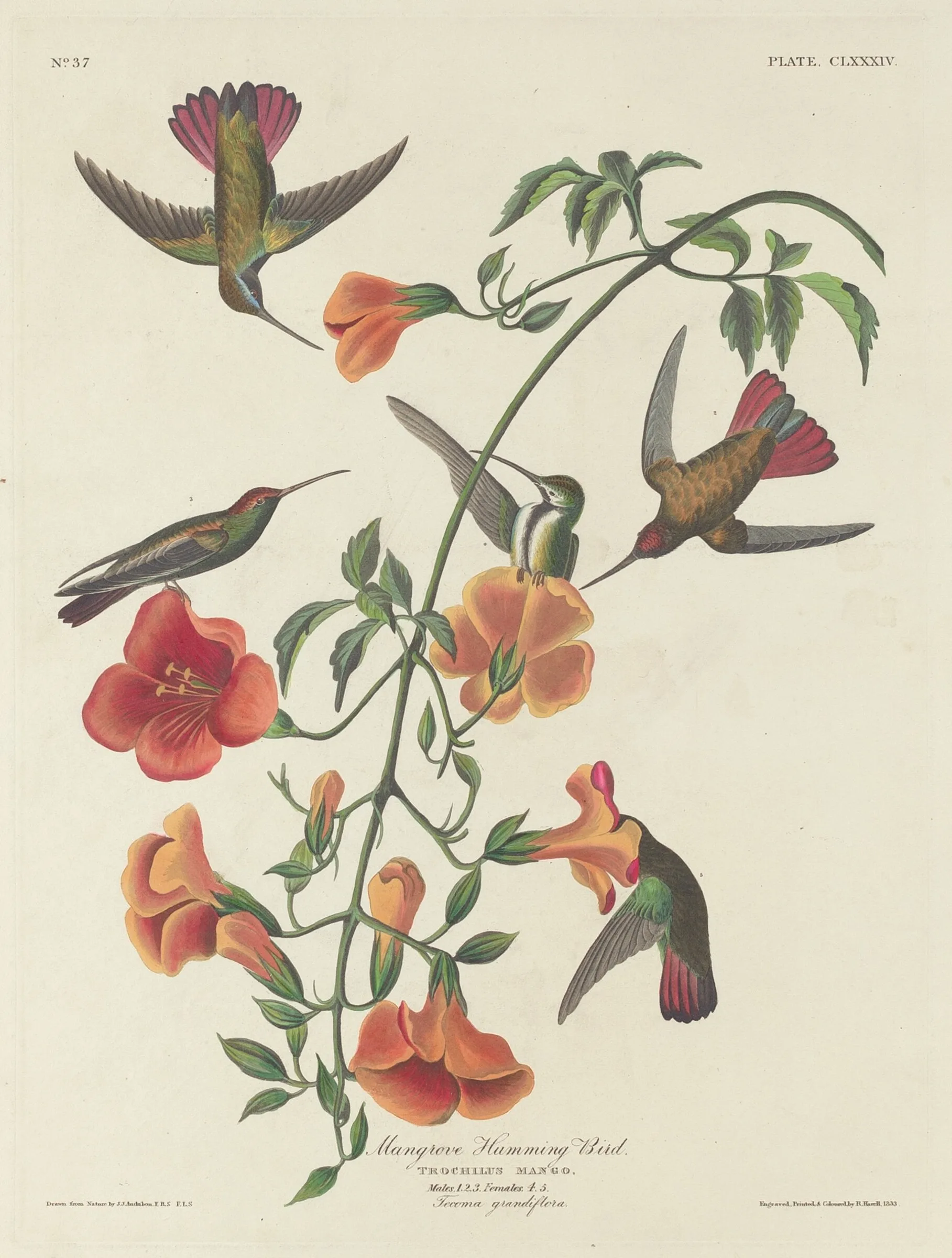
Audubon's “Mangrove Humming Bird”, The Birds of America, plate CLXXXIV
Click or press Enter to enlarge
Open the full-resolution image (2293 px, National Gallery of Art)
| Plate | 184 (CLXXXIV) |
|---|---|
| Audubon's name | Mangrove Humming Bird |
| Modern name | Green-breasted Mango |
| Scientific name | Anthracothorax prevostii |
| Status | Least Concern |
| Engraved by | Robert Havell, after Audubon's watercolor |
| Date | 1834 |
| Medium | Hand-colored engraving and aquatint on Whatman wove paper |
| Plants and setting | Large-flowered Bignonia (Campsis grandiflora), drawn by Maria Martin |
| Collections | Hummingbirds |
| This impression | National Gallery of Art, Washington, 1945.8.184; Gift of Mrs. Walter B. James |
About this plate
Plate 184 shows a pair of mango hummingbirds at the large orange-red trumpet flowers of a Bignonia vine. The birds are bronze-green above with a dark central stripe down the throat and breast and purple-red in the tail. Audubon credited the drawing of the flowering plant to Miss M. Martin, Maria Martin of Charleston.
Audubon never saw the bird alive. The specimen came from Dr Benjamin Strobel of Key West, who caught it on a bush where it sat apparently tired after crossing the sea. Strobel gave it to John Bachman, who gave it to Audubon. Bachman's notes, quoted in the chapter, present it as only the second hummingbird known from the United States after the Ruby-throated.
Audubon called it Trochilus mango. The bird is usually identified as the Green-breasted Mango, Anthracothorax prevostii, which ranges from eastern Mexico through Central America to northern South America and is a rare stray to south Texas. Some authors suggest the Key West bird may have been another mango species from the Caribbean. The Green-breasted Mango is listed as Least Concern.
The plant, Bignonia grandiflora in the text, is now Campsis grandiflora, the Chinese trumpet vine, an Asian relative of the native trumpet creeper that was grown in southern gardens.
In Audubon's words
It affords me great pleasure to introduce to the lovers of Natural History a second species of Humming Bird as an inhabitant of the United States. The specimen which is now in my possession, was obtained by Dr STROBEL at Key West in East Florida. He informed me that he had succeeded in capturing it from a bush where he had found it seated, apparently wearied after its long flight across the Gulf of Mexico, probably from some of the West India Islands, or the coast of South America. Whether this species is numerous in any part of Florida, I have had no means of ascertaining.
John James Audubon, Ornithological Biography, vol. 2 (1834), “The Mango Humming Bird”. Read the full chapter.