Bachman's Warbler (Plate 185)
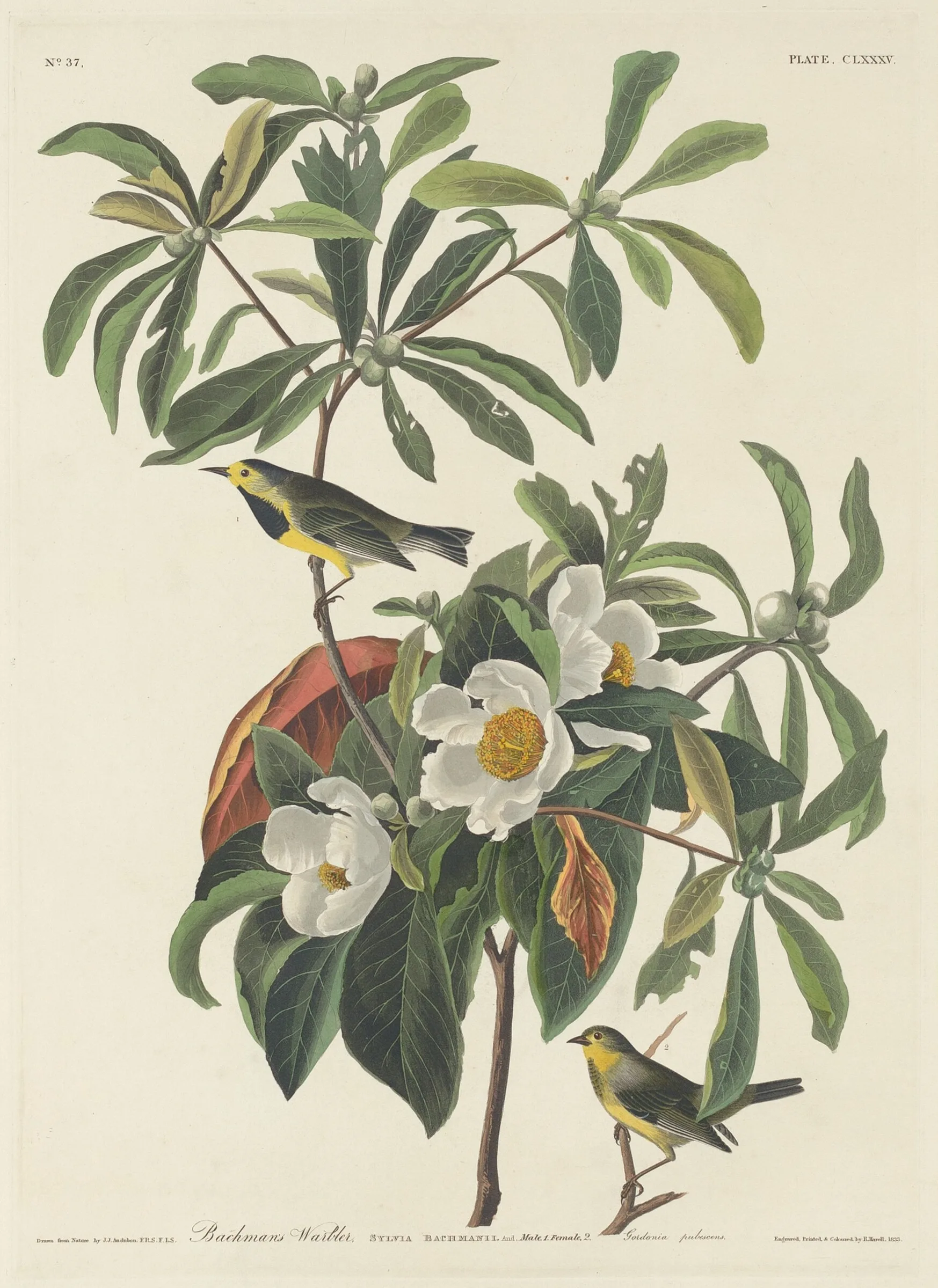
Audubon's “Bachman's Warbler”, The Birds of America, plate CLXXXV
Click or press Enter to enlarge
Open the full-resolution image (2526 px, National Gallery of Art)
| Plate | 185 (CLXXXV) |
|---|---|
| Audubon's name | Bachman's Warbler |
| Modern name | Bachman's Warbler |
| Scientific name | Vermivora bachmanii |
| Status | Possibly extinct |
| Engraved by | Robert Havell, after Audubon's watercolor |
| Date | 1834 |
| Medium | Hand-colored engraving and aquatint on Whatman wove paper |
| Plants and setting | Franklin tree (Gordonia pubescens, now Franklinia alatamaha), drawn by Maria Martin |
| Collections | Songbirds, Extinct Birds |
| This impression | National Gallery of Art, Washington, 1945.8.185; Gift of Mrs. Walter B. James |
About this plate
Plate 185 shows a male and female Bachman's Warbler with a flowering branch of the Franklin tree. The male has a yellow face and underparts, a black crown patch and a black bib. The female is duller, with a grey crown and no bib. The plant, with large white flowers and yellow anthers, was drawn by Maria Martin, sister-in-law of John Bachman.
Audubon never saw the bird alive. Bachman found the first specimen a few miles from Charleston, South Carolina, in July 1833, while Audubon was in Labrador, and sent him a pair to draw. Audubon named it Sylvia bachmanii after its discoverer. It is now Vermivora bachmanii, a close relative of the Blue-winged and Golden-winged Warblers.
Bachman's Warbler bred in canebrakes and bottomland swamp forest in the southeastern United States and wintered in Cuba. It was always rare. Clearing of southern swamp forests and canebrakes is thought to have driven it to extinction. The last widely accepted records are from the 1960s near Charleston, with an unconfirmed report from Louisiana in 1988. The U.S. Fish and Wildlife Service declared it extinct in 2023. IUCN lists it as Critically Endangered, possibly extinct.
The Franklin tree is a story of loss as well. Audubon called it Gordonia pubescens. It is Franklinia alatamaha, found by John and William Bartram in Georgia in the 1760s and not seen in the wild since the early 1800s. It survives only in cultivation.
In Audubon's words
My friend BACHMAN has the merit of having discovered this pretty little species of Warbler, and to him I have the pleasure of acknowledging my obligations for the pair which you will find represented in the plate, accompanied with a figure of one of the most beautiful of our southern flowers, originally drawn by my friend's sister, Miss MARTIN. I myself have never had the good fortune to meet with any individuals of this interesting Sylvia, respecting which little is as yet known, its discoverer having only procured a few specimens of both sexes, without being able to find a nest. The first obtained was found by him a few miles from Charleston, in South Carolina, in July 1833, while I was rambling over the crags of Labrador. According to my amiable friend, it was "a lively active bird, gliding among the branches of thick bushes, occasionally mounting on the wing and seizing insects in the air in the manner of a Flycatcher. It was an old female that had to all appearance just reared a brood of young.
John James Audubon, Ornithological Biography, vol. 2 (1834), “Bachman's Warbler”. Read the full chapter.