Sabine's Gull (Plate 285)
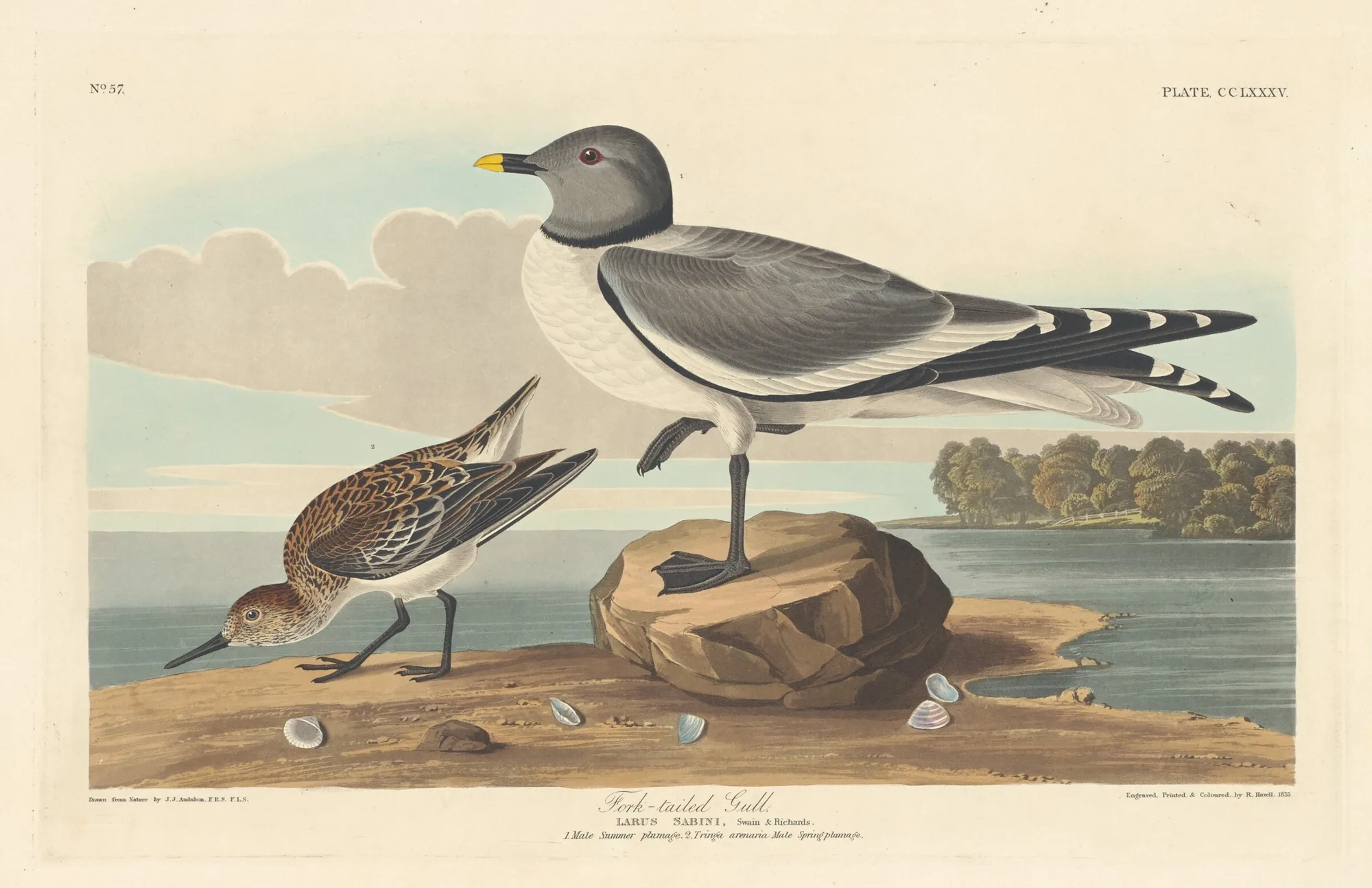
Audubon's “Fork-tailed Gull”, The Birds of America, plate CCLXXXV
Click or press Enter to enlarge
Open the full-resolution image (2885 px, National Gallery of Art)
| Plate | 285 (CCLXXXV) |
|---|---|
| Audubon's name | Fork-tailed Gull |
| Modern name | Sabine's Gull |
| Scientific name | Xema sabini |
| Status | Least Concern |
| Engraved by | Robert Havell, after Audubon's watercolor |
| Date | 1835 |
| Medium | Hand-colored engraving and aquatint on Whatman wove paper |
| Collections | Seabirds |
| This impression | National Gallery of Art, Washington, 1945.8.285; Gift of Mrs. Walter B. James |
About this plate
Plate 285 shows a single adult male in breeding plumage. It has a slate-grey hood edged in black, a black bill with a yellow tip, and the shallow forked tail that gave Audubon his name for it. The bold black, white and grey triangles on the wing are the field mark birders look for today.
The bird is Sabine's Gull, Xema sabini, the only member of its genus. Joseph Sabine described it in 1819 from birds his brother Edward Sabine collected off west Greenland on John Ross's Arctic voyage of 1818. Audubon quoted Richardson's account of that discovery. It describes the birds nesting among Arctic Terns and diving boldly at anyone who came near the nest.
Sabine's Gull breeds on wet Arctic tundra in Alaska, Canada, Greenland and Siberia. It is very much a bird of the open ocean outside the breeding season. Atlantic birds winter in the cold upwelling waters off southwest Africa, and Pacific birds off Peru and Chile. It is seen from shore only rarely, so most birders find it on pelagic trips. The IUCN lists it as Least Concern.
Audubon saw it alive only once, flying over the harbour at Halifax, Nova Scotia, on his way home from Labrador in 1833. He reported that his friend Thomas MacCulloch saw great numbers more than a hundred miles off Newfoundland.
In Audubon's words
On my return from Labrador, I had the pleasure of seeing this interesting little Gull flying over the harbour of Halifax in Nova Scotia. It was in company with our Common American Gull. Although I have not observed it on our eastern shores or farther south on the coast, it is not improbable that it rambles there in winter along with other species which, like itself, breed far north. Its flight in some measure resembles that of the Common Tern, although it is more decided, and, consequently, more like that of the smaller species of its own genus. In the course of a voyage from Pictou in Nova Scotia to Hull in England, lately performed by my friend Mr Thomas MacCulloch, he saw great numbers of this species when more than a hundred miles off Newfoundland.
John James Audubon, Ornithological Biography, vol. 3 (1835), “The Forked-tailed Gull”. Read the full chapter.